Dwarkesh Patel

Dwarkesh Patel

Author and podcast host (born 2000)

Kurzbiografie aus WikipediaFoto: DwarkeshPod, CC BY 4.0, über Wikimedia Commons

Zwei Jahre auf Sendung

GastHostErwähnt

Selbst moderierte Folgen

Mo16Nov
Dwarkesh Podcast

Dwarkesh PodcastHost

Paul Christiano – We could be 12 months away from AIs that can overthrow the government

Paul Christiano is head of the Alignment Research Center. Previously, he was head of AI safety at the US AI Safety Institute. Before that, he led alignment at OpenAI, where he invented RLHF. He’s recently joined OpenAI’s board (though here he is speaking as a private citizen). Paul thinks that on the current trajectory (absent any slowing down), there is a 1 in 3 chance that we could have superintelligence powerful enough to overthrow the government within a year. (He articulates a concrete scenario). He argues that the labs should pause further algorithmic progress until they can secure their weights and research secrets. Otherwise China could simply steal the superintelligence in the middle of the intelligence explosion, and the labs would no longer be able to slow down even if they saw their models going off the rails. He also explains how AIs will be trained during the intelligence explosion, and why even a system trained entirely inside a data center could still have the capabilities profile such that humans would have very little chance of competing with it or controlling it. And he discusses the plan for alignment - basically, making a superintelligence that actually does what we ask the way we mean it. Fixing reward hacks and building better graders will help up till the next few model generations, but he thinks that no single current approach has better than even odds of letting us control superintelligence. The hope is that the AIs figure out the solution to this problem during the intelligence explosion. Watch on YouTube; read the transcript. Sponsors * Jane Street has finally come around on formal methods. Ron Minsky, who co-heads Jane Street’s technology group, told me that up until recently, formal methods just weren’t worth the cost. But coding agents have made them easier to apply AND increased the importance of code verification. So now Jane Street is hiring Formal Methods Engineers in both their London and New York offices. If you’re interested, or if you want to watch my full conversation with Ron, go to janestreet.com/dwarkesh * Antithesis is NOT another LLM-based code-review tool. It doesn’t try to reason abstractly about how a PR might break your system. Instead, it just runs your code. You start by defining the rules that your system must never break. Then, whenever an agent proposes a change, Antithesis runs your code through thousands of adversarial worlds, testing whether or not it still adheres to your rules. If you want to try it, go to antithesis.com/dwarkesh and use code DWARKESH for 50% off your first month. * WorkOS lets you give agents their own sign-up flow. This matters because agents tend to pick tools they can use right away, rather than ones that require humans to register. Fortunately, providing this kind of dedicated path is easy: if you already use WorkOS for login, you just toggle on “Agent Registration” in the WorkOS dashboard. Once it’s enabled, you can decide what agents are allowed to do on their own, and what needs to wait until the person they’re working for gets involved, all with the permissions you’ve already set up. Learn more at workos.com/authkit Timestamps (00:00:00) – We could be 12 months away from AIs that can overthrow the government (00:11:44) – Why an AI might want to takeover (00:20:49) – How an AI takeover could happen (00:35:35) – If labs keep racing without security, China will just steal the weights of superintelligence (00:53:15) – The case for pausing now instead of later (00:59:31) – Superintelligence will be good at learning from real-world experience (01:11:32) – Crossing the sim-to-real gap (01:22:23) – METR says AI progress doubled, so why is revenue growth slowing? (01:27:57) – The best plan we have is to build the plane as we fly it This is a public episode. If you would like to discuss this with other subscribers or get access to bonus episodes, visit www.dwarkesh.com
1 h 39 min

Fr13Nov
Dwarkesh Podcast

Dwarkesh PodcastHost

The avalanche that hit math is coming for AI development

If you asked me earlier this year how far away we are from superintelligence, I’d probably have said at least the better part of a decade. But over the last three months, from debating people on and off the podcast, I’ve updated my views a ton. Let me walk you through how my thinking has changed. If you want to read the written version (with footnotes and links) you can check it out here: https://www.dwarkesh.com/p/rsi This is a public episode. If you would like to discuss this with other subscribers or get access to bonus episodes, visit www.dwarkesh.com
44 min

Fr30Okt
Dwarkesh Podcast

Dwarkesh PodcastHost

What Robert Caro learned about power after studying it for 50 years

The Robert Caro interview. Watch on YouTube; read the transcript. Sponsors * Antithesis lets you run thorough simulation tests on every PR your coding agents ship. That’s because Antithesis is FAST. On a recent project, it packed fifteen hours of simulation into each fifteen-minute run: every change could be tested in thousands of hostile worlds before being merged. Every minute your software spends in Antithesis is one of the unluckiest hours it will ever experience. Learn more at antithesis.com/dwarkesh * WorkOS’s Airlock is a judgment layer that sits between your agents and your most important tools. When an agent makes a request, Airlock evaluates it against your company’s policies and decides whether to allow it, block it, or escalate it to a human. If it allows it, Airlock takes action on behalf of the agent, which means your agents never see your API keys or other credentials. Airlock is in early access. If you’re interested, go to workos.com/airlock * Jane Street’s mystery ASIC puzzle is over, and they’ve published a blog post that reveals the chip’s purpose. You can read it here: blog.janestreet.com/asic-puzzle-results/. More importantly, there’s another challenge live now! For this one, you have to design a protocol-emulator ASIC that can be used to test chips outside of a live system. Jane Street will pay to fabricate their favorite submissions. The competition is open until January 18th. Get started at janestreet.com/dwarkesh Timestamps (00:00:00) – How Caro gets people to talk (00:05:03) – Does America need a little more Moses today? (00:12:42) – Moses the young idealist (00:17:57) – Watching Moses lose power (00:24:01) – Did Moses realize he was changing? (00:27:53) – Building during the Great Depression (00:32:51) – The threats and promises of Lyndon Johnson (00:36:08) – Could Kennedy have passed Johnson’s laws? (00:41:00) – Getting a book down to one sentence (00:46:21) – All the material that never made it into the books (00:52:59) – Loneliness This is a public episode. If you would like to discuss this with other subscribers or get access to bonus episodes, visit www.dwarkesh.com
1 h 01 min

Do29Okt
Dwarkesh Podcast

Dwarkesh PodcastHost

What I learned about power from LBJ and Robert Moses

I recently got to interview Robert Caro, who is my favorite author of all time.  This gave me the excuse to reread his biographies of Lyndon Johnson and Robert Moses, and to compile my prep notes into this video essay. These guys pulled off some truly incredible schemes. Thanks to Max Farrens, who paired with me in writing the script for this video essay. If you just want to read the essay: https://www.dwarkesh.com/p/lessons-in-power This is a public episode. If you would like to discuss this with other subscribers or get access to bonus episodes, visit www.dwarkesh.com
25 min

Do1Okt
Dwarkesh Podcast

Dwarkesh PodcastHost

Si Sheppard – How did a few hundred Spanish soldiers topple two empires?

New episode with military historian Si Sheppard. The conquests of the Aztec and Inca empires might be the most shocking events in human history. Hernan Cortés and some hundreds of Conquistadors landed on a new continent they knew basically nothing about, and within 2 and a half years, conquered the 6 million strong Aztec empire. Then, a decade later, Francisco Pizarro did the same thing to an Incan Empire of some 10 million inhabitants. In both cases, the Conquistadors consistently beat native armies while being literally 100x (or even in some cases 1000x) outnumbered - and in many cases, did so without taking a single casualty. And they did this with 99% of their military forces being made up of the very natives they were trying to subjugate. We often forget how wild human history is. People talk about AI takeover as if it would be some crazy, unprecedented sci-fi outcome. But this would not be the first time an alien force whose motives the defenders barely understand use more advanced technology and diplomatic cunning to outmaneuver and then take over a much larger and long established existing order. Watch on YouTube; read the transcript. Sponsors * Jane Street’s intern projects are even more ambitious than I realized. One intern spent his summer researching LLM memorization, figuring out how to quantify and reduce it. This matters because, when Jane Street tests their models on historical data, they need to know that performance reflects predictive power, not just memorized outcomes. Another intern spent his time developing a new activation checkpointing scheme: his custom version ended up outperforming PyTorch’s native one. If you want to read about more 2026 intern projects or apply for Jane Street’s 2027 internships, go to janestreet.com/dwarkesh * Grok Bot can tackle the tasks you’ve been meaning to handle but just haven’t gotten around to. For example, SpaceXAI recently gave Grok Bot access to their procurement contracts, vendor spend, and usage data: it ended up identifying over $100,000 in potential savings for them. I decided to try this on my own spend, and Grok Bot found over $5,000 of savings for me, even though I run a pretty small team. Try it out yourself at x.ai/bot * Antithesis solves one of the biggest problems with traditional software testing: to test for a bug, you first have to be able to imagine it. Antithesis runs your system through thousands of parallel histories and steers your tests for you, injecting faults and generally trying to make everything as adversarial as possible. That way, your software gets tested against scenarios you’d never imagine but that could still arise in the real world. Learn more at antithesis.com/dwarkesh Timestamps (00:00:00) – Cortés’s conquest of the Aztecs (00:22:39) – Pizarro’s conquest of the Inca (00:26:59) – Explaining Conquistador military superiority (00:34:39) – Could the natives have beat the Conquistadors? (00:48:56) – The Aztecs and Incas did not get to learn from each other (00:56:11) – Why Spain still lost in the long run (01:07:47) – Why didn’t the Aztecs/Incas adapt better to European warfare? (01:14:16) – Conquistador motivation (01:26:22) – Why Mughal India also couldn’t play the Europeans off each other (01:33:42) – Diplomacy was just as important as technology This is a public episode. If you would like to discuss this with other subscribers or get access to bonus episodes, visit www.dwarkesh.com

1 h 37 min

Do17Sep
Dwarkesh Podcast

Dwarkesh PodcastHost

Noam Brown – Agent swarms, alignment, & recursive self-improvement

New episode with Noam Brown. We talk about multi-agent, Navier-Stokes, and what the current explosion of maths progress tells us about what happens once you automate AI research. And we also discuss how we will know if the models are actually aligned before we kick off RSI. Watch on YouTube; read the transcript. Sponsors * Jane Street has been interested in AI for a lot longer than you’d think, and not just for trading. In 2011, a full year before AlexNet and over a decade before ChatGPT launched, they hosted the first FOOM Debate between Eliezer Yudkowsky and Robin Hanson on whether AI would lead to an intelligence explosion. Now Jane Street is revisiting the question with a new panel: Daniel Kokotajlo, Ege Erdil, Ryan Greenblatt, and Jaime Sevilla, hosted by Ron Minsky in San Francisco this October. I expect it to be a truly excellent conversation. Register at janestreet.com/dwarkesh * Grok Bot has made handing off work super easy. It runs on its own cloud computer, where it installs the tools it needs to handle tasks end-to-end. For the podcast, we use Grok Bot to help produce our videos. You may have noticed that our ads feature animations of real websites. Getting these pixel-perfect used to mean running a convoluted, multi-step workflow ourselves. Now we just let Grok Bot handle it. Best of all, Grok Bot has learned all of our specs and preferences, so we don’t have to redescribe the task each time! Try Grok Bot for yourself at x.ai/bot * Antithesis gives you the confidence of a giant test suite without actually having to write one. Say you’re doing a major backend refactor: building enough tests to trust it could take weeks. Antithesis solves this by running your software through countless simulated worlds, injecting faults and hunting for failures. On any PR, you can turn a dial to decide exactly how much testing you want. And because every run is fully deterministic, agents can branch off the moment a bug appears, rewind it, inspect memory, and replay it, all while the original test keeps running. Learn more at antithesis.com/dwarkesh Timestamps (00:00:00) – Multi-agent and Navier-Stokes (00:15:28) – How will AI firms work? (00:22:02) – What math progress tells us about recursive self improvement (00:40:22) – Hugging Face and alignment (01:01:18) – The internal/external model gap (01:08:34) – Chain of thought is degrading (01:14:12) – How will we know when alignment is solved? This is a public episode. If you would like to discuss this with other subscribers or get access to bonus episodes, visit www.dwarkesh.com

1 h 20 min

Fr11Sep
Dwarkesh Podcast

Dwarkesh PodcastHost

AI researchers debate how close we are to recursive self-improvement

New episode with John Schulman, Beren Millidge and Charlie O’Neill. I got together with some of the most insightful AI researchers I know who are at the openish companies, because I wanted to hear the details of what's actually happening at the frontier and what comes next. Watch on YouTube; read the transcript. Sponsors * Antithesis helps you trust your code. As agents generate more and more of your software, the bottleneck shifts from your engineers actually writing code to verifying it. Antithesis does that testing for you. Ron Minsky, who co-leads Jane Street’s tech group, told me that Antithesis was able to help his team shake out bugs in software that had already undergone heavy review. If you want to see how it fits into your development process, go to antithesis.com/dwarkesh * Grok Bot has been a great way to hand off tasks. My team uses it as a producer: whenever my editor posts a rough cut of an interview in Slack, Grok Bot opens the transcript on its own computer, matches my notes to the exact moments they refer to, and uses a file of my preferences to suggest edits. Then it sends me its top clip candidates so I can review everything from my phone, which saves my editors from sorting through hours of footage. Try Grok Bot for yourself at x.ai/bot * Jane Street just launched its most ambitious competition yet: design a protocol-emulator ASIC. Basically, if you have a chip you want to test outside of a live system, you should be able to connect it to your design and have it simulate realistic traffic. Jane Street wants general-purpose, reprogrammable designs that can work across multiple protocols and remain useful as new ones emerge. The most novel submissions will actually get taped out, and the winners will receive a physical copy! The competition is open until January 18, 2027, and teams are encouraged. To get started download the template code at janestreet.com/dwarkesh Timestamps (00:00:00) – Steelmanning the case against RSI (00:18:39) – What’s driving the Chinese labs’ progress (00:28:06) – How will automated AI researchers be trained (00:33:51) – Will long-horizon RL elicit AGI? (00:45:24) – The sim-to-real gap (01:00:33) – How much progress is explained by data? (01:18:03) – Why is RL working so well? (01:24:54) – Move 37 and entropy collapse (01:28:32) – Rapid-fire timelines This is a public episode. If you would like to discuss this with other subscribers or get access to bonus episodes, visit www.dwarkesh.com
1 h 37 min

Mi15Apr
Dwarkesh Podcast

Dwarkesh PodcastHost

Jensen Huang – TPU competition, why we should sell chips to China, & Nvidia’s supply chain moat

I asked Jensen about TPU competition, Nvidia’s lock on the ever more bottlenecked supply chain needed to make advanced chips, whether we should be selling AI chips to China, why Nvidia doesn’t just become a hyperscaler, how it makes its investments, and much more. Enjoy! Watch on YouTube; read the transcript. Sponsors * Crusoe’s cloud runs on state-of-the-art Blackwell GPUs, with Vera Rubin deployment scheduled for later this year. But hardware is only part of the story—for inference, Crusoe’s MemoryAlloy tech implements a cluster-wide KV cache, delivering up to 10x faster TTFT and 5x better throughput than vLLM. Learn more at crusoe.ai/dwarkesh * Cursor helped me build an AI co-researcher over the course of a weekend. Now I have an AI agent that I can collaborate with in Google Docs via inline comment threads! And while other agentic coding tools feel like a total black-box, Cursor let me stay on top of the full implementation. You can try my co-researcher out at github.com/dwarkeshsp/ai_coworker, or get started on your own Cursor project today at cursor.com/dwarkesh * Jane Street spent ~20,000 GPU hours training backdoors into 3 different language models, then challenged my audience to find the triggers. They received some clever solutions—like comparing the base and fine-tuned versions and extrapolating any differences to reveal the hidden backdoor—but no one was able to solve all 3. So if open problems like this excite you, Jane Street is hiring. Learn more at janestreet.com/dwarkesh Timestamps (00:00:00) – Is Nvidia’s biggest moat its grip on scarce supply chains? (00:16:25) – Will TPUs break Nvidia’s hold on AI compute? (00:41:06) – Why doesn’t Nvidia become a hyperscaler? (00:57:36) – Should we be selling AI chips to China? (01:35:06) – Why doesn’t Nvidia make multiple different chip architectures? This is a public episode. If you would like to discuss this with other subscribers or get access to bonus episodes, visit www.dwarkesh.com

1 h 43 min

Do5Feb
Cheeky Pint

Cheeky PintHost

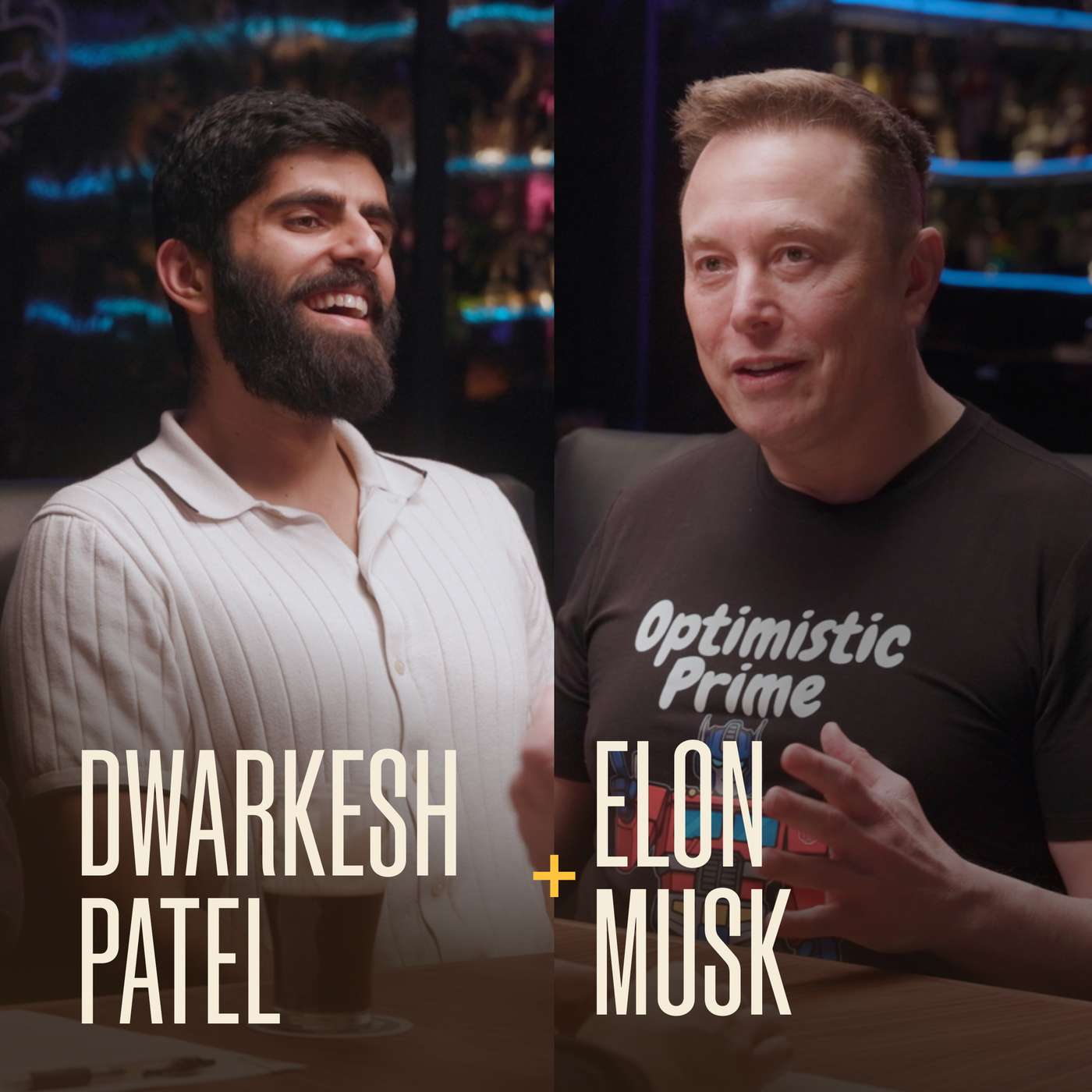
Elon Musk on Space GPUs, AI, Optimus, and his manufacturing method

John Collison and Dwarkesh Patel sit down with Elon Musk to discuss why the future of AI isn’t on Earth, but in the "always sunny" vacuum of space. Between pints, they discuss the brutal physics of scaling—from the "farcically cheap" solar cells coming out of China to switching Starship from carbon fiber to stainless steel—as well as the “infinite money glitch” of humanoid robots, China, and DOGE. Timestamps 00:00:23 Space GPUs 00:35:39 Alignment 00:58:48 xAI 01:15:01 Optimus 01:28:03 China 01:40:46 Management 02:16:38 DOGE 02:34:58 Space GPUs redux

2 h 46 min

Do5Feb
Dwarkesh Podcast

Dwarkesh PodcastHost

Elon Musk — "In 36 months, the cheapest place to put AI will be space”

In this episode, John and I got to do a real deep-dive with Elon. We discuss the economics of orbital data centers, the difficulties of scaling power on Earth, what it would take to manufacture humanoids at high-volume in America, xAI’s business and alignment plans, DOGE, and much more. Watch on YouTube; read the transcript. Sponsors * Mercury just started offering personal banking! I’m already banking with Mercury for business purposes, so getting to bank with them for my personal life makes everything so much simpler. Apply now at mercury.com/personal-banking * Jane Street sent me a new puzzle last week: they trained a neural net, shuffled all 96 layers, and asked me to put them back in order. I tried but… I didn’t quite nail it. If you’re curious, or if you think you can do better, you should take a stab at janestreet.com/dwarkesh * Labelbox can get you robotics and RL data at scale. Labelbox starts by helping you define your ideal data distribution, and then their massive Alignerr network collects frontier-grade data that you can use to train your models. Learn more at labelbox.com/dwarkesh Timestamps (00:00:00) - Orbital data centers (00:36:46) - Grok and alignment (00:59:56) - xAI’s business plan (01:17:21) - Optimus and humanoid manufacturing (01:30:22) - Does China win by default? (01:44:16) - Lessons from running SpaceX (02:20:08) - DOGE (02:38:28) - TeraFab This is a public episode. If you would like to discuss this with other subscribers or get access to bonus episodes, visit www.dwarkesh.com

2 h 50 min