Literacy in Color: A Science of Reading Aligned Podcast for Educators
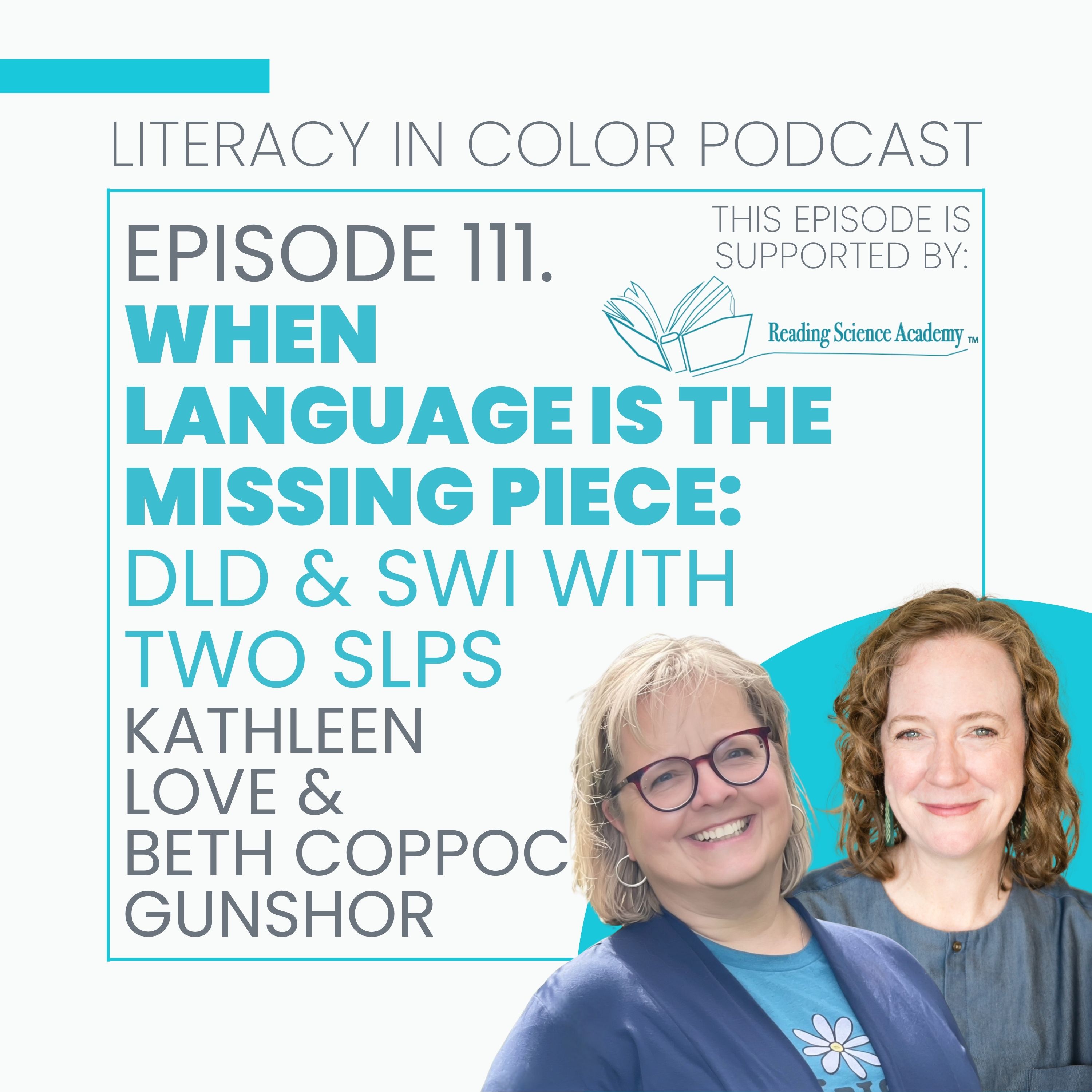
111. When Language is the Missing Piece: DLD & SWI with Two SLPs, Kathleen Love & Beth Coppoc Gunshor
Developmental Language Disorder (DLD) affects approximately 1 in 14 people, yet many educators have never heard of it. So what might DLD actually look like in the classroom? How can we better support students when difficulties with language intersect with dyslexia, ADHD, executive function, reading, spelling, and writing? Speech-language pathologists, Kathleen Love and Beth Coppoc Gunshor take us for a deep dive into DLD and language-based literacy intervention. Kathleen and Beth unpack the differences and overlap among DLD, dyslexia, and ADHD, including why a student who appears inattentive or off-task may actually be struggling with the language demands of a task. They also share subtle signs of DLD educators can watch for: from vague vocabulary and word-retrieval difficulties to challenges following directions, understanding complex sentences, and telling cohesive stories. Then, the conversation turns practical. Kathleen and Beth explore ways educators can manage cognitive load, strengthen vocabulary instruction, and provide the repeated, explicit language experiences students with DLD may need. They also take us inside their intervention practices to show how Structured Word Inquiry (SWI) can extend far beyond spelling – supporting morphology, vocabulary, syntax, semantic networks, executive function, oral language, and even confidence. Key Takeaways: DLD defined The overlap and distinctions among DLD, dyslexia, and ADHD Practical ways to reduce unnecessary cognitive load without reducing the thinking How to strengthen vocabulary instruction for students with language difficulties Why Structured Word Inquiry can be a powerful tool for building language as well as literacy Resources Mentioned: Conifer literacy app DLD and Me OxEd & Assessment / NELI Dr. Tiffany Hogan / The Speech and Language (SAiL) Literacy Lab 2026 ASHA Convention Connect with Kathleen Love: Website: https://conifermatrix.com/ Instagram: @conifermatrix Conifer Matrix on Facebook Website: https://www.raincityreading.com/ Instagram: @rain.city.reading Rain City Reading on Facebook Rain City Reading on YouTube Rain City Reading Newsletter Connect with Beth Coppoc Gunshor: Website: http://bcgslp.com/ Instagram: @bcgslp BCG SLP on Facebook BCG SLP Shop - T-Shirts BCG SLP Shop - Stickers This podcast is brought to you by Reading Science Academy, where our friend Stephanie Stollar is giving Literacy in Color listeners an exclusive, free grouping resource bundle designed to help you spend less time figuring out what to do with screening data and move more quickly into purposeful, skill-based groups. Get your FREE grouping resource bundle here. Or, become a member of Reading Science Academy to learn in community and receive research-backed support alongside over 1,600 literacy educators. Connect with Michelle: Visit: www.michelleandthecolorfulclassroom.com Follow me on Instagram: @michelle_thecolorfulclassroom & @logosliteracyacademy Join our Facebook Community Sign up for my Newsletter Shop on TPT: The Colorful Classroom For Phonics Resources, grab: The COLORFUL Phonics Toolkit Want to Support the Podcast? Make a Donation to Support Production Interested in Learning More about Morphology? Logos Literacy Academy with Michelle Sullivan & Sarah Paul Join: Beyond Phonics Club - our Membership Community