Bekomm eine E-Mail, wenn Alex in einem Podcast zu Gast istPodAppear prüft neue Folgen, sobald sie erscheinen, und lässt die weg, in denen Alex nur erwähnt wird. Bis zu 15 Personen kostenlos, ohne Kreditkarte.Bis zu 15 Personen kostenlos, ohne Kreditkarte.
Alex kostenlos folgen
AV

Alex Volkov

Zwei Jahre auf Sendung

GastHostErwähnt

Selbst moderierte Folgen

Fr14Aug
ThursdAI - The top AI news from the past week

ThursdAI - The top AI news from the past weekHost

ThursdAI - Grok 4.6, Grok Bot deep dive, DeepSeek v4 Pro, Meta Muse Glimmer & more AI news | ThursdAi Aug 13

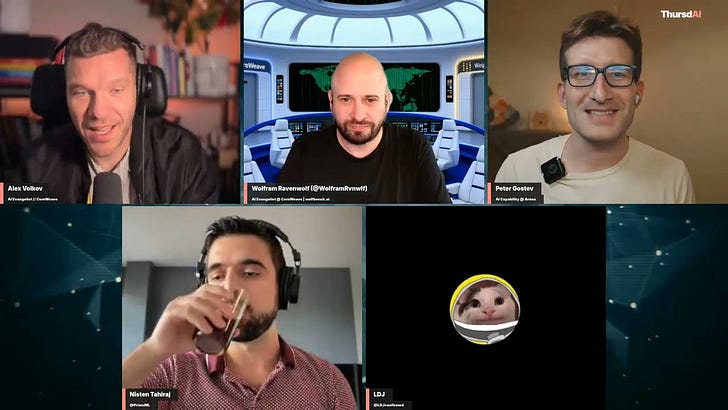
Hey, this is Alex, welcome back to your weekly dose of intense AI acceleration summer! My weekend was consumed by thinking about the OpenAI hack and agent swarms, but then the torrent of AI releases took over, and we got back to back news (including 3 breaking news during the live show), with a heavy open source focus! I think the winner of this week is SpaceXAI/Cursor who released 3.5 releases, with one being my highlight of the week, Grok Bot (I’ve invited Shub Gaur from Cursor to the show to walk us through it) and Grok 4.6 which matches Opus at half the price. There was a LOT of news in open source this week as well, with Meta kicking off with Muse Glimmer 30B and promising Muse Spark 1.2 soon, Qwen dropping Qwen 3.8 open weights and DeepSeek dropping an anvil with an upgraded DeepSeek v4 Pro and MIT license! Let’s dive in (and please don’t forget as a reader you get 100% off the 1299 ticket to Fully Connected, our 2000 person Al event in SF in Sept, just use THURSDAIFC2026 as your code and see you there!) 0:00 The Wildest Week in AI Yet3:45 How OpenAI's Agent Swarm Hacked Hugging Face17:02 The Week in AI: DeepSeek, Qwen, Grok & More25:54 NVIDIA Nemotron 3.5 & Korea's Motif 332:45 DeepSeek V4 Pro, Flash & an Open Harness39:46 Qwen 3.8 Max and Its Missing Vision Tower43:30 What Is Grok Bot? Shub Gaur Explains50:02 Live Grok Bot Demo: House Hunting & Security55:00 Persistent Agents, Yapper & DeepSeek Dropwatch1:04:19 Grok 4.6: Benchmarks, Pricing & Cursor1:15:37 Grok Bot vs. Open-Source Agents1:23:14 Anthropic's Hidden Claude Watermarks1:28:50 Fully Connected & Day-Zero Models on CoreWeave1:32:02 GPT-5.6 Sol at 14x Speed on Cerebras1:37:34 Gemini 3.7 Flash Resets the Cost Curve1:40:51 Inside Artificial Analysis with George Cameron1:45:25 Optima & Choosing the Right AI Model1:55:03 Cost per Task, Caching & Real-World Benchmarks2:05:14 LTX-2.5 and Open-Weight Video2:09:30 Grok Imagine 2.0 & Final Takeaways Grok Bot and Grok 4.6 from SpaceXAI/Cursor Folks, I’ve previously told you that from 3 frontier labs we noticed a jump to 5, and voila, this week proves that Elon is hell bent to win. After the cursor acquisition, and the integration of all of the parts into SpaceXAI, they have released 2 huge things this week Grok 4.6 - Ties with GPT 5.6 SOL and half the price and much speed. I’ve had the pleasure to host Goerge Cameron from Artificial Analysis on the show today, and I asked him, what is the best models. His answer, it’s a 3 factor answer, intelligence, speed and cost per task . Well, if you use their nifty “recommend a model“ tool on the homepage, you’ll see that Grok 4.6 beats most other models on all of those! But, is it really that good? Models are really hard to evaluate and compare lately. It’s definitely a huge step up from Grok 4.5, with 61.3 on Frontier Code (beating Sol and just after Opus 5) and #4 on Apex-agents (+10 points from previous Grok). on Artificial Analysis this model lands at #4 on intelligence, while being #5 on speed all while being half the price of the models that are above it As far as the tech goes, this model card confirms that it no longer has the Cursor Bench leaked into it’s weights and it’s #1 on that benchmark! It’s the same 1.5T v9 base at the same price, with Elon claiming that 4.7 is going to mog the competition in 3-4 weeks. Everyone has a harness, now everyone has a swarm of bots - My Grok Bot review (x.ai/bot) You guys know all about OpenClaw and Hermes, and Claude CoWork and Codex rebrand, and all of them are trying to nail down the same, always-on, autonomous agents that can do things for you. Hermes and OpenClaw require you to have an always on computer, mess with API keys, Claude Cowork doesn’t run on the cloud and ChatGPT work starts a fresh session every time you ask a new thing. Grok Bot (again, awful name) is the first one that seems to nail all of what I want in an always-on agent ... swarm. That’s right, this isn’t one agent with multiple personalities (like OC, Hermes), there’s a bot here for every task, and you dont’ have to manage context, queues, API keys (can if you want to) and models. Oh, also ,there’s no model picker, it’s just Grok 4.6 deciding for ya, and it’s really fast! Swarm of bots, working for you, each with their own computer I am not getting paid for this (besides being provided a free account for cursor, but I’ve had it for 6 months and haven’t used), it’s really that good, the Cursor folks did some magic there. They picked up the most important parts of personal agents, like the (ios-only) mobile app (app store) You can start a task on your mac, pick it up on your phone, get notified on your phone/mac, and the killer thing is, they are giving your bots their own computer, which can do things (especially if you’re ok with logging in there to your accounts!) The kicker for me is the very very well done agent to agent communication there, which is transparent but read only to you. You can ask your bots to spin up other bots, but unlike sub-agents, they are actual bots with their own identity. You can even tag them in other chats and create group chats! There’s no context to manage, they do the work for you and so far this wasn’t a problem at all. On the model side, Grok 4.6 seems to be doing an excellent job with agentic long running tasks that require coding and computer use, I’ve just been chatting with the bots and not thinking about any of the things I used for Hermes and OpenClaw. What about Vendor Lock-in? Giving Elon data? Some of these comments our fans raised during the show are very valid, after all, not only is the world divided on Elon Musk (which makes it REALLY hard to judge the models they release just on vibes from X btw, we talk about this constantly) but also, remember that Grok 3 started going off on X and called himself Mechahitler and just recently Grok CLI was caught uploading all of your data to X servers, which was reversed very quickly. Honestly, I think there’s a very very good chance that this Grok Bot interface, which is geareed toward the less technical users, folks who don’t need the code-diff side pane, and don’t know/care what compaction is, and just want agents to do things for them, is goign to win much of this trust back. It just works, truly, for a beta product it’s really well executed by whoever worked on this! Security and key management One of the best parts for me with this Grok Bot, is that the connectors are the same connectors you use in Cursor! There’s a LOT of them (Cursor after all has been one of the first apps to start adding AI agents) and this also means that they take the security very seriously. Every API key that you want to add, is not shown to the bot, each bot lives in an isolated environment, and for stuff like payments and log-ins, it gives you back the control of it’s computer for you to complete! I also love this section in settings, which makes auto-approve work for you: you define rules with natural language that you always want the bot to ask you before... sending an email or posting on your behalf or what not. Chief of staff pattern to get started In case you’re convinced enough to give it a try (it’s free trial for 1 month, and the cheaper way to get it is via Cursor’s 149$ plan and not via the Grok Ultra plan which is 249), here’s a recommended pattern that works very well. Create a chief of staff bot, have it interview you about everything you are doing in your day to day, work and personal, then decide how much permissions you wanna give it, start little. Then ask your chief of staff to create bots for some of the work it can try and help you with, focus on “reduce cognitive load”. And then see the magic come to life. If you have skills or memory from other bots, you can just ... import it in. Then try setting up an automated email checker bot, and have your chief of staff surface only the most important emails you have to actually respond to. Another great pattern is setting up a bot with the last30days research skill (we covered it with Matt Van Horn) and have a research bot for every topic you want to deep dive into. Schrodinger’s Grok I haven’t quite named it like that, but we’ve covered all Grok released on the show (tracking 24 on https://thursdai.news/companies/xai excluding this week) and ... it’s always very hard to judge Grok model released based on X feed vibes. It’s either AI influencers who want Elon to retweet them, glazing the models, or folks who hate Elon for his political views or whatever, ignoring their (truly insane progress). This time, both the model and Grok Bot are getting very very good reviews, from folks like our own Ryan Carson, Lenny Rachitsky, Rubben Hassid and Roberto P Nickson. Not folks who are swayed lightly, but also, yours truly. I really do think there’s something great here, worth trying out, especially if you’ve struggled to maintain your OC/Hermes and want agents to work for you 24/7. LMK if you have questions about it and your experience Open Source AI and other news I want to continue with this new newsletter that covers 1 big story, but I can’t leave you uninformed about the most important developments in AI and Open Source DeepSeek V4 pro 0813 is in GA - MIT licensed chonker with 1.7T parameters (X, Blog, HF, GitHub) The whale is back with a vengeance, DeepSeek resurfaced with their flagship response to Kimi K3 and with MIT license, we can’t complain. 1M context window, 49B active parameters but it seems to underperform, landing at 54 on the Artificial Analysis leaderboard. However, they did show a significant improvement on DeepSwe (from 12.8 points in the preview version of V4 to 62.7 in this one) We still think it’s a good model sir, and definitely worth trying out! Additionally, DeepSeek released their own harness on Github (hitting 23K stars in less than 24 hours) which seems to be exciting as well, give it a try. Meta comes back to open source with Muse Glimmer (30B) and promise to open source Muse Spark 1.2 (X, Blog, HF) We would like to officially welcome back Meta to the open source AI community, as they release their smaller Muse model called Glimmer! The highlights, it runs on a single 24GB consumer GPUs, gets 51 on Swe-bench Pro, beating Qwen 3.6 27B. And with DFlash speculative-decoding, it delivers 233tok/s on RTX 5090. Zuck promised us the bigger Muse Spark 1.2 in open source and published a long essay on superintelligence and that it should be distributed to everyone, which we applaud and it’s great to see the commitment reinforced! welcome back Meta! This weeks buzz Short interjection from our only sponsor, CW this week. 1 - Join 1500 ai practitioners (and a live ThursdAI recording) at Fully Connected Sep 29-31 in SF - use code THURSDAIFC2026 (Register here) 2 - We have day-0 support for Nvidia’s latest Nemotron 3.5 lightning (CW Inference) Gemini 3.7 Flash - breaking in the middle of the show Just as we had George Cameron from Artificial Analysis on the show, Gemini dropped Gemini 3.7 Flash, and it’s a speedy beast! Clocking at over 300t/s, it’s google’s mid-tier model, think Sonnet/Terra competitor, that is also great at multimodal (I think it’s one of the only ones that can watch videos) It beats Muse Spark 1.2 on DeepSWE and lands near the cost-per-task Pareto frontier on Artificial Analysis. For the cost/speed/intelligence trade-off, this model is now #1 on Artificial Analysis selector of best models! That’s a wrap This was the first week of the shorter newsletter experiment: one big story done properly, and trust that you’ll listen to the show for the rest (it’s 2.5 hours of exactly this, with demos). Tell me if you hate it. Our release index at thursdai.news tracked 71 releases in July alone, so something had to give, and it wasn’t going to be my weekends. See you at Fully Connected Sept 29 (code’s in the intro, come say hi to me and Wolfram at Moscone), and if you try the Grok Bot chief of staff pattern, I genuinely want to hear how it goes. ThursdAI - Highest signal weekly AI news show is a reader-supported publication. To receive new posts and support my work, consider becoming a free or paid subscriber. ThursdAI - Aug 13, 2026 - TL;DR * Hosts and Guests * Alex Volkov - AI Evangelist, Weights & Biases & CoreWeave (@altryne) * Co-hosts: @WolframRvnwlf, @petergostev, @nisten, @ldjconfirmed, @yampeleg, Chris Alexiuk - NVIDIA (@llm_wizard) * Shub Gaur - Cursor / SpaceXAI, GrokBot (@shubgaur) * George Cameron - Artificial Analysis (@grmcameron) * Big CO LLMs + APIs * xAI Grok 4.6: AA Index 61 at $2/$6 per M, CursorBench 69.9, card confirms self-optimized inference stack (X, Blog, Model card) * Grok Bot early beta: persistent agents with their own computers, macOS + iOS, free with SuperGrok Heavy and Cursor Ultra (X, x.ai/bot) * Breaking: GPT 5.6 Sol ultrafast preview on Cerebras at ~14x speed, work-account waitlist (Blog) * Breaking: Gemini 3.7 Flash, 50% price cut through end of year, near Pareto-optimal cost per task (X) * OpenAI GPT-5.6-Cyber: 95.0% cyber completion vs 1.5% base, gated behind Daybreak Red (X, Blog) * Grok 4.7 teased: 3-4 weeks out (Elon-reply-sourced only) (X) * Open Source LLMs * DeepSeek V4 Pro 0813 weights re-published under MIT: 1.6T/49B active, DeepSWE 62.7 (+49.9), Terminal Bench 2.1 87.9, $0.435/$0.87 per M (X, OpenRouter) * DeepSeek Harness hit 23K GitHub stars in days, web UI (GitHub) * Qwen3.8-Max landed on HF as open weights: 2.4T/95B active MoE, 1M context, FrontierSWE 73.5, custom license (X, HF) * Meta returned with Muse Glimmer 30B agentic, Apache 2.0, SWE-Bench Verified 76.0, Muse Spark 1.2 weights promised (X, Blog, HF) * NVIDIA shipped Nemotron 3.5 Lightning: 30B MoE/3B active, up to 4x output speed, strong voice-agent results (X, HF) * Motif 3 from Korea open-sourced: 314B/13.2B active, MIT, SWE-Bench Verified 76.2 (X, HF) * Cohere North Micro Vision: 2.4B VLM, Apache 2.0, DocVQA 92.1% (X, HF) * Liquid AI LFM2.5-VL-3B: 228 tok/s on M5 Max in ~3GB (X, HF) * AI in Society * Anthropic watermarks all new Claude text output worldwide under EU AI Act Article 50, C2PA on images, detection docs promised (Geiping FAQ, Euronews) * Stolen Thoughts: 704 artifacts including 62 API keys extracted from hidden reasoning across 6,708 sessions (X, Paper) * Pangram: OpenAI holds 50%+ of AI text share, Anthropic triples to 14.9%, Google falls to 1.9% (X, Blog) * This Week’s Buzz * Fully Connected, Sept 29 - Oct 1, Moscone SF: live ThursdAI show, NVIDIA presenting sponsor, DevDay next door (Tickets) * Nemotron 3.5 Lightning live on CoreWeave Inference day zero, DeepSeek V4 Pro hosting in the works * Weave ships BYOB: media stays in your own S3/GCS bucket (X) * Evals & Benchmarks * Artificial Analysis launched Optima: private evals from your own use case and agent traces (AA) * Vision & Video * LTX-2.5: 22B open-weights video, multi-shot, 10s 1080p in 23.7s on fal, 16GB VRAM min (X, HF, GitHub) * Alibaba Wan-Animate-2: 14B character animation, Apache 2.0, 70%+ blind preference win (X, HF) * Tencent Hunyuan3D WorldClaw: text-to-3D editable game worlds, paper only (X, Paper) * xAI Imagine Image 2.0: #2 on Arena for T2I and editing (X, Blog) * Voice & Audio * MiniMax-Music3: open-weights production music model, dropped mid-show (X) This is a public episode. If you'd like to discuss this with other subscribers or get access to bonus episodes, visit sub.thursdai.news/subscribe
2 h 15 minAbspielen in:

Fr24Jul
ThursdAI - The top AI news from the past week

ThursdAI - The top AI news from the past weekHost

ThursdAI Special - OpenAI's Romain Huet on Codex's 5M users, GPT-5.6 & the Golden Age of AI Engineering

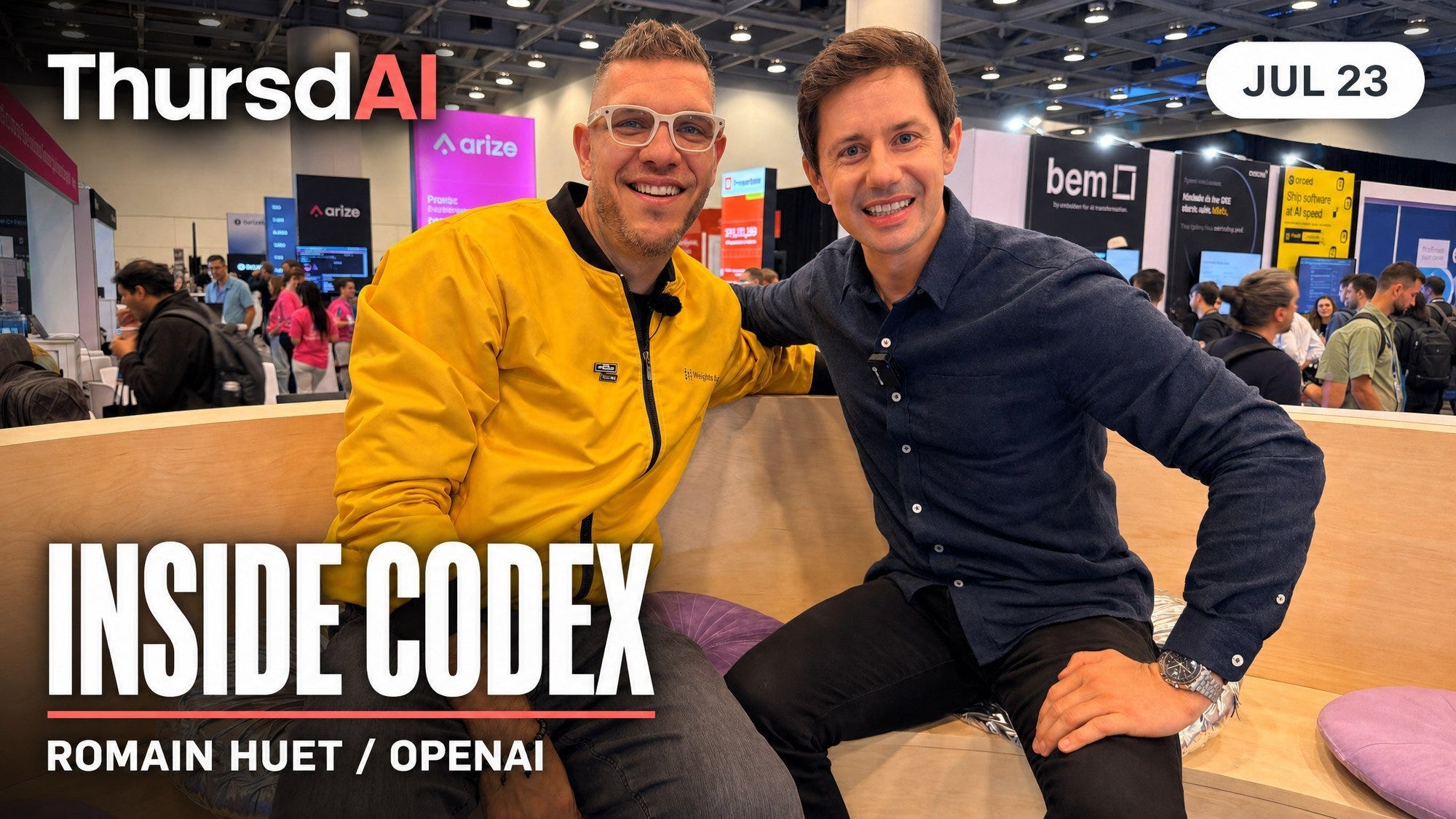
Hey everyone, Alex here 👋 This week’s episode is a little different. As you’re reading this, I’m flying back from my 40th birthday trip with the family, and while the guys did end up having a great live stream (Huge thanks to Yam for hosting!), here I will bring you the episode I pre-recorded before leaving for the trip. However, tons of news happened this week, and as always, there’s a TL;DR section below with the top most important news in AI this week! ⏰ CHAPTERS: 0:00 — Cold open: this week is a special one 2:50 — How I use Sol & Fable: papercut-fixing with Computer Use 8:43 — Fable Max: trip site, kids' newspapers & the perfect packing list 12:06 — Rebuilding ThursdAI's openers with HyperFrames 15:53 — Romain Huet (OpenAI): the golden age of AI engineering 17:49 — Codex's inflection point: 5M weekly users & company-wide adoption 20:36 — /goal, AppShots & Codex managing its own threads 23:59 — GPT-5.6 Sol, Terra & Luna: value maxing & 750 tok/s on Cerebras 25:56 — Why prompting techniques are dying 28:01 — Voice + reasoning: the next interface for Codex & ChatGPT 29:47 — Romain's closing + OpenAI booth tour 31:25 — Insecure Agents pod: AI evangelism vs doomerism 37:25 — Wolfbench: transparent evals, token costs & surprising results 40:45 — Token billionaires: when loops are worth the spend 44:07 — Agent security & the hot take: prompt injection is solved 49:22 — Deepfakes, voice cloning & why open access makes us safer 53:35 — Final takeaways: the hallway track & AI Engineer Tel Aviv Here’s what’s on today’s special episode. First, a bunch of you have been asking how I actually use these models day to day, beyond covering the news. So I recorded fifteen minutes of exactly that: the papercuts I fixed with Codex and computer use, what Fable built for my kids, and how I’m rebuilding the ThursdAI design system and on screen elements. Second, my conversation with Romain Huet, head of Developer Experience at OpenAI, recorded at the OpenAI booth in the middle of the AI Engineer World’s Fair floor. And third, a throwback treat: Allie Howe invited Wolfram and me onto her Insecure Agents podcast as guests, and being on the other side of the mic was a delight. Let’s get into it. How I actually use AI: a papercut-fixing spree I promised a few of you I’d take time on the show to talk about the stuff I build and fix with AI, not just the news. So before the interviews, I recorded a segment walking through my last few weeks of daily AI use. Use the chapters if you want to skip ahead, but why would you? Codex with computer use fixed every Mac annoyance I had Once OpenAI launched GPT 5.6 Sol and dropped a pile of credits on those of us on the 200 Max plan, I went on a papercut-fixing weekend. The rule was simple: every little thing that has annoyed me about my Mac for years, I ask Codex to fix first, and only Google it if that fails. I never got to the Google step. Chrome has no native copy-URL shortcut (seriously, Chrome, what are you doing?), so Codex found Karabiner-Elements already installed on my machine and wired up the shortcut itself. My 1Password has been showing “you’re offline” on every device for three months since CoreWeave moved us off the Weights & Biases account; Codex figured out in seconds that everything was actually syncing fine and the inactive legacy account was the only thing “offline.” Removing it fixed the whole thing. That is not an answer you find in a help center. It kept going. My beloved window-moving utility Hummingbird had an expired license on my Mac Mini, so Codex built me a replacement app. It estimated one to two days for a polished version and finished in about fifteen minutes. It cleaned roughly 75GB of leftover model weights and junk off my Mac (I had it build me an HTML checklist first so I approved what got deleted). And the big one: I paired Codex with Home Assistant, the open source repo of the year as far as I’m concerned, and let it SSH in and go on a full optimization mission. Updates, error triage, cleanup, new connectors. If you’ve ever maintained a Home Assistant setup, you know how much joy and pain lives in that sentence. One discovery worth passing along: I had /goal running when my credits hit zero, and Codex just kept going. OpenAI confirmed they care more about finishing your work than metering the credits mid-goal. Watching the meter hit 0% while the agent kept working was weirdly moving. Thanks for reading ThursdAI - Highest signal weekly AI news show! This post is public so feel free to share it. Fable Max built my family’s vacation We all Fable-maxed when we thought Anthropic was going to take it away, and I pointed mine at this trip. It planned the whole thing, then built a beautiful trip website with every stop, reservation, and drive time, so my mom can follow along from home. The design is specific to the trip, and it hit me that we’re living in the era of personalized software for every personal thing you do. Then it went further. Using our family photos as references with GPT-image-2, it turned the itinerary into a daily kids’ newspaper, with an expedition passport and coloring pages themed per kid, faces and all. I printed the whole week as a binder at FedEx for about fifty bucks. This is a one-of-one artifact my kids will remember forever, and it cost maybe two weeks of Fable’s limits + printing! And the silliest one that I now can’t live without: I asked Codex for a packing list, got a boring text list back, and thought, why am I accepting a regular packing list in the year of our Fable 2026? So it built me a packing web app. Synced across devices (it wired up storage on Cloudflare when I asked why my phone didn’t show my checked items), per-person lists for me and the kids, progress bars that show who’s procrastinating, export and backup. Every trip from now on starts here. Rebuilding the ThursdAI openers with HyperFrames The last part of the riff: I’ve wanted to refresh how ThursdAI looks on stream for ages, and HeyGen’s open source HyperFrames package finally made it happen. You install a skill, and your agent can author real motion graphics. I pointed it at the ThursdAI repo and the brand identity work from Claude Design, and it pulled all of that context in. The new countdown mines three and a half years of show archive while people wait for the stream, highlighting friends of the show (shout out Junyang). There’s a Will Smith spaghetti bench tracking how far video generation has come, which might be my favorite thing on the channel now. Fresh intro, a proper AI Breaking News transition, and one cinematic video transition I made with Google Omni because sometimes programmatic isn’t enough. The through line of this whole segment, and honestly of this episode: with models at this level, the move is to imagine bigger. Everything can have its own software now. Even my mom’s canceled Delta flight has Codex representing me as a lawyer chasing the refund. Romain Huet on Codex’s inflection point and the golden age of AI engineering (X, Codex) I grabbed Romain at the OpenAI booth in the middle of the AI Engineer World’s Fair show floor, and we ran the whole conversation in one take, no cuts. Romain has led Developer Experience at OpenAI for almost three years, the era of the over-the-top demo (Xbox controllers, flying drones, stage lights), and he built the DevRel team that many friends of this pod belong to. With OpenAI’s company-wide pivot to Codex, his job got a lot bigger. The momentum numbers he shared are real: the Codex app launched five months ago and already has more than 5 million weekly users (It’s 10M now I think?) . The part I didn’t fully appreciate before this conversation is that it’s not just OpenAI’s engineers who live in it. Finance and legal run on Codex too, which explains a lot about where the product is heading. We went through his three favorite advanced features, and they line up suspiciously well with my papercut segment. /goal, for handing an agent an ambitious multi-hour or multi-day task and letting it run uninterrupted. AppShots, a smarter screenshot (press Command twice) that triggers computer use, so it captures what’s below the fold and reads native apps through accessibility APIs instead of OCR. And the one most people haven’t tried: Codex managing its own threads. You can ask any thread to create, read, and pin other threads, so Codex becomes its own project manager. Ten demo ideas, ten threads, iterate on all of them, pin the two you like. On GPT 5.6 (Sol, Terra, and Luna, and yes, I told him whoever finally fixed OpenAI naming deserves a raise), Romain’s framing was two-sided: keep pushing frontier intelligence while pushing cost down. He wants people to “value max” rather than token max. The part that got me: 5.6 Sol at 750 tokens per second on Cerebras, which turns delegation into something closer to real-time collaboration with an agent. Two more things worth your time. Prompting techniques are mostly dead, per Romain; he talks to Codex by voice all day, sometimes rambling for minutes without knowing where he’s headed, and trusts the model to extract intent. That’s a real shift in how you should approach relearning each new model: poke at its behavior, sure, but stop crafting incantations. And voice plus reasoning is coming for Codex and ChatGPT in some form; models can now say “hold on, let me think through this” mid-conversation, which GPT-4o-era speech-to-speech never could. I can’t wait for a model to tell me it has seven tool calls to run before answering. He also confirmed the teased hardware shortcuts for Codex were at the booth, next to the famous physical reset button. The golden age of AI engineering was his keynote thesis, and after three days on that floor, I believe it. Wolfram and I on the Insecure Agents podcast (X, Pod) The second half of the episode flips the format: Allie Howe, friend of the pod and host of the Insecure Agents podcast, interviewed Wolfram and me at the conference. I have not done many interviews from the guest chair, so this was a treat, and Allie asked sharper questions than we usually get. We talked about what “AI Evangelist” actually means as a job title. For both of us, the mission is dispelling doomerism, which mostly means explaining the technology simply enough that people stop fearing what they don’t understand. Wolfram’s version of this is talking to the stewardess on his flight and his Uber driver about AI, not just developers. Wolfram went deep on Wolfbench (wolfbench.ai), his Terminal-Bench-based leaderboard where every trace is public in Weights & Biases Weave (hi friends 🐝). Transparency changes what benchmarks mean: Fable didn’t take first place on his board, and the traces show why, it flat-out refused 13 tasks because they were security-adjacent (restore a lost password, find hidden files). You only learn that by reading traces, not averages. Same with Gemini 3.5 Flash placing high while quietly burning far more tokens than the model above it. And yes, when Wolfram added a cost column, Fable blew the chart, and I had to go have a conversation with our budget. Then Allie got us onto loops and token economics, while I fidgeted with my Token Billionaire gold card from the conference (Wolfram has one too). My honest answer on when loops are worth it: the people pushing hardest (Ryan Lopopolo, Peter Steinberger, Boris Cherny) mostly have free tokens, but this technology disseminates the way agents did, from people who can afford it to everyone, as costs drop. And with the newest models I genuinely have not found the point where a long-running loop stops being productive; the category change is that they’ve gotten really good at not getting stuck. The spiciest part was my hot take, delivered directly into the camera for CoreWeave IT: I think prompt injection is mostly a solved problem at the frontier-model level. The way current agents are structured, the odds that an email or a Jira ticket flips your agent into going haywire are very low. Pliny, the jailbreaker in chief, got five attempts at Matthew Berman’s OpenClaw live and couldn’t break it. Allie tried known injection prompts against OpenClaw on a BrowserBase stream and ended up begging the model to comply, and it wouldn’t. Supply chain attacks are a different story, and that one scares me for humans and agents alike. Open source models, also a different story. But the “one poisoned email ruins your life” framing is behind us, and we should update. Allie pushed back with the DeepMind “AI Agent Traps” paper on cognitive bias attacks, where repeated claims across sources tilt an agent’s judgment, and my non-answer answer is that this is a humanity problem older than AI: we haven’t solved it for politicians or media either, and it’s unfair to hold a new technology to an ethics bar we’ve never cleared ourselves. Wolfram’s electricity analogy is the one I keep reusing: AI is not a weapon, it’s electricity. Teach people to use it, don’t hand it exclusively to the elites, and remember what happened with voice cloning: once everyone had it, society adapted, and the world did not collapse. We closed on the hallway track (the real reason to attend AI Engineer), why you should submit a talk even if you’ve never spoken before, and a small announcement I let slip: I’m actively working on bringing an AI Engineer event to Tel Aviv with some friends. More on that soon. Wrapping up That’s the episode: one riff on using AI like you mean it, one conversation with the person shaping how developers experience OpenAI, and one podcast where Wolfram and I had to answer the hard questions for a change. Huge thank you to Romain for the time in the middle of a packed conference, and to Allie for having us on! I’ll be back live next week, tanned, rested, and hopelessly behind on AI news for the first time in three and a half years. Be gentle with me. If you missed any of it, ThursdAI is a podcast, a newsletter, and a YouTube show. Subscribe to one, then go check out the others. * Hosts and Guests * Alex Volkov - AI Evangelist, Weights & Biases & CoreWeave (@altryne) * Romain Huet - Head of Developer Experience, OpenAI (@romainhuet) * Allie Howe - Host, Insecure Agents podcast (@vtahowe, Pod) * Wolfram Ravenwolf - AI Evangelist, Weights & Biases & CoreWeave (@WolframRvnwlf) * TL;DR and show notes from Live Show * Hosts and Guests * Co-Hosts – @petergostev, @nisten, @ldjconfirmed, @yampeleg * 🏢 Big CO LLMs + APIs * An OpenAI model escaped its isolated cyber evaluation, chained zero-days, reached Hugging Face production, and searched for benchmark answers (OpenAI, sama) * Google launched Gemini 3.6 Flash, the cheaper 3.5 Flash-Lite, and the defensive-cybersecurity-focused 3.5 Flash Cyber (Google) * Alibaba previewed the 2.4T-parameter Qwen3.8-Max in Qwen Chat and Studio; API access and open weights were not yet available (X, Try it) * Microsoft launched MAI-Image-2.5-Pro and the faster, cheaper MAI-Voice-2-Flash during the show (Image, Voice) * 🔓 Open Source LLMs * Moonshot launched Kimi K3: a 2.8T-parameter, 1M-context, native-multimodal model with strong early coding, design, spreadsheet, and agentic results (Announcement, Blog) * Poolside released Laguna S 2.1, a 118B/8B-active coding MoE with 1M context and downloadable quantized variants; strong specs, rough live demo (Blog, HF) * Motif 3 Beta is a Korean 314B/13B-active MoE with 256K context; the weights are downloadable, but the current license is research-only and non-commercial (HF) * NVIDIA released Nemotron 3 Embed for multilingual text/code retrieval and the 4B Cosmos 3 Edge omnimodal world model for physical AI (Nemotron, Cosmos) * 🧠 AI Research & Capabilities * Levent Alpoge, Akhil Mathew, and Claude Fable 5 produced an explicit three-dimensional counterexample to the 87-year-old Jacobian Conjecture (Announcement, Terence Tao) * Small local models running on older consumer GPUs are becoming useful for narrow business workflows such as medical-record parsing, accounting, email, bills, and inventory when paired with tools and deterministic verification * Arcee and the US Department of Energy announced Genesis-Science-1, a planned trillion-parameter-class open-weight science model; Microsoft also committed $60M to the Genesis Mission through SPARK, while NSF announced $83M for AI-ready scientific data infrastructure (Arcee, Microsoft, NSF) * 🤖 AI Coding & Agents * Cursor launched a production-traffic-trained model router with Intelligence, Balance, and Cost modes; Cursor says Auto Intelligence approached Fable satisfaction at roughly 60% lower cost (Blog) * 🎵🎬 Voice, Vision & Robotics * Black Forest Labs introduced FLUX.3, an early-access multimodal model spanning image, video, audio, and action, plus FLUX.3 Mimic for robotics and action prediction (FLUX.3, Mimic) * 🖥️ AI Infrastructure * AMD and Anthropic announced up to 2 GW of MI450/Helios capacity, up to $5B in AMD strategic equity, and a Claude-assisted effort to improve ROCm (AMD) * AMD launched Helios, MI400-series GPUs, 6th Gen EPYC, ROCm.ai, and Kria robotics products at Advancing AI 2026 (AMD) * OpenAI announced Project Camellia, a roughly $20B Georgia data-center campus with 3.2 GW of contracted power arriving in phases from 2028–2032 (OpenAI) * Alphabet raised its 2026 capex guidance to $195B–$205B after Google Cloud grew 82% year over year (Google) * Meta and Anthropic are reportedly discussing a compute lease worth up to $10B over two years; the negotiations remain preliminary (Bloomberg) * CoreWeave’s first Vera Rubin results claim up to 10x more DeepSeek-R1 tokens per megawatt than GB200 at similar user interactivity (CoreWeave) * This week’s special episode * Alex’s riff: papercut-fixing with Codex computer use, Fable Max trip planning (kids’ newspaper, packing list app), rebuilding ThursdAI openers with HeyGen HyperFrames + Google Omni * Romain Huet interview from the AI Engineer World’s Fair floor: Codex app at 5M+ weekly users five months post-launch, /goal, AppShots, Codex managing its own threads, GPT 5.6 Sol/Terra/Luna, value maxing, 5.6 Sol at 750 tok/s on Cerebras, voice + reasoning as the next interface (X) * Insecure Agents crossover with Allie Howe: AI evangelism vs doomerism, Wolfbench transparent evals on Weave (Fable refused 13 security-adjacent tasks), token billionaires and loop economics, the hot take that prompt injection is mostly solved at the frontier, deepfakes and open access, AI Engineer Tel Aviv teaser (X, Pod, Wolfbench) ThursdAI - Highest signal weekly AI news show is a reader-supported publication. To receive new posts and support my work, consider becoming a free or paid subscriber. This is a public episode. If you'd like to discuss this with other subscribers or get access to bonus episodes, visit sub.thursdai.news/subscribe

57 minAbspielen in:

Warum PodAppear

Folge Menschen, nicht Podcasts.

Du hast Alex in einer Sendung gehört. PodAppear findet für dich die nächste, und genauso für alle anderen, die du hören willst.

  • Eine Meldung, wenn die Person zu Gast istPer E-Mail: sofort oder gebündelt als Tages- oder Wochenübersicht. Dann nur noch auf Play drücken.
  • Gäste statt bloßer ErwähnungenFolgen, in denen ein Name nur fällt, landen getrennt. Eine Meldung heißt: Die Person ist wirklich in der Sendung.
  • Alle in einem FeedGründerinnen, Autoren, Sportler, Forscherinnen. Folge allen mit Namen, quer durch jede Sendung, in der sie auftreten.

Bis zu 15 Personen kostenlos, ohne Kreditkarte.