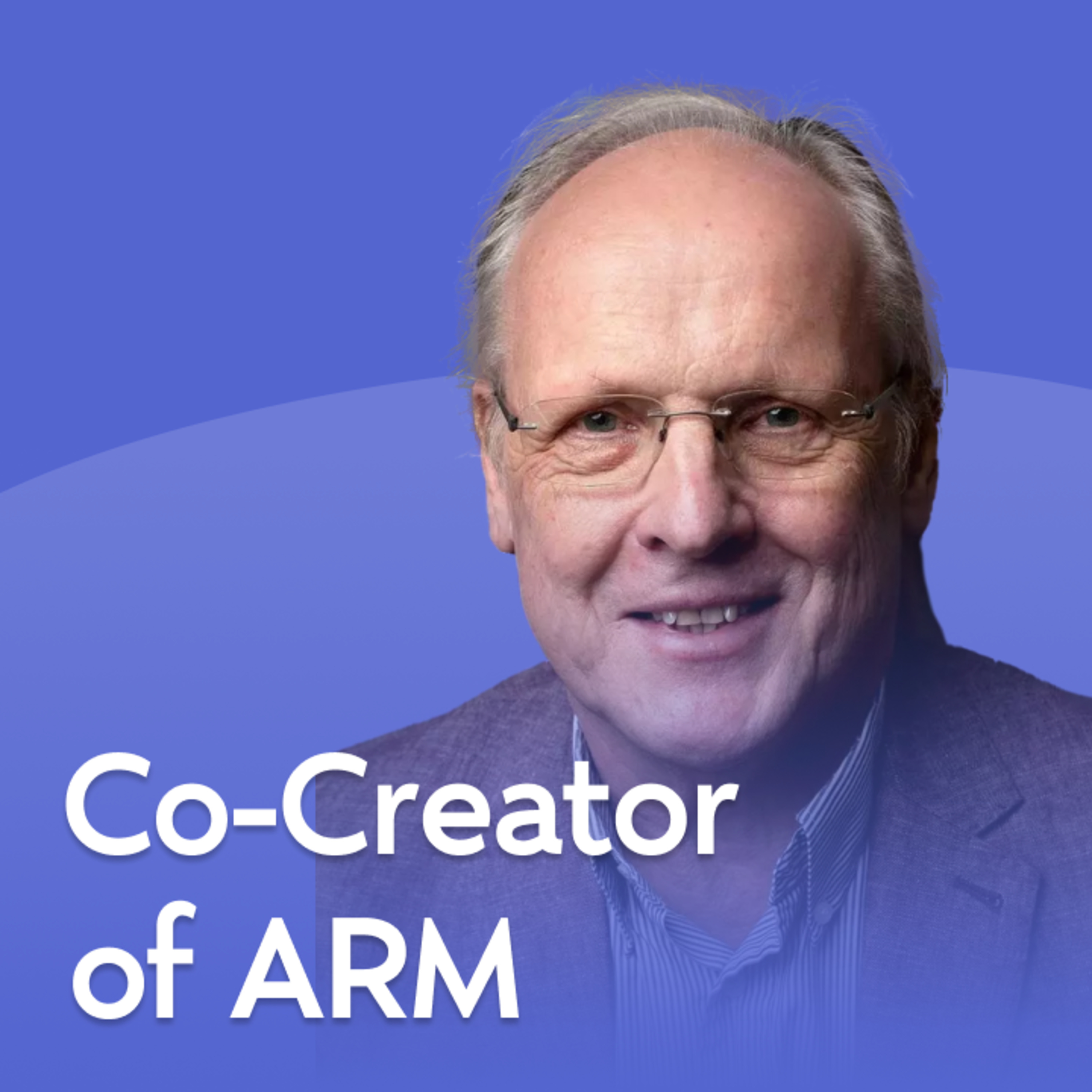
How Two First-Timers Created the World’s Most Popular Processor | Steve Furber
Wer in dieser Folge vorkommt
Steve FurberGast
Warum PodAppear „Gast“ sagt
“How Two First-Timers Created the World’s Most Popular Processor | Steve Furber”Kapitel
Zeitmarken aus den Shownotes. Tippe auf eine, um dort weiterzuhören. Werbung, die der Anbieter bei jedem Abruf einfügt, kann diese Zeiten um ein, zwei Minuten verschieben.
Beschreibung der Folge
In 1984, two first-time chip designers, Steve Furber and Sophie Wilson, created what would become the most popular processor in the world (ARM). I interviewed Steve about how they did it with such a small team that had no formal training.
We also covered a bunch of questions about hardware design and his answers were so clear. I learned a lot and hope you enjoy the episode!
• My ergonomic keyboard project I mentioned, you can follow along here: https://read.compose.llc/
• The Kickstarter page for it: https://www.kickstarter.com/projects/ryanlpeterman/compose-simple-ergonomics-beautifully-done
Podcast links:
• YouTube: https://www.youtube.com/watch?v=3K9L0dRRzOs
• Apple: https://podcasts.apple.com/us/podcast/the-peterman-pod/id1777363835
• Transcript: https://www.developing.dev/p/e075-steve-furber
Thank you to this episode's sponsors for supporting my work:
Ganze Beschreibung zeigen
• WorkOS: makes your app Enterprise Ready with easy to use APIs to add SSO, SCIM, RBAC, and more in just a few lines of code, check them out at https://workos.com/
• Chargebee: billing and monetization infrastructure for the AI economy, so your pricing can evolve alongside your product, check them out at https://www.chargebee.com/
Timestamps:
(00:00) Intro
(00:27) Building his first computer
(05:28) BBC Micro
(10:28) Designing the ARM processor
(17:15) Why their design was better
(23:38) Emulators and interpreters
(25:58) Instruction sets and microarchitecture
(31:08) How they learned chip design
(34:27) Why they were so successful
(39:57) America vs UK
(42:40) Why Acorn failed
(44:10) Neuromorphic computing
(48:52) Winning an IMO medal
(50:45) His most proud engineering
(51:46) Top technical book recommendation
(52:29) Advice for young people
(54:42) Outro
Where to find Steve:
• Personal website: https://personalpages.manchester.ac.uk/staff/steve.furber/
• University of Manchester research profile: https://research.manchester.ac.uk/en/persons/steve.furber/
• X: https://x.com/FurberSteve
• LinkedIn: https://www.linkedin.com/in/stevebfurber/
• GitHub: https://github.com/sfurber
• ORCID: https://orcid.org/0000-0002-6524-3367
• Google Scholar: https://scholar.google.com/citations?user=jLnsiBEAAAAJ
• Wikipedia: https://en.wikipedia.org/wiki/Steve_Furber
Where to find Ryan:
• Newsletter: https://www.developing.dev/
• X/Twitter: https://x.com/ryanlpeterman
• LinkedIn: https://www.linkedin.com/in/ryanlpeterman/
• Threads: https://www.threads.com/@ryanlpeterman
• Instagram: https://www.instagram.com/ryanlpeterman
• TikTok: https://www.tiktok.com/@ryanlpeterman
Referenced in this episode:
• Reduced Instruction Set Computer Architectures for VLSI: https://mitpress.mit.edu/9780262111034/reduced-instruction-set-computer-architectures-for-vlsi/
• Computer Architecture: A Quantitative Approach: https://shop.elsevier.com/books/computer-architecture/hennessy/978-0-443-15406-5
• Computer Organization and Design: The Hardware/Software Interface: https://shop.elsevier.com/books/computer-organization-and-design/patterson/978-0-08-050257-1