The Steady State Sentinel cover
Podcast

The Steady State Sentinel

von The Steady State

The Steady State Sentinel hatte in den letzten 12 Monaten 19 bestätigte Gäste in 18 Folgen. Zuletzt: Mark Blumberg, 24. Nov. 2026.

Apple PodcastsSo werden Gäste bestätigt

The Steady State Sentinel is produced by The Steady State, a community of former national security professionals who spent their careers safeguarding the United States at home and abroad. Today, we continue that mission by staying true to our oaths to defend the Constitution, uphold democracy, and protect national…

Gäste der Sendung

Di24Nov
The Steady State SentinelMB

Mark BlumbergGast

Delayed Justice will not be Denied: Building Cases the DOJ Won’t

What happens to the rule of law when the people charged with enforcing it choose not to look? In this episode of The Steady State Sentinel, hosts Lauren Anderson and Peter Mina sit down with Mark Blumberg, executive director and chief legal counsel of the Rule of Law Project, to examine what he calls a two-tier system of justice: one for the powerful and well-connected, and one for everyone else. Drawing on three decades of investigating official misconduct at the Department of Justice, Blumberg explains how the hollowing out of DOJ’s Public Integrity Section and its civil rights oversight offices, along with a wave of pardons, has left a gap in accountability. He also explains why he thinks that filling the gap can’t wait for a future administration. Together, they explore how public corruption affects ordinary Americans, from rural hospitals to childcare, and where corruption and abuses by ICE and Border Patrol overlap - the private contracts behind immigration detention. But identifying the gap is only the beginning. Blumberg describes how a team of former prosecutors and federal agents plans to do the pre-grand-jury work that complex cases depend on. They will draw on whistleblowers, investigative journalists, NGOs and Congressional oversight, and bring cases to state attorneys general and local prosecutors now rather than waiting on Washington. He argues that the project’s real mission is to give a rebuilt Justice Department “the gift of time”: case files ready on day one, before statutes of limitations run out. From the career public servants still holding the line inside government to the former prosecutors and agents volunteering outside it, this conversation argues that accountability isn’t abstract, and that no one is above the law or beneath its protections. Mark Blumberg is the Executive Director and Chief Legal Counsel of The Rule of Law Project, where he directs the organization’s strategy, oversees its independent investigations, and serves as its principal public voice. He spent nearly 30 years in the Civil Rights Division of the U.S. Department of Justice, most recently as Special Legal Counsel in the Criminal Section, where he investigated complex official-misconduct conspiracies, developed new prosecutorial theories, and led national initiatives to protect democratic institutions. He created the Division’s initiative to combat voter suppression and led it for two decades, and he served on the FBI’s Shooting Investigation Review Group and CBP’s National Use of Force Review Board. He also trained generations of federal prosecutors and agents in grand-jury practice, witness interrogation, and investigative strategy. The Rule of Law Project, which launched on October 26, 2026, is an independent, nonpartisan team of former career prosecutors and investigators that investigates public corruption and state violence and builds the criminal cases the DOJ would have brought in ordinary times.

41 minAbspielen in:

Di10Nov
The Steady State SentinelUE

Uriel EpshteinGast

Defending Democracy: Lessons from Ukraine to America

What does authoritarianism actually look like before a democracy falls? In this episode of The Steady State Sentinel, retired Space Force Colonel Bree Fram sits down with Uriel Epshtein, CEO of the Renew Democracy Initiative, to examine the warning signs of democratic erosion in the United States and the lessons Americans can learn from those who have lived under authoritarian rule. Drawing on his family's experience in the Soviet Union and his recent visit to war-torn Ukraine, Epshtein describes the extraordinary resilience of Ukrainians living under Russian bombardment, the creeping normalization of political intimidation, and the dangers of replacing the rule of law with the selective application of justice. Together, they explore how authoritarian leaders consolidate power, exploit political divisions, and undermine the freedoms Americans have long taken for granted. But recognizing the danger is only half the battle. Fram and Epshtein examine the global relationships between authoritarian leaders, what it would take for Ukraine to secure a lasting victory, and how American citizens, veterans, and national security professionals can defend democratic institutions at home. Epshtein argues that the pro-democracy movement must move beyond simply warning people about authoritarianism and offer a compelling vision of what freedom can deliver for ordinary Americans. From the courage of Soviet dissidents to the resilience of Ukraine, this conversation makes the case that democracy's survival depends not only on confronting the forces threatening it, but on giving people something worth fighting for. Uriel Epshtein is the Chief Executive Officer of the Renew Democracy Initiative (RDI), a nonprofit organization chaired by Russian democracy advocate and former world chess champion Garry Kasparov. Since joining RDI in 2017, Epshtein has led efforts to counter authoritarianism, support pro-democracy dissidents around the world, expand civic education, and mobilize humanitarian assistance for Ukraine. A graduate of Yale University, he founded the Peace & Dialogue Leadership Initiative, a program dedicated to bridging the civilian-military divide and encouraging informed discussion of American foreign policy. Before joining RDI, he worked at the Boston Consulting Group and held strategy roles at Uber and DoorDash. The son of parents raised in the Soviet Union, Epshtein speaks Russian and French and frequently comments on democracy, international affairs, and the global struggle against authoritarianism.

44 minAbspielen in:

Mo2Nov
The Steady State SentinelNJ

Nina JankowiczGast

ELECTION SPECIAL: America Has Disarmed Against Disinformation — Just Before the Midterms

With the November 3 midterm elections approaching, what happens when the United States dismantles its defenses against disinformation just as the threats intensify? On this episode of The Steady State Sentinel, host Lauren Anderson is joined by disinformation expert Nina Jankowicz, co-founder and CEO of the American Sunlight Project, to examine the growing threats posed by foreign influence operations, political manipulation, and attacks on the institutions responsible for protecting American democracy. Drawing on her experience studying Russian propaganda and serving in the federal government, Jankowicz explains why she believes the Trump administration's rollback of counter-disinformation programs has left the United States increasingly vulnerable to foreign adversaries and domestic manipulation. The conversation also takes a deeply personal turn as Jankowicz recounts the harassment, threats, and intimidation she experienced after being appointed to lead the Department of Homeland Security's Disinformation Governance Board. She and Anderson explore how political intimidation silences researchers and public servants, the erosion of democratic norms, and the dangerous relationship between inflammatory rhetoric and political violence. As Americans prepare to vote, Jankowicz offers practical advice for recognizing disinformation, navigating online manipulation, and engaging constructively with those who hold different beliefs. At its heart, this episode asks a critical question: What happens to a democracy when people are afraid to speak the truth? Nina Jankowicz is an internationally recognized expert on disinformation, democracy, and online harassment, and the co-founder and CEO of the American Sunlight Project, a nonprofit dedicated to combating disinformation and defending freedom of expression. She previously served in the Department of Homeland Security, where she was appointed to lead the Disinformation Governance Board, and has worked with the National Democratic Institute and the Wilson Center on democracy, foreign influence, and information security. Jankowicz is the author of How to Lose the Information War and How to Be a Woman Online, and was named one of TIME magazine's 100 Most Influential People in AI. She also hosts DISARMED, a podcast examining the dismantling of America's defenses against disinformation and the consequences for democratic institutions and national security.

37 minAbspielen in:

Di27Okt
The Steady State SentinelJW

James WalkinshawGast

Trump, Corruption, and a Weaponized DOJ: Can a New Congress Fight Back?

Congressman James Walkinshaw (VA-11) joins host Bree Fram on The Steady State Sentinel to examine the growing challenges to American democracy and Congress's constitutional responsibility to check executive power. Serving on both the House Oversight and Homeland Security Committees, Rep. Walkinshaw discusses the Trump administration's weakening of independent watchdogs, allegations of government corruption, and the challenges of holding federal agencies accountable. From unannounced inspections of ICE detention facilities to congressional subpoenas and investigations, he outlines how lawmakers can confront executive overreach and defend the rule of law. With Election Day just around the corner, Rep. Walkinshaw warns of efforts to undermine confidence in the electoral process and the possibility of challenges to the November results. He and Fram also explore the politicization of the Department of Justice, threats to the independence of the federal workforce, and the importance of preserving a professional, nonpartisan civil service. Despite these challenges, Rep. Walkinshaw makes the case for optimism, arguing that civic engagement, constitutional accountability, and meaningful institutional reform can help America emerge from this period with a stronger democracy. The Steady State has endorsed Rep. Walkinshaw. Congressman James Walkinshaw represents Virginia's 11th Congressional District, a community home to a significant population of federal employees, military families, and national security professionals. He serves on the House Committee on Oversight and Government Reform and the House Committee on Homeland Security, where his work focuses on government accountability, constitutional oversight, and the protection of civil rights. Walkinshaw is the founder and co-chair of the Federal Workforce Caucus, advocating for the independence and professionalism of the federal civil service. Before entering Congress, he served on the Fairfax County Board of Supervisors and as chief of staff to Congressman Gerry Connolly. He is endorsed by The Steady State.

32 minAbspielen in:

Di20Okt
The Steady State SentinelFK

Frank KendallGast

Frank Kendall Sounds the Alarm: America’s Military Is Being Politicized From the Top Down

From autonomous weapons to political interference, a former Air Force Secretary confronts the threats to America's military future. In this episode of The Steady State Sentinel, retired Space Force Colonel Bree Fram sits down with former Secretary of the Air Force Frank Kendall to examine the future of warfare and the mounting challenges facing America's military leadership. Drawing on Fram's recent firsthand observations in Ukraine and Kendall's book on the future of warfare, they explore how artificial intelligence, autonomous weapons, and uncrewed systems are fundamentally transforming modern combat. Kendall explains why America's military must move beyond traditional platforms, what Ukraine's battlefield innovations reveal about the next generation of warfare, and why careful strategic planning is essential to maintaining America's military advantage. The conversation turns to the growing politicization of the Pentagon and the consequences for military professionalism, national security, and democratic accountability. Kendall delivers a sharp assessment of current Defense Department leadership and the rise of authoritarianism. He discusses the revocation of his security clearance, and warns about the dangers of silencing dissent within the armed forces. From the feasibility of the administration's Golden Dome missile defense initiative to the importance of America's alliances, Fram and Kendall examine the difficult decisions facing the nation's military leaders. At the heart of their discussion is a fundamental question: When political pressure conflicts with professional judgment and constitutional obligations, will America's military leaders have the courage to speak up? Frank Kendall served as the 26th Secretary of the Air Force from 2021 to 2025, overseeing the U.S. Air Force and Space Force, and previously served as Under Secretary of Defense for Acquisition, Technology, and Logistics from 2012 to 2017. With more than five decades of experience in national security, military modernization, engineering, and defense acquisition, Kendall has held senior positions across government and the private sector, including Vice President of Engineering at Raytheon and a seat on the Board of Directors of Leidos. A graduate of the United States Military Academy at West Point, he holds advanced degrees from the California Institute of Technology, Long Island University, and Georgetown University Law Center. He has also worked as a pro bono human rights attorney and is the author of Lethal Autonomy: The Future of Warfare Whether We Like It or Not, published in July 2026.

40 minAbspielen in:

Di13Okt
The Steady State SentinelJM

James MartinGast

“A Few Good People”: James Martin on Service, Democracy & Congress

The Florida congressional candidate on military service, democratic institutions, national security, and why Congress needs to reclaim its constitutional role. Episode Summary: In this candidate edition of The Steady State Sentinel, host Bree Fram sits down with James Martin, Democratic nominee for Congress in Florida’s 21st District and a Coast Guard officer whose career has taken him from commanding cutters to working at the highest levels of the federal government. The Steady State has endorsed James Martin in his congressional race. Martin discusses his closely contested primary, why he believed every vote needed to be counted before declaring victory, and what serving through a presidential transition taught him about the responsibilities national security professionals carry regardless of who occupies the White House. Martin also draws on his experience conducting and overseeing counternarcotics operations to discuss how maritime interdictions work, the intelligence gathered from detained suspects, and the consequences of abandoning established law-enforcement processes. The conversation expands to congressional war powers, the relationship between Congress and the executive branch, and the importance of rebuilding the government's national-security workforce. Martin closes by reflecting on what running for office has taught him and the idea that motivates his campaign: that the country may be only “a few good people” away from changing its direction. Guest bio: James Martin is a fourth-generation Floridian from Hobe Sound and the Democratic nominee for Congress in Florida’s 21st District. A graduate of the U.S. Coast Guard Academy, where he studied Naval Architecture and Marine Engineering, Martin served nearly a decade on active duty, including a deployment to the Arabian Gulf and command of two Coast Guard cutters based in Fort Pierce. From 2022 to 2025, he served as Chief of Staff for National Security Affairs and Executive Secretary in the Office of the Vice President, serving through the presidential transition. He continues to serve as a lieutenant commander in the U.S. Coast Guard Reserve. James Martin is endorsed by The Steady State.

37 minAbspielen in:

Di6Okt
The Steady State SentinelAF

Alex FinleyGast

Spies, Yachts & Kleptocrats: Alex Finley on Russia’s Hidden Money

What bureaucracy, satire, sanctions, and superyachts reveal about intelligence, Russian power, and Western institutions. Episode Summary Former CIA officer, journalist, author, and Russian oligarch yacht tracker Alex Finley joins John Sipher for a wide-ranging conversation about intelligence, Russian influence, kleptocracy, and the strange places a career in national security can lead. Finley explains how her background in journalism shaped her work as a CIA reports officer, where verifying sources, understanding access, and connecting intelligence collectors with analysts were central to the job. She also reflects on the War on Terror, the disconnect she saw between policy narratives and realities on the ground, and why those experiences eventually became material for her satirical novels about the absurdities of intelligence bureaucracy. The conversation then turns to Finley’s unlikely second career tracking Russian oligarchs’ superyachts. What began as curiosity about enormous yachts appearing in Barcelona became a window into the financial networks surrounding Russian elites. Finley explains how yachts can expose the movement of oligarch wealth; the Western banks, lawyers, businesses, and legal systems that enable it; and the challenges governments face when sanctioned assets become tied up in years of litigation. The episode closes with a broader discussion of Russian influence operations, political will in Europe, democratic institutions, and whether there are still reasons for optimism. Guest bio Alex Finley is a former CIA operations officer, author, journalist, and open-source researcher focused on Russian influence and kleptocracy. Initially a journalist covering national security and Washington, she later served overseas with the Agency. Finley is the author of a trilogy of satirical novels about the intelligence world and writes Rant with Alex Finley, a Substack covering national security, democracy, corruption, and politics. She has also become widely known for tracking superyachts linked to Russian oligarchs, using open-source information to examine sanctions, hidden ownership, and the financial networks surrounding Russia’s political elite.

38 minAbspielen in:

Di22Sep
The Steady State SentinelDH

Donna Hughes-BrownJim BrownGast

143 Day incarceration : A Lawful Permanent Resident, a Bad $25 Check, and the Cost of America's Immigration System

A legal-status hospice care provider detained for 143 days tells her story — the conditions inside, the demand for obscure "magical paperwork," and why she and her husband are now fighting to change the law. Hosts Lauren Anderson and Peter Mina sit down with Donna Hughes-Brown, a British-born lawful permanent resident who has lived in the United States for nearly 50 years, and her husband Jim Brown, a Navy corpsman who served 20 years including Desert Storm. In July 2025, returning from Ireland through Chicago O'Hare, Donna was detained by CBP — requesting she show "some magical paperwork" — and would spend the next 143 days in immigration detention. Her offense: a bad $25 check written to a grocery store in 2012 that had already been adjudicated and was only a misdemeanor. She describes being handcuffed on the jet bridge, no medication for six weeks, and a corrections officer invoking the "five-second rule" when her pill hit the floor. Jim describes calling 200 congressional offices and being told "we don't do legal stuff" — until he told one staffer to resign and turn in their badge, and a week later got a call: “Can you be in D.C. on Wednesday?” Donna warns all listeners : "Just because you're legal doesn't mean you're safe." The episode closes with a description of her data-driven advocacy — 84% of detainees have no criminal record, 19,000 homicides by U.S. citizens last year versus nine by immigrants — and her mission to treat all persons with dignity: "Before you are any of those things, you are human first." Episode Transcript

41 minAbspielen in:

Di15Sep
The Steady State SentinelLP

Les PaldyGast

No Cloak, No Dagger: A Professor's Secret Life Inside the CIA

A distinguished professor and decorated intelligence officer on 25 years of balancing academia and espionage, the value of scientific credentials in the field, and why diversity makes the CIA stronger. Host Jim Lawler sits down with his former CIA colleague Dr. Les Paldy, a distinguished service Professor Emeritus at Stony Brook University who spent 25 years balancing two identities: university professor by day and and on contract with the CIA in service to the United States. Paldy shares how he was first recruited — a classic spotting operation by a former Agency officer who approached him after a conference talk. He explains how his scientific credentials allowed him to "go where others could not," attending conferences in China and Eastern Europe to spot and assess foreign scientists as potential recruitment targets. He describes the cultural differences between academia and the CIA — the openness and shared inquiry of the university versus the compartmentation and top-down directives of the Agency. He reveals how he kept his secret life hidden from colleagues for decades, with only his wife and two sons knowing he was "doing something with the CIA." He reflects on what people get wrong about the Agency, why diversity is essential to its mission, and why he'd do it all over again. The episode closes with advice for young people considering intelligence careers. Guest info: Lester Paldy is a distinguished service professor emeritus at Stony Brook University and a decorated former intelligence officer. He served on teams in the CIA's Directorate of Operations and the FBI Counterintelligence Training Center at Quantico, Virginia. He is a former Marine Infantry Officer and the author of No Cloak, No Dagger: A Professor's Secret Life Inside the CIA. He spent 25 years balancing a career in academia with service as with the CIA , using his scientific credentials to spot and assess foreign scientists at conferences around the world. Episode Transcript

38 minAbspielen in:

Di8Sep
The Steady State SentinelFred Wellman

Fred WellmanGast

From West Point to Congress: A Veteran Runs on Common Sense and Service

A former Army lieutenant colonel and Lincoln Project executive on why he's running for Congress, the "weight of leadership," and why the costs, chaos, and corruption of this administration are hitting home in Missouri. Host John Sipher sits down with Fred Wellman, a West Point graduate, former Army Lieutenant Colonel, and current Democratic candidate for Missouri's 2nd Congressional District. Wellman shares his journey from growing up in Kirkwood, Missouri, to flying scout helicopters in Desert Storm, serving three tours in Iraq, and later running a veterans-focused business, working with the Lincoln Project, and now running for Congress. He reflects on the "weight of leadership" — the lesson that leadership should be keenly felt— and how losing his first wife and unborn child in a car accident taught him the importance of empathetic leadership. He contrasts his approach with his opponent, 13-year incumbent Ann Wagner, who is known as "absent Anne" for refusing to hold town halls, who quadrupled her net worth while in office, and has never once broken with Trump. Wellman outlines his plans for “day one:” banning stock trading by members of Congress, turning back tariffs, restoring healthcare subsidies, and addressing the affordability crisis. He also warns about the long-term damage of the administration's military purges, noting that these will have negative consequences for generations to come. "When you fire the women who are generals, when you pass over the black men and women who are generals, the message is sent, and this is gonna echo through the United States military for a generation to two generations." The Steady State endorses Wellman for embodying the values of national security professionals. Guest info: Fred Wellman is a West Point graduate, former Army Lieutenant Colonel, and the Democratic candidate for Missouri's 2nd Congressional District. He flew scout helicopters in Desert Storm and served three tours in Iraq. He earned a master's degree from Harvard's Kennedy School and later founded a business serving veterans and military families. He served as Executive Director of the Lincoln Project and now hosts a podcast on democracy and politics. He is running to replace 13-year incumbent Ann Wagner. Episode Transcript

46 minAbspielen in:

Di1Sep
The Steady State SentinelJeff Stein

Jeff SteinGast

A Million-Dollar Lawsuit and the State of American Intelligence

Veteran journalist Jeff Stein on the chilling effect of Strategic Lawsuit Against Public Participation (SLAPP) suits, the purge of the intelligence community, and why he's "cautious" about the future. Host Jim Lawler sits down with Jeff Stein, the founding editor-in-chief of Spy Talk and a veteran journalist who has covered the intelligence community for over 40 years — and who earlier this year beat back a $1 million defamation suit brought by a Trump administration official. Stein shares the visceral reaction to being served on his front porch on Martin Luther King Jr. Day, and why he knew from the start his reporting would hold up. He explains how the Trump administration has weaponized litigation against journalists, and warns that this creates a chilling effect on sources and reporters alike. He expresses concern regarding the "raw mass firings" of intelligence professionals who served under Democratic administrations — a radical departure from past practice — and the counterintelligence nightmare this creates. He warns that the Iran war is a strategic disaster, that Trump "seems mesmerized by Netanyahu," and that the decimation of CISA and the undermining of NATO are genuine threats. He closes with his view of the upcoming elections: "Trump is a national security threat, and the Democrats... that's our only vehicle for getting rid of this national security threat." Guest info: Jeff Stein is the founding editor-in-chief of Spy Talk, an independent Substack outlet and podcast covering U.S. intelligence, defense, and foreign policy. Before going independent, he wrote the Spy Talk column at Newsweek and earlier founded the CQ Homeland Security column at Congressional Quarterly. He is the author of three books, including A Murder in Wartime and Saddam's Bomb Maker. From 1968 to 1969, he served as a case officer with the 525th MI Group in Vietnam, running a network of spies against communist forces and was awarded a Bronze Star. Episode Transcript

46 minAbspielen in:

Di25Aug
The Steady State SentinelNH

Nina HachigianGast

The Autocrats' Worst Enemy: Why Despots Fear Mayors

A former U.S. Ambassador and Los Angeles Deputy Mayor on why local leaders are democracy's front line, how cities can resist authoritarianism, and what you can do to help. Host Lauren Anderson sits down with Ambassador Nina Hachigian, founder and CEO of the Alliance for Local Leaders International, a nonprofit dedicated to supporting and connecting mayors and governors globally to solve shared challenges. Drawing from her recent Foreign Affairs article, "The Autocrats' Worst Enemy," Hachigian explains why mayors are the most trusted level of government (70% trust, held for decades) and how in autocracies around the world, they have served on the front lines to protect democratic freedoms. She shares harrowing examples: the mayor of Gdańsk assassinated for his support of LGBTQ rights; the mayor of Caracas jailed for leading protests; and Istanbul's mayor thrown in jail and facing 2,000 years of sham charges. She discusses how the current US administration is using classic authoritarian tactics including weaponizing federal funding against states and cities that didn't support the president’s election. She offers hope through local innovation (participatory budgeting) and civic engagement–volunteering, connecting and communicating with local representatives, and the simple act of getting to know your neighbors. Her message: "Mayors are the canaries in the coal mine," when assessing the health of our democracy. And local democracy is where renewal begins. Episode Transcript

34 minAbspielen in:

Di18Aug
The Steady State SentinelGC

Glenn ChafetzGast

Cornucopia of Vectors of Theft: How China Is Stealing America's Economic Future

A former CIA officer on China’s espionage successes, America’s IP losses, and the growing threat to the U.S. economy. Host John Sipher sits down with his former CIA colleague Glenn Chafetz, now Director of the 2430 Group, a nonprofit focused on state-sponsored espionage against the economy. Chafetz explains how technology has transformed espionage — from the days of clandestine meetings in parking garages where “if you didn’t get caught red-handed, you didn’t get caught” to a world where "commercial surveillance far outstrips government surveillance" and the changes the technological expansion required of the CIA. He describes China's coordinated, party-state, intentional, and purposeful effort to steal American intellectual property (IP) calling China’s intelligence service "the single most successful intelligence organization in the history of the planet." He argues that American companies are losing the IP war because their focus on quarterly profits prevents them from calculating the significant long-term cost of stolen technology and making needed investments in counterintelligence efforts that would protect their IP. He warns that China's informal network of autocracies — Russia, Iran, North Korea — functions as a modern "Axis of Evil," and that the U.S. is destroying its own alliance network at the worst possible time. He closes with advice for companies: You have to become sufficiently expert in economic espionage, counter-espionage, counterintelligence, because if you don't, your competitors will. Guest info: Glenn Chafetz is the Director of the 2430 Group, a nonprofit providing research and advice on state-sponsored espionage efforts against the US economy, and publisher of the tRed Report, the organization’s recurring intelligence/geopolitical brief . He served at the State Department and the Arms Control and Disarmament Agency before spending much of his 30 year government career at the CIA which included three tours as Chief of Station.. He became the first person to oversee the Agency’s program of espionage tradecraft in the age of technological expansion. View Episode Transcript

49 minAbspielen in:

Di11Aug
The Steady State SentinelJC

Julia CurleeGast

The Intelligence You Don't See: A Career Analyst Warns about Systemic Weaponization of the Intelligence Community

A former CIA analyst and NSC director on the weaponization of the DNI, the decapitation of the NSC, and why dissent is no longer tolerated. Host Bree Fram, a retired Space Force colonel, sits down with Julia Curlee, a former CIA analyst with 25 years of experience who served as an National Security Council (NSC) director in the Biden and second Trump White Houses and as a presidential daily intelligence briefer to Vice President Pence. Curlee explains how intelligence was designed to work — raw reports transformed into context-rich analysis to help policymakers make informed decisions — and how that system has been systematically dismantled. She describes the Office of the Director of National Intelligence (ODNI) as a "loaded gun waiting on the table" that has been weaponized under Tulsi Gabbard and Bill Pulte, and warns that the NSC's coordination function has been "decapitated," leading to catastrophic planning failures in the run-up to the Iran war. She reveals how the head of the National Intelligence CounciL (NIC) was fired for delivering an assessment that didn't align with Stephen Miller's desired narrative, and how this has taught analysts that "any form of dissent" will be held against them. She closes with a sobering assessment: the Iran war is a strategic blunder that rivals Iraq, the U.S. has no good way out, and it will take decades to rebuild the trust that has been destroyed with allies and partners. Guest info: Julia Curlee is a former CIA analyst with 25 years of experience in national security. She served as an NSC Director in the Biden and second Trump White Houses and as a presidential daily intelligence briefer to the Vice President. She completed multiple tours in the Middle East and South Asia and served in the CIA's China Mission Center. She holds master's degrees from the National War College and American University and is currently a public service fellow at Lawfare. Episode Transcript

46 minAbspielen in:

Di4Aug
The Steady State SentinelMF

Mark FowlerGast

The Iran You Don't See: The Regime, the People, and What America Gets Wrong

A 22-year veteran of the CIA and Iran specialist on why the regime survives, the MOU disaster, the lessons of Iraq, and the history and humanity of Iranians. Host Jim Lawler sits down with his former CIA colleague Mark Fowler, a decorated case officer and one of the most experienced Iran operations officers of his generation. Fowler explains what makes Iran such a uniquely demanding target — not because Iranians are hard to recruit, but because the U.S. has no presence inside the country. He shares why the regime has survived for 45 years: improving education and infrastructure, using the internet as a safety valve, and brutally crushing protest leadership. He reflects on the lessons of the Iraq Weapons of mass destruction (WMD) failure, warning against mirror imaging. He offers a devastating critique of the Iran Memorandum of Understanding (MOU), calling it a "disaster" that gave Iran everything and "guarantees we'll be back." He discusses the complex internal rivalries between the Ministry of Intelligence and Security (MOIS) and Islamic Revolutionary Guard Corps (IRGC,) the danger of hitting civilian targets, and why any resolution will require the administration to "drink the poison" of a bad deal. He closes with what Americans get wrong about Iran: that most Iranians simply want to live their lives, raise their families, and see their country live up to its potential. Mark Fowler is a decorated CIA case officer who served the Agency for 22 years, including as the number- two position on Iran operations. He is a Farsi-speaking Middle East specialist and a veteran of the U.S. war on terror. He served as the Directorate of Operations senior representative to the WMD commission following the Iraq WMD failure. He is the author of the soon-to-be published novel A Prince of Mirrors: A CIA Odyssey of Trust and Betrayal, and writes a Substack column. Episode Transcript

49 minAbspielen in:

Di28Jul
The Steady State SentinelBH

Bruce HeldGast

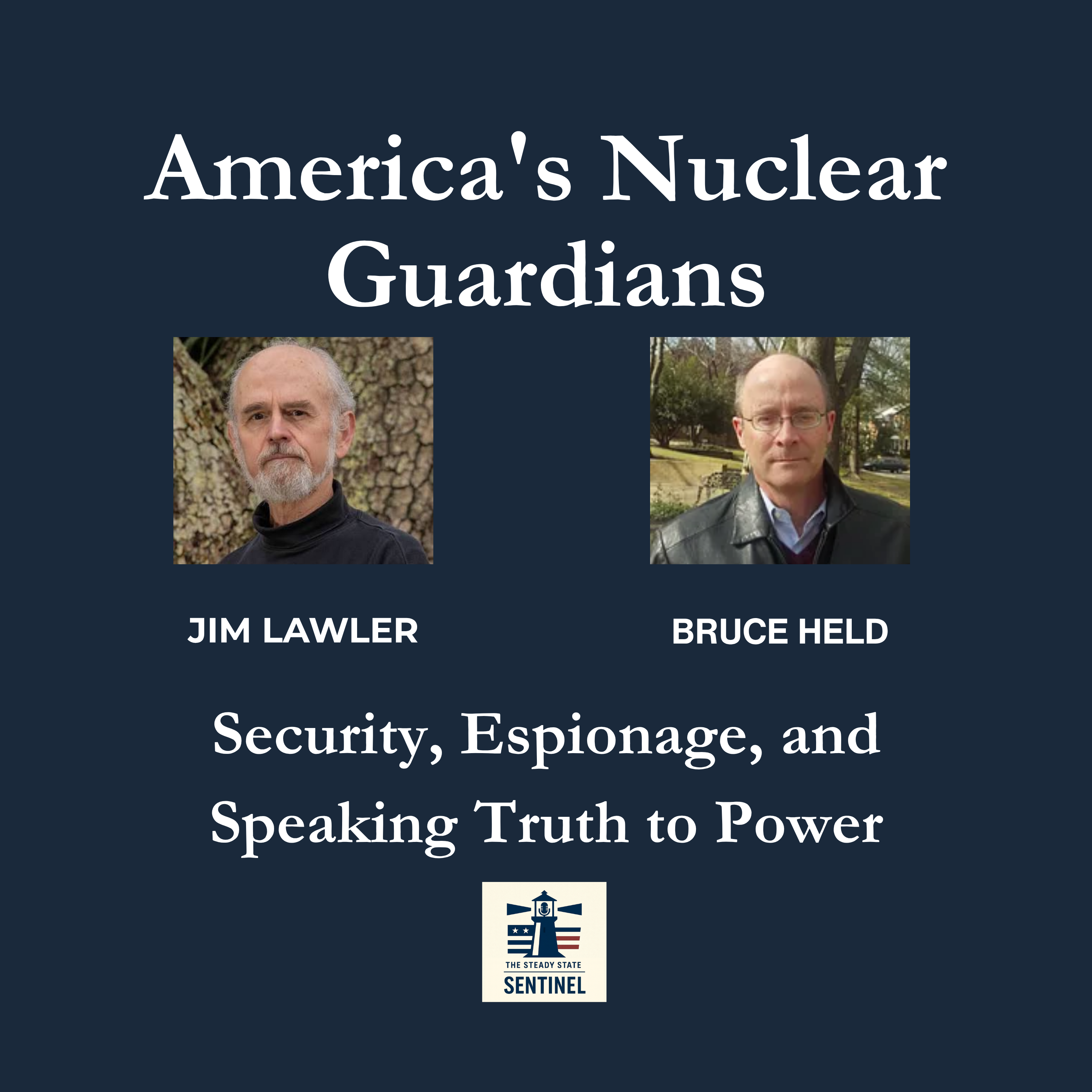
America's Nuclear Guardians: A Conversation on Security, Espionage, and Speaking Truth to Power

A former acting Under Secretary for Nuclear Security on the damage being done to the Department of Energy’s (DOE) Office of Intelligence and Counterintelligence, and why he "never bets against America." Host Jim Lawler sits down with his former CIA colleague Bruce Held, who served as Chief of Station on three continents, Special Assistant to two National Security Council principals, Director of DOE's Office of Intelligence and Counterintelligence, and ultimately acting Under Secretary for Nuclear Security. Held describes DOE’s Office of Intelligence and Counterintelligence unique mission — leveraging the thousands of top-secret cleared scientists at the national labs to understand foreign nuclear programs and prevent technological surprise. Held describes the brutal budget battles with the Pentagon over funding America's neglected nuclear deterrent, and the ultimate resolution in which participants prioritized national security above parochial interests. He warns that the current administration's cuts and restructuring at the National Nuclear Security Administration (NNSA) and DOE will take a decade to rebuild, creating a dangerous window of vulnerability. He discusses the counterintelligence threat from Russia and China, the importance of proactive engagement over bureaucratic secrecy, and why the American people should be asking hard questions about DOGE's access to personnel data. Guest info: Bruce Held is a former Senior CIA clandestine Case Officer who served as Chief of Stationon three continents and special assistant to two National Security Council principals. He was Director of DOE's Office of Intelligence and Counterintelligence and later served as acting Under Secretary for Nuclear Security at the National Nuclear Security Administration. He is the author of several books on espionage history, including A Spy's Guide to Santa Fe and Albuquerque and The Spy's Guide to the Kennedy Assassination, as well as a Substack column, The Spy's Guide to American History. He also writes spy fiction, including The Intimate Spy. Episode Transcript

40 minAbspielen in:

Di21Jul
The Steady State SentinelJR

Jessica RuttenberGast

Breaking the Cockpit Barrier: One Pilot's Fight to Engineer Inclusion into the Military

A retired Air Force lieutenant colonel on height requirements that excluded 44% of women, the first maternity flight suit, and why "truth isn't afraid of transparency." In her debut as a co-host of the Steady State Sentinel, retired Space Force Colonel Bree Fram joins Lauren Anderson to interview retired Lieutenant Colonel Jessica Ruttenber, a senior pilot with over 3,000 flight hours. Their conversation explores the effects on combat readiness of hidden barriers, the importance of data over anecdotes, the chilling effect of censorship and erasure of military history (including the Tuskegee Airmen and The Women Airforce Service Pilots (WASPs) and why veterans have a duty to speak out. Lt. Col. Ruttenber shares her journey from being told she was "too short" to fly to becoming a driving force behind the Department of Defense's first maternity flight suit and the Equality for Military Mothers Amendment. She reveals how an outdated 1960s anthropometric study based on the "average male" excluded 44% of women from aviation — and 74% of Black women. She explains how changing a single policy gave the Air Force "30 instant pilots" worth of man-hours. She closes with a powerful message: sometimes "surviving is the ultimate rebellion" when the system wasn't designed for you. Episode Transcript

49 minAbspielen in:

Di14Jul
The Steady State SentinelJL

Jim LawlerGast

The Recruiter's Recruiter: Trust, Treason, and the Human Elements of Espionage with Jim Lawler

25-year CIA case officer and author Jim Lawler on the ten qualities of a top recruiter, the A.Q. Khan takedown, the Hanssen case, and why speaking truth to power matters more than ever. In this episode, host Lauren Anderson turns the tables on co-host Jim Lawler, a 25-year veteran of the CIA's clandestine service and the officer who led the takedown of the A.Q. Khan nuclear smuggling network, an operation that former deputy CIA director John McLaughlin called "the closest thing to a perfect intelligence operation." Lawler shares how a chance interview with a CIA recruiter in 1976 led him to a career he loved. He reveals the qualities of a top recruiter — curiosity, listening, extreme empathy, patience, persistence, creativity, ruthlessness, and even what he calls "the metaphysics" — and tells the story of his first recruitment: a deputy chief of mission who initially rejected him, then came back days later to say yes and provided stack of sensitive information. Lawler reflects on the Robert Hanssen case (which he calls "a sacred vow" broken), the erosion of trust inside intelligence agencies under the current administration, and why he still encourages young people to serve. Guest info: Jim Lawler served for over 25 years as a case officer with the CIA, including as a member of the Senior Intelligence Service. He led the team that dismantled the A.Q. Khan nuclear smuggling network — the world's largest and most dangerous black market for nuclear weapons technology. Former deputy CIA director John McLaughlin called this operation "the closest thing I have ever seen to a perfect intelligence operation." Since retiring, Lawler has taught at CIA, FBI, and DIA, and is the author of three spy novels: Living Lies, In the Twinkling of an Eye, and The Traitor's Tale. Episode Transcript

52 minAbspielen in:

Gäste, die länger als 12 Monate zurückliegen, gibt es mit Pro. Pläne ansehen