The Amp Hour cover
Podcast

The Amp Hour

von The Amp Hour (Chris Gammell and David L Jones)

The Amp Hour hatte in den letzten 12 Monaten 21 bestätigte Gäste in 20 Folgen. Zuletzt: Scott Hanson, 10. Nov. 2026.

Website der SendungApple PodcastsSo werden Gäste bestätigt

The Amp Hour is a weekly conversation about electronics and the people who design them.

Gäste der Sendung

Di10Nov
The Amp HourSH

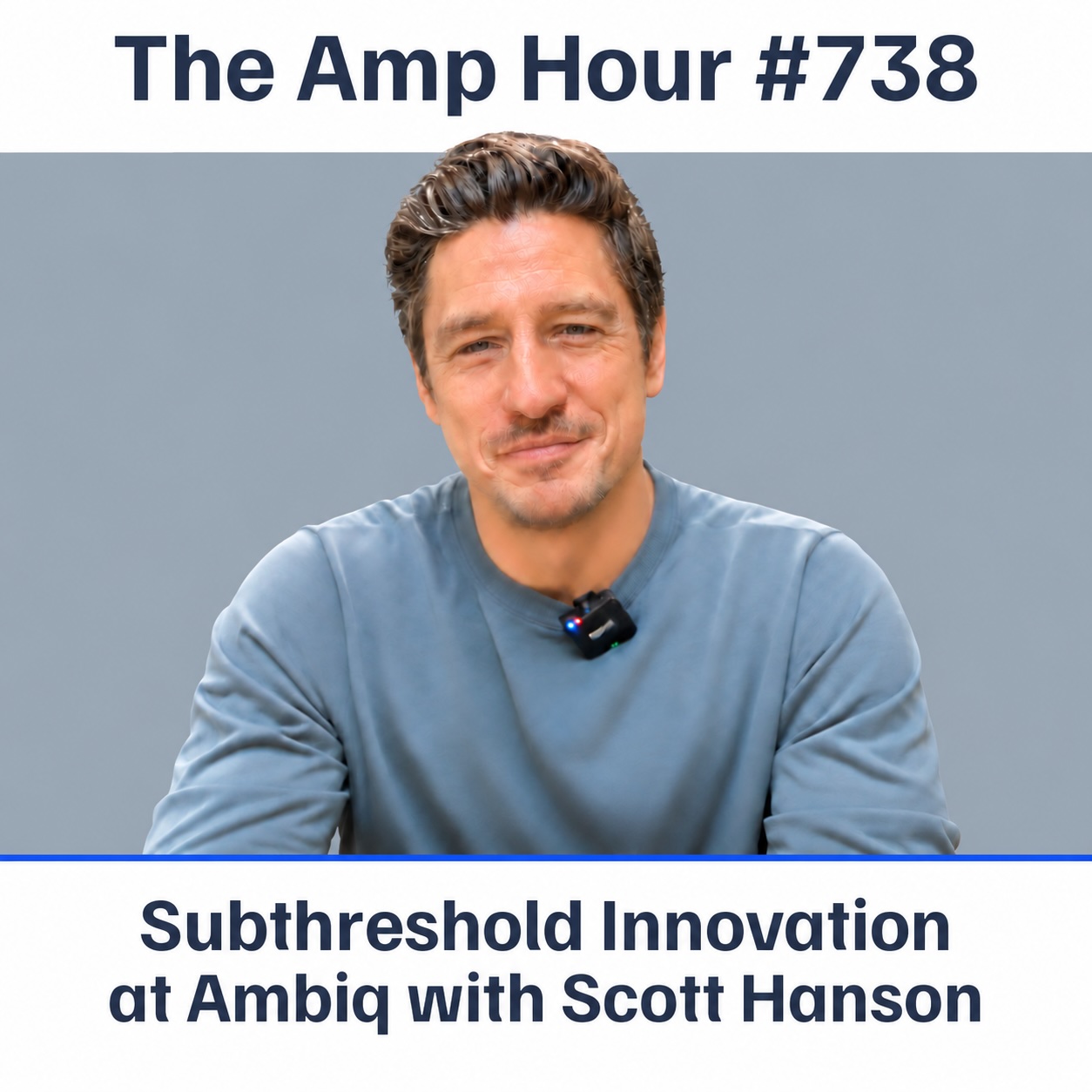
Scott HansonGast

Subthreshold Innovation at Ambiq with Scott Hanson

Scott Hanson is founder and CTO of Ambiq, a pioneer in ultra-low-power semiconductor design based in Austin, Texas. He joins Chris to discuss tech transfer from his PhD research at the University of Michigan, sub-threshold and near-threshold transistor operation, building relationships with foundries like TSMC, and how Ambiq is leveraging edge AI, neural codecs, and scalable hardware architectures to redefine energy efficiency in embedded electronics. Timeline Chris welcomes Scott Hanson, founder and CTO of Ambiq, to discuss low-power microcontroller design and the origins of Ambiq from his PhD research at the University of Michigan. (00:00:15) Scott describes the mid-2000s research into “smart dust”_building cubic-millimeter computers with integrated sensors, microcontrollers, radios, and batteries operating under nanowatt and picojoule energy constraints. (00:00:45) Chris and Scott discuss Dust Networks (spun out of UC Berkeley and later acquired by Linear Technology) and trace sub-threshold and near-threshold circuit roots back to 1970s wristwatch development. (00:01:45) Scott explains how sub-threshold design runs transistors at voltages far below standard textbook levels, serving as the foundational precursor to modern IOT and edge AI. (00:02:45) Scott contrasts university cleanroom fabbing at Michigan—where rapid shuttle runs with foundries like IBM and TSMC prioritize room-temperature prototypes—against commercial volume manufacturing. (00:03:30) Chris recalls the MEMS facility at Case Western Reserve University, noting how process node geometry scaling naturally drops operation and threshold voltages. (00:04:45) Scott breaks down how FinFET transistors provided a step-function improvement with near-ideal sub-threshold slope, allowing lower threshold and supply voltage operation despite voltage scaling saturation at advanced nodes. (00:06:00) Scott shares research results from Michigan showing experimental sub-threshold circuits operation down to 0.1V and even 65 mV under ideal laboratory conditions. (00:07:45) Scott recounts the pivotal moment riding an elevator when he decided to execute tech transfer from his PhD research into a startup rather than following traditional academic or corporate research paths. (00:08:45) Scott describes securing state and federal research grants to fund commercialization while serving a one-year postdoc to determine whether to build medical devices, IP licensing, or standalone chips. (00:10:15) Scott recalls starting Ambiq in 2010 during a venture capital low point for semiconductor startups following the 2008 financial crisis and Wi-Fi startup fatigue. (00:12:15) Scott reflects on initially pitching processors that would lag Moore’s law to save capital, before realizing that competing required keeping pace with advanced process nodes. (00:14:00) Scott explains choosing Austin for Ambiq’s headquarters due to lower operating costs and a rich local semiconductor talent pool, while Chris mentions working in Samsung’s Austin fab from 2006 to 2008. (00:15:45) Scott highlights the vast CAD tooling access (such as Cadence tools and secure ARM IP research rooms) available at universities compared to the steep licensing costs faced by early-stage startups. (00:17:45) Scott describes how EDA vendors, ARM licensing fees, and legal counsel absorb early startup funding, and how pitching TSMC required establishing executive-level relationships. (00:19:30) Scott details how taking investment from venture firm Kleiner Perkins and chairman Wen-Chi Chen helped Ambiq build a strategic partnership with TMMC. (00:21:45) Scott emphasizes that low-power startup tech must still leverage leading-edge fab manufacturing to remain competitive against rival chips. (00:23:45) Scott explains the decision to use general-purpose off-the-shelf TSMC transistors to avoid losing wafer yield and foundry capacity allocation. (00:24:45) Scott describes collaborating with TSMC to refine SPICE simulation models for ultra-low-voltage regions and adopting Low Voltage Format (LVF) for static timing analysis. (00:26:15) Scott emphasizes that sub-threshold design makes circuits exponentially sensitive to temperature, voltage, and process variation, requiring resilient chip architecture. (00:28:45) Scott takes a deep dive into transistor physics in weak inversion, explaining how diffusion current functions below threshold gate voltage. (00:31:00) Chris proposes a leaky2door frame analogy for sub-threshold leakage control, which Scott confirms accurately illustrates controlling weak conduction trickling under the gate. (00:33:00) Scott explains why 200-300 mV offers the optimal energy efficiency trade-off for sub-threshold circuits, while digital logic runs near-threshold to balance performance. (00:34:15) Scott details single-die SoC integration, explaining why edge devices like wearables must combine MCU cores, radios, ADCs, GPUs, and power management onto a single chip. (00:38:00) Scott outlines how different circuit blocks run at targeted voltage levels—against commercial volume manufacturing. (00:39:45) Scott describes managing over 50 unique power domains inside Apollo microprocessors to optimize energy efficiency across operating modes. (00:41:00) Chris and Scott discusshow sub-threshold operation shines during low-power sleep states when microcontrollers are waiting between measurement cycles. (00:42:30) Scott explains how integrating parallel Neural Processing Units (NPUs) running hundreds of multiply-accumulate (MAC) operations per cycle at 100 MHz on a 12nm node achieves high AI throughput at ultra-low voltage. (00:43:45) Scott notes that Moore’s law and edge AI workload parallelization are accelerating low-power chip architecture opportunities. (00:45:00) Scott outlines Ambiq’s broad technology platform, spanning wearables, industrial sensors, smart home devices, utility meters, and medical patches like ECG and EEE monitors. (00:46:00) Scott discusses how Ambiq’s early Apollo processors gained traction in smartwatches, fitness bands, and smart rings that adopted machine learning for heart rate and sleep monitoring a decade ago. (00:47:30) Scott discusses going public via IPO to fund product portfolio expansion and address the challenge of building scalable software, documentation, and customer support. (00:49:15) Chris and Scott discusshow chip companies have inherently evolved into software companies, exploring pricing models like higher chip margins versus software licensing and royalties. (00:51:00) Scott describes customer edge AI workloads, including industrial vibration anomaly detection, acoustic detection sensors, and conversational voice interfacturing. (00:52:30) Scott highlights the organizational friction between data science teams training models in ivory towers and firmware teams trying to execute them on hardware, emphasizing the need for simulator and profiling tools. (00:55:00) Chris and Scott discuss wireless connectivity options like Bluetooth LE, 802.15.4 (Thread), Wi-Fi, and cellular modems placed alongside the host processor, and Scott’s vision to apply SPOT low-voltage tech to radios. (00:57:30) Scott addresses Zephyr RTOS support, explaining how customer demand has made Zephyr integration a high priority for Ambiq’s SDK roadmap alongside hardware abstraction layers (HAL), board support packages (BSP), and FreeRTOS. (01:08:00) Scott reflects on startup customer dynamics, explaining how early customization for anchor clients eventually evolves into standardized platforms serving thousands of customers. (01:09:45) Scott introduces Ambiq’s CompressionKit, a software development kit enabling neural codecs for AI-driven data compression and decompression. (01:11:15) Scott explains how neural codecs adaptively compress sensor streams (audio, IMU, biometrics) by 10x to 16x, drastically reducing radio transmission power and memory storage requirements. (01:13:30) Scott clarifies how acoustic detection sensors use low-power local classifiers to trigger audio buffer recording and neural codec compression for cloud verification. (01:15:30) Scott and Chris examine event lifeloging on wearables (such as siren or speech event detection) and discuss the privacy advantages of local edge AI processing compared to cloud server processing. (01:17:15) Scott advises prospective developers to start with Ambiq evaluation kits, sensor modules, and AI coding agents to accelerate embedded C code development. (01:19:00) Scott pitches the flagship Apollo 510 processor—featuring an ARM Cortex-M55 core with Helium vector extensions, GPU, 7-8MB memory, and 250 MHz clock speed—alon`side the Apollo 5 Lite and Apollo 330. (01:21:30) Scott reveals Ambiq’s upcoming 12nm “Atomiq” processor, equipped with a high-performance NPU and expanded memory for large edge AI models. (01:23:45) Scott mentions Ambiq’s presence at upcoming events like CES and invites engineers to apply for open positions across AI, chip design, firmware, test, and sales on the Ambiq Careers page. (01:25:15)
1 h 03 minAbspielen in:

Mi7Okt
The Amp HourEP

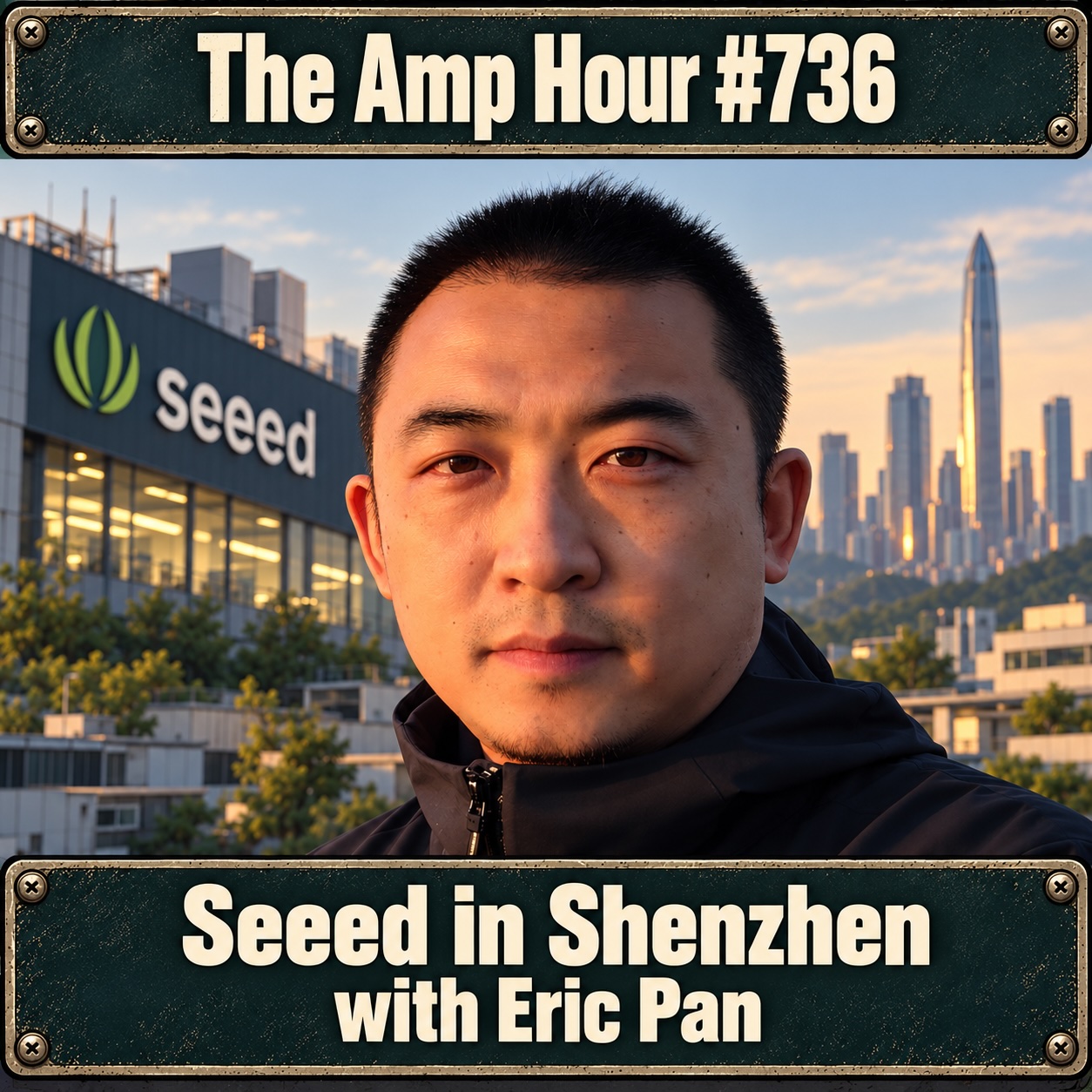
Eric PanGast

Seeed in Shenzhen with Eric Pan

Eric Pan is the founder and CEO of Seeed Studio, an open-source hardware and manufacturing platform based in Shenzhen, China. He joins Chris to discuss Seeed’s journey from early open-source roots to modern robotics, navigating the hardware ecosystem in Shenzhen, bridging the gap between semiconductor companies and developers, and how physical AI and low-cost hardware platforms are transforming innovation. Timeline Chris welcomes Eric Pan, founder and CEO of Seeed Studio, to discuss open-source hardware, the evolution of Shenzhen, and the emerging robotics ecosystem. (00:00:15) Eric recounts founding Seeed Studio in Shenzhen in 2008, starting with just two people committed to open hardware. (00:02:45) Eric discusses his background working at Intel and how Seeed’s earliest projects supported artists and interactive installations needing custom electronics. (00:05:30) Chris and Eric reminisce about the landmark 2015 Maker Faire Shenzhen and look forward to its return this December. (00:09:15) How hardware startups, suppliers, and maker spaces collaborate, share resources, and exchange talent across Shenzhen. (00:13:00) How the process of procuring components, tooling, and materials in Shenzhen has transformed over the past decade. (00:16:45) How Shenzhen’s modular electronics supply chain is pivoting to support rapid prototyping and production of robotic platforms. (00:20:30) Looking at Espressif Systems as a standout model of a domestic chip company that built a global market by championing developer communities and open-source software. (00:24:15) Why traditional semiconductor manufacturers are often hesitant to fund grassroots developer support, and the cost of neglecting community adoption. (00:27:45) How silicon vendors like Rockchip engage with open hardware ecosystems and community developers. (00:31:15) Brief audio dropout during the recording session. (00:34:45) The engineering philosophy behind creating the thumb-sized Seeed Studio XIAO microcontroller board series and packing high compute into minimal footprints. (00:35:15) Assessing the rise of “vibe coding” and how generative AI code assistants are influencing firmware development and electronics prototyping. (00:38:00) Exploring whether large language models and software automation threaten hardware platforms or act as powerful accelerators for engineers. (00:40:45) Brief recording interruption. (00:43:00) How rapid tooling and AI-assisted workflows speed up iteration cycles for physical electronics. (00:43:15) How Seeed is moving beyond board manufacturing to act as an ecosystem advisor connecting silicon vendors, factories, and developers. (00:45:15) Eric shares his perspective on viewing Shenzhen’s manufacturing hub as an open supermarket of modular resources rather than a cutthroat arena. (00:47:30) Exploring the shift from pure software models to embodied intelligence, connecting back to Chris’s conversation on Episode 732: Hands-on Physical AI with Kevin Cloutier. (00:49:45) Chris discusses purchasing the SO-101 Robot Arm Kit, which he previously mentioned in Episode 734, and how Seeed stepped in to support DIY builders who kept asking for assembly and calibration help. (00:52:00) How the open-source LeRobot framework is democratizing imitation learning, teleoperation, and robotics training. (00:54:15) Discussing the open-source Pollen Robotics Microduck bipedal robot and reinforcement learning sim-to-real pipelines. (00:56:30) Why sub-$200 open-source kits and standardized software stacks are lowering barriers to robotics education. (00:58:30) Seeed’s collaboration with NVIDIA around Jetson hardware for edge AI and robot control. (01:00:15) How Seeed serves as a vital bridge between chipmakers and global developer communities. (01:01:45) The practical realities of modern factory automation on the ground in Shenzhen. (01:03:00) Exploring the full spectrum of industrial automation—from simple fixtures and cobots all the way up to humanoid robots. (01:04:15) How the Seeed Fusion PCBA turnkey service helps hardware innovators prototype and scale production. (01:05:30)

1 h 01 minAbspielen in:

Do24Sep
The Amp HourKM

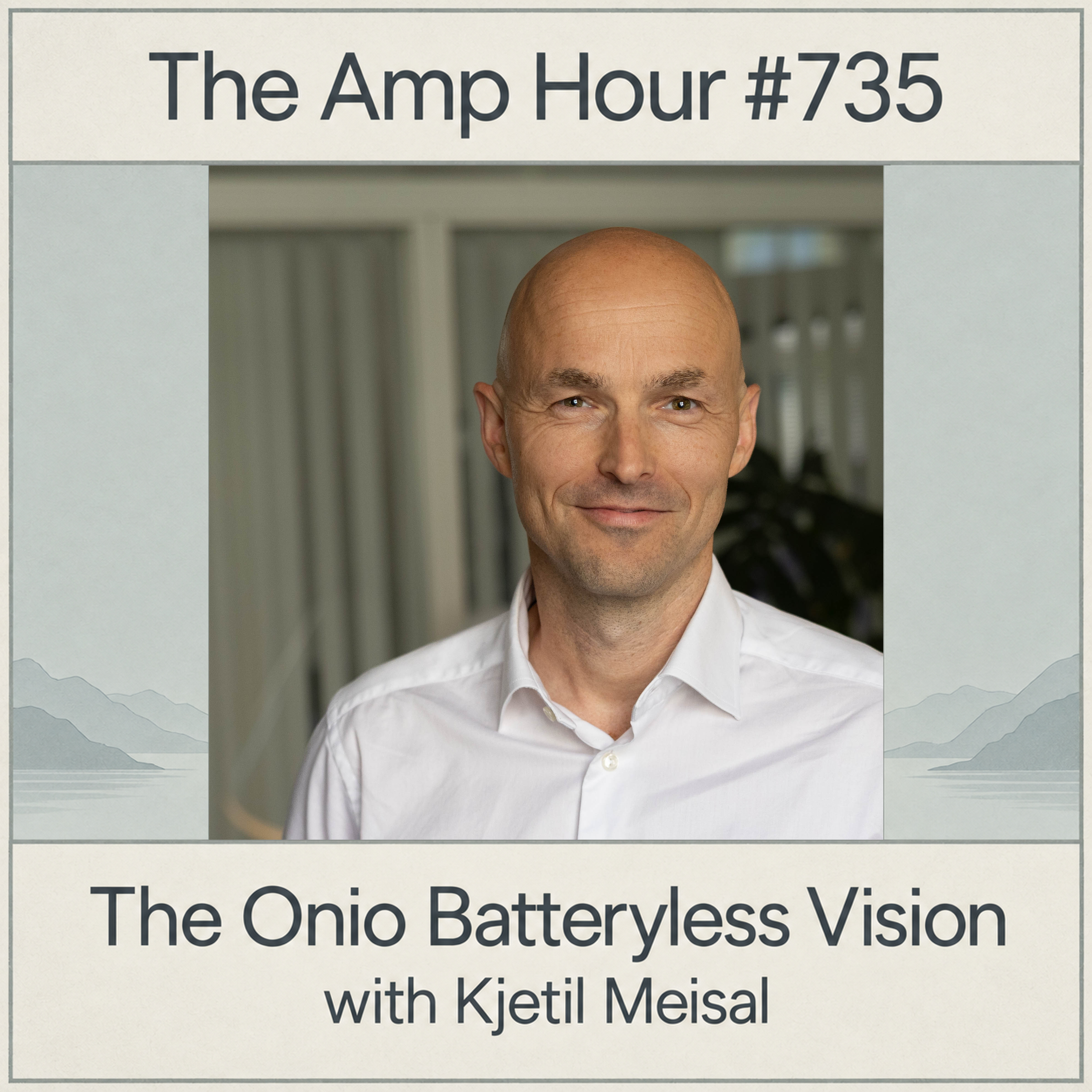
Kjetil MeisalGast

The Onio Batteryless Vision with Kjetil Meisal

Kjetil Meisal, CEO and co-founder of Norwegian semiconductor startup ONiO, joins Chris to discuss the development of ONiO.zero—a revolutionary batteryless microcontroller powered entirely by ambient energy harvesting. They dive into Norway’s rich semiconductor heritage, custom RISC-V architecture, sub-microwatt cold starts, paper-based biofuel cells with BeFC, and making “stick and forget” IoT sensors a reality. Timeline Welcome Kjetil Meisal: Chris welcomes Kjetil Meisal, CEO of ONiO, to discuss their vision for truly batteryless microchips. (00:00:15) Stick and Forget: Exploring the core dream of deployment-friendly IoT sensors that run indefinitely on harvested energy without maintenance. (00:02:15) Nordic Silicon Heritage: Kjetil highlights Norway’s deep semiconductor roots and ecosystem spanning Oslo and Trondheim. (00:05:00) Norwegian Chip Companies: A breakdown of global heavyweights built on Norwegian acquisitions, including Texas Instruments (former Chipcon), Silicon Labs (former Energy Micro), ARM Trondheim (former Faltung), Microchip (Atmel AVR team, discussed on The Amp Hour #633), Nordic Semiconductor, Novelda, and startups like ONiO. (00:07:45) The ONiO.zero Platform: Banner specs of the ONiO.zero MCU—a custom RISC-V CPU core, multi-protocol 2.4 GHz radio, power management unit, and multi-domain energy harvesting. (00:13:00) Energy Storage Options: Moving from ceramic capacitors and supercapacitors to rechargeable cells under a “batteries not required” philosophy. (00:15:45) Going Back to 2016: The origin story of ONiO with co-founders Kjetil Meisal, Runar Finanger, and Vemund Bakken exiting Novelda to solve low-power challenges. (00:19:15) From Fever Patches to Silicon: Transitioning from a single-use temperature monitoring patch concept to general-purpose ultra-low-power silicon. (00:22:15) Mature Process Nodes and In-House IP: Why ONiO chose a robust, mature silicon node and developed 100% of their IP in-house without third-party licensing. (00:25:00) Developer Mental Shift: How clock gating, powered-off blocks, and GCC-based toolchains require firmware developers to think in terms of energy scarcity. (00:27:45) Sub-Microwatt Cold Start Sequence: How the Power Management Unit harvests ambient voltage, triggers ultra-low voltage monitoring loops, and safely boots the RISC-V core. (00:30:00) Pomegranate Seed Power: Demonstrating extreme low-power operation by booting the chip and transmitting Bluetooth signals off citrus fruits, tomatoes, blueberries, and a single pomegranate seed. (00:32:30) Energy Harvesting Sources: Matching ambient indoor light, outdoor solar, Peltier thermal gradients, and RF signals with ultra-efficient silicon. (00:37:00) Managing the Energy Reservoir: Transmitting data in bursts, managing duty cycles, and running a wireless thermostat for two weeks on a supercapacitor in total darkness. (00:40:00) Custom 2.4 GHz Radio Stage: Achieving -100 dBm sensitivity at 3 mA RX and 0 dBm at 6 mA TX with custom RF integration supporting 5+ protocols. (00:42:30) Why RISC-V over ARM?: Why ARM’s licensing fees and instruction restrictions led ONiO to custom RISC-V microarchitecture tweaks, echoing open-architecture discussions on The Amp Hour #637 and The Amp Hour #687. (00:45:30) CoreMark & ULPBench Benchmarks: Breaking down ONiO’s 22 µW/MHz efficiency, 4.1 CoreMark/MHz score, and record 180.75 EEMBC ULPMark score. (00:48:30) Compute Trade-offs: Balancing clock speed vs. leakage and why continuous low-power computing outweighs raw high-performance processing in IoT. (00:52:00) On-Board TinyML and Event Processing: Using lightweight edge signal processing to transmit event triggers rather than continuous raw data streams. (00:54:30) Key Application Domains: Deploying batteryless sensors in precision agriculture, smart building infrastructure, asset tracking, and perpetual biosensing (as previously explored on The Amp Hour #733). (00:58:00) Biofuel Cells with BeFC: Partnering with French startup BeFC to combine paper-based enzymatic sugar fuel cells with ONiO silicon for compostable tracking tags and skin patches. (01:00:15) Customer Engagement & Trade Shows: Partnering with early-access customers, offering QFN packages, and appearing at IFA Berlin, Electronica, GITEX Global, and TechCrunch Disrupt. (01:01:45) Sustainable Electronics: Exploring biodegradable PCB substrates, finding ONiO at onio.com, and following their updates on LinkedIn. (01:02:45)

1 h 04 minAbspielen in:

Do10Sep
The Amp HourAK

Andy KongGast

Perpetual Wearable Biosensing with Andy Kong

Chris welcomes Andy Kong to discuss “Chargerless” and how to build ultra-low-power wearable health trackers that never need wall charging. (00:00:15) From Hacker Mindset to Startup Founder: They discuss Andy’s background in biosensing, staying with Samy Kamkar, and bringing a pragmatic “get things done” hacker mindset to founding Chargerless in San Francisco, as documented on Andy’s personal website. (00:02:10) Solving the Wearable Charging Bottleneck: Andy explains how frustration with daily Apple Watch charging led him to design a wearable requiring only one minute of daily sunlight exposure, noting that modern wearables are bottlenecked by battery volume rather than logic chip size. (00:04:30) Deliberately Underpowered MCUs: Chris and Andy explore system architecture trade-offs, focusing on Chargerless’s choice of an underpowered microcontroller paired with lean firmware rather than feature-heavy, power-hungry processors. (00:07:15) Intelligent Sampling vs. Continuous Monitoring: They contrast Whoop and Apple Watch’s continuous PPG power drain with Chargerless’s periodic sampling approach, which reserves high-frequency tracking for active workout modes. (00:09:45) The Limits of Commercial Sensor ICs: Why off-the-shelf health ICs from TI and Analog Devices consumed 100 times too much power due to unoptimized ADCs, inefficient amplifiers, and fixed pulse timings. (00:12:20) EKG vs. Wrist PPG: Explaining how multi-lead chest EKGs measure electrical heart potential vectors, whereas wrist Photoplethysmography (PPG) uses green light reflection to detect oxygenated blood volume changes. (00:15:05) Badge Life and DIY Biometrics: Chris and Andy reminisce about community hardware projects like Chaos Camp’s Card10 EKG badge, Kerry Scharfglass’s IR-synchronized dragonfly badge, and Chris’s earlobe PPG sensor that flashed LEDs inside a Solo cup based “badge”. (00:17:50) Custom Discrete PPG Frontend: How Andy replaced commercial ICs with a discrete circuit that strobes a green LED 50 times per second for microsecond bursts, cycling both the LED and transimpedance amplifier. (00:20:40) Eliminating Decoupling Lag: Stripping decoupling capacitors removed turn-on delays, while using two amplifier stages avoided high-capacitance digital potentiometers. (00:23:10) Pivoting Away from BCI: Andy describes his college research on brain-computer interfaces (BCIs) with OpenBCI and why he abandoned non-invasive EEG due to microvolt-level signal noise from cable movement. (00:25:55) Quantified Self & Personal Informatics: Discussing how self-trackers capture environmental data to identify root causes of complex health symptoms. (00:28:30) Low-Power Bluetooth Data Batching: How Bluetooth Low Energy accounts for less than 5% of overall power draw by batching 10 KB payloads every 10 minutes for fast burst transmissions to the phone. (00:31:15) Form Factors and Ring Safety: Comparing Whoop, Oura, Garmin, and Fitbit Air trackers, while covering smart ring battery constraints, Samsung battery recall testing, and degloving risks. (00:34:00) Whoop’s Slide-On Battery: How Whoop designed a slide-on battery pack to charge while being worn, avoiding the user drop-off caused when devices are taken off to charge. (00:36:45) Solar Harvesting & Laser Dicing: Chargerless uses boost converters to harvest power from amorphous solar cells, which Andy initially custom diced with laser cutters at MIT. (00:39:20) Bare-Metal Registers & 28-Hour Days: Transitioning from dev boards to custom PCBs required low-level MCU register programming, custom Makefiles, and a 28-hour daily cycle sleep study in tinfoiled rooms. (00:42:10) Pricing & Open Data Access: Chargerless is rolling out a pre-production run of a few hundred units for $199 with no subscription fees on getchargerless.com and open data export capabilities. (00:45:00) Power Over Skin (Body Channel Communication): Andy breaks down his Power over Skin research project, which sends 40–100 MHz RF power safely through human skin using the body as an antenna. (00:47:45) Microwatt Energy Harvesting: Utilizing Skyworks low-forward-drop diodes, tank circuits, and rectifiers to harvest microwatts for powering LED earrings, ring joysticks, and skin patches. (00:50:30)

1 h 06 minAbspielen in:

Mi26Aug
The Amp HourKC

Kevin CloutierGast

Hands-on Physical AI with Kevin Cloutier

Kevin Cloutier is the North American Lead for Physical AI at CapGemini, a global engineering consulting firm. He is a computer engineer who is passionate about taking complex computations to the edge. He joins Chris to discuss the transition from legacy, statically programmed factory robotics to modern, imitation-learning-based “Physical AI,” building and calibrating the affordable $200 3D-printed SO101 robot arm using the LeRobot open-source framework or Intel’s Physical AI Studio, and orchestrating complex robotic systems entirely on local edge hardware. Timeline Chris welcomes Kevin Cloutier to discuss “Physical AI” and how it relates to robots and things that move in the physical world. (00:00:15) Meeting at Embedded World: They reminisce about meeting at the Canonical booth in front of a robot demonstration, which you can see in the Embedded World Demonstration Video. (00:02:10) Trade Shows and Geography: Chris and Kevin discuss Embedded World in Nuremberg, Germany, upcoming SPS, and the high concentration of manufacturing robots in Europe compared to the US. (00:03:50) The “Unicorn Developer” Shift: Kevin talks about his background in computer engineering and how the “unicorn developer” has shifted from the full-stack web developer of the 1990s to someone who can operate, program, repair, and train physical robots. (00:06:05) Factory Robots vs. Edge Cases: Contrasting legacy, statically programmed factory robots (like ABB or Universal Robots hanging car doors) with modern generative AI approaches capable of handling real-world edge cases. (00:09:15) The Robotics Software Stack: Demystifying the layers above motor drivers, including Real-Time Operating Systems (RTOS), Linux, and message-passing frameworks like ROS (Robot Operating System) and ROS 2. (00:12:40) Orchestrating Systems of Systems: Kevin describes playing tic-tac-toe using Vision Language Action (VLA) models, where a higher-level camera and computer vision system orchestrate the coordinates for the movement model. (00:15:10) The Evolution of Compute: How modern silicon, integrated GPUs, and SOCs have allowed the massive, heavy control boxes of legacy robots to shrink down to a small NUC-sized device mounted directly on the robot. (00:18:05) The SO101 Robot Arm: Introducing the SO101 3D-printed robot arm from Hugging Face, which democratizes robotics by allowing anyone to build a leader-follower setup for around $200. (00:21:20) How “Backyard Engineers” Learn: Kevin’s advice for firmware and hardware engineers stepping into robotics: follow the documentation, get it running, and then ask questions about what you don’t know. (00:23:55) Calibration and the LeRobot Framework: A look at using the LeRobot open-source framework to calibrate hobby-grade motors and define their movement limits. (00:26:40) Recording “Episodes” via Imitation Learning: How users physically guide the leader arm to control the follower arm while a webcam records the visual and servo coordinate data. (00:28:50) Training the Model: Organizing data into short 5-episode chunks to make deletion easier, and training the model locally on NVIDIA GPUs or in the cloud. (00:31:30) From Training to Evaluation: Moving from training to evaluating the custom model, and asking questions about action chunking, model stutter, and operating frequency. (00:35:10) Sensor Fusion vs. Pure Vision: The current dominance of cameras in physical AI, and the potential to fuse accelerometers and time-of-flight sensors on mobile robots like Autonomous Mobile Robots (AMRs). (00:41:00) Real-World Calibration Challenges: Kevin shares a story of someone knocking over his camera boom at Hannover Messe and how he used April Tags to quickly recalibrate the camera’s physical coordinates. (00:43:15) The Reality of Humanoids: Debunking humanoid hype and explaining why full humanoids are further out than the public thinks, due to immense hardware cost, degrees of freedom, and safety. (00:45:50) The Puppeteer behind the Curtain: Kevin points out that many impressive humanoid demos, like the Unitree G1 at Hannover Messe, are actually being teleoperated by an engineer standing nearby. (00:48:40) The Complexity of Robot Subsystems: Using Steve Crunch and the book “Exploding the Phone” as an analogy for how modern robotic systems have become too complex for a single human to fully understand. (00:52:15) Understanding SmolVLA and SmolVLM: Diving under the hood of Vision Language Action models, which are fine-tuned transformer models that translate visual inputs into physical robotic coordinates. (00:55:10) Local AI and the NPU: How modern System-on-Chips (SOCs) let engineers run models locally on the CPU, GPU, or Neural Processing Unit (NPU) using optimization toolkits like Intel OpenVINO. (00:58:15) The Joy of the Physical World: Why working with physical hardware and robots is far more creative and rewarding than optimizing spreadsheets or SaaS applications. (01:04:30) “If the Robot Can’t Kill You, It’s Not Fun”: Kevin shares his colleague’s favorite metric for a truly exciting robotics project. (01:07:10) Advice on ROS and “Cobbling”: Starting with duct tape and bubble gum, and learning message-passing frameworks like ROS only when you need to coordinate multiple independent robots. (01:09:30) Physical AI Studio Demo: An invitation to see Kevin showcase Intel’s Physical AI Studio with multiple active robots at the upcoming AI Infra conference in Santa Clara. (01:14:45) Find Kevin online at his website cloutier.engineer or on LinkedIn. (01:20:10)

59 minAbspielen in:

Mi19Aug
The Amp HourRF

Robert FennisGast

E&M Reality Emerges with Robert Fennis

Robert Fennis is an RF engineer and consultant from the Netherlands and the creator of EMerge: a free, open-source 3D Finite Element Method (FEM) electromagnetic solver written in Python. He joins Chris to discuss demystifying the black magic of RF engineering, the mathematical and physics foundations of simulation, and how Emerge is “the IKEA of FEM solvers” in that it makes electromagnetic simulation accessible to everyone. Timeline Chris welcomes Robert Fennis, creator of EMerge, to discuss RF simulation as a way to unlock knowledge of the universe. (00:00:15) LinkedIn Shout-outs: Chris and Robert praise the amazing RF visualizations done by past guests Lukas Henkel, Sam Aldahar, and Katerina Galitskaya. (00:01:20) The Wizard School of RF: They discuss how RF engineering is often seen as a black magic wizard school of electronics, despite being normal to Robert. (00:03:10) Pyramid of Knowledge: Robert explains how learning RF and simulation is like building a pyramid step-by-step, where you have to understand waves, ports, and S-parameters rather than trying to build it all from scratch. (00:05:00) Python and LLMs: EMerge is written as a Python module but utilizes fast external libraries under the hood. They talk about how script-based engineering allows LLMs to assist by writing simulation code from existing examples on the EMerge Hub on GitHub. They draw a comparison to OpenSCAD’s parametric code-first approach in mechanical design. (00:07:30) The Big Three Full-Wave Simulation Methods: Robert explains how full-wave solvers attempt to approach exact solutions to Maxwell’s equations. (00:11:30) Finite Difference Time Domain (FDTD): A time-stepping method that operates similarly to movie physics engines, marching forward in time. (00:12:15) Method of Moments (MoM): A method solving specifically for currents and voltages on conductors, using Green’s functions to calculate interactions without discretizing the surrounding air. (00:13:40) Finite Element Method (FEM): A frequency-domain solver derived from variational calculus (the Principle of Least Action). It solves for complex electric fields in the airspace surrounding conductors, treating conductors as boundary constraints. (00:15:10) The Veritasium Switch Video: They connect the physics of FEM to the famous Veritasium switch debate, noting that energy travels outside of wires. This is why FEM solvers must discretize the surrounding airspace to capture the physics, as famously illustrated in the Veritasium switch video. (00:18:20) The Challenges of Real-World Boundaries: In FEM, boundary conditions define where the simulation ends. Choosing the right boundaries is critical because perfect electric conductors can introduce unrealistic internal resonances. (00:20:45) Simplifying vs. Overcomplicating Models: Mentor advice on simplifying models to ensure convergence. Robert warns that adding too much detail quickly exhausts RAM, which is currently expensive. (00:22:15) Frequency and Detail: A rule of thumb is that higher frequencies make small details matter more. Right-angled corners on PCB traces act as parasitic capacitors at 10 GHz, and silk screen on a 2.4 GHz patch antenna can completely de-tune it. (00:24:30) Bluetooth Antenna Design Workflow: Chris shares his fear of designing custom 2.4 GHz antennas for boards like the NRF52840. Robert outlines his step-by-step customer consultation process, evaluating orientation and directivity (omnidirectional vs. directional). (00:32:15) The Logarithmic Scale of Decibels: Squeezing S11 reflection coefficients from -20 dB to -25 dB only wins a fraction of a percent of energy. Since receivers have massive dynamic ranges, aiming for -10 dB or even -5 dB is often perfectly fine for non-critical systems. (00:36:40) The Incremental Design Method: Instead of modeling the entire system, start with the simplest geometry (e.g., a simple square patch or wire). Find the length where it resonates, and then introduce components like plastic enclosures, screws, or clips one by one to see how they shift the resonant frequency. (00:41:20) Working with Ports in EMerge: EMerge uses lump ports (numbered starting from 1) for PCBs and computes S-parameters like S11, which can be plotted on a logarithmic scale with the built-in plot_SP function. (00:44:50) Alternative EMerge Applications: (00:47:45) PCB Filters: Designing microstrip and coupled-line filters on FR4 or Rogers substrates. FR4 is risky due to variations in refractive index, making simulation validation highly valuable before spending money on expensive substrates. (00:48:10) Radar Cross-Section (RCS): Modeling how objects scatter electromagnetic waves. (Note: Large stealth bombers are computationally impractical for EMerge, but smaller models work). (00:51:30) Power Dividers: Tuning Wilkinson power dividers. (00:52:45) Crosstalk and Signal Integrity: Making sure high-speed 1 Gbps bitstreams arrive intact without degrading or leaking into other ports. You can view an example crosstalk simulation on the EMerge Showcase page. (00:53:30) Under-the-Hood Engineering and Performance: (00:55:00) Robert shares his story of spending a week straight getting 3D solver matrices to assemble and solve. (00:55:15) He highlights that 98% of the effort in building a solver is computational geometry (meshing), for which EMerge uses the GMSH library. (00:58:30) Linear algebra is solved using Intel MKL on x86 platforms (thanks to Olaf Schenk) and Apple Accelerate on macOS (thanks to Dr. Jonathan Hogg). (01:00:15) The solver assembles sparse coordinate matrices converted into compressed column storage. (01:02:00) Robert wants EMerge to be the IKEA of FEM solvers—not perfect, but free, accessible, and good enough. (01:03:50) The Nightmare of Importing PCBs: Why computational geometry makes importing PCBs incredibly difficult. (01:08:15) Gerber Files: Aperture-based photographic formats. Approximating circles with polygons can lead to tiny gaps that crash mesh engines. (01:09:45) STEP Files: They model trace thickness physically (which is unnecessary for EMerge) and cause floating-point rounding errors on round holes. (01:11:30) ODB++: Robert is using Claude/AI to help write an ODB++ parser. (01:13:00) Method Chaining and the Builder Pattern: An alternative to importing CAD files is describing geometry programmatically using a method chaining philosophy in Python (e.g., drawing traces with straight, turn_right, and skip functions). This forces the user to keep things simple, making the design additive rather than subtractive. (01:15:45) Closing Thoughts and Consulting: Robert runs a consulting business but emphasizes that the open-source software is GPLv2 and has no warranty. He prefers teaching clients how to use the software and run simulations themselves. You can connect with Robert and other RF simulation enthusiasts via the EMerge Discord community. (01:19:30) Recommended Reading List The Finite Element Method in Electromagnetics by Jian-Ming Jin (the mathematically dense Bible of FEM) Davidson’s electromagnetics textbook Computational Electromagnetics with MATLAB by Matthew M. Sadiku (an accessible textbook that can be translated to Python or Octave)

1 h 22 minAbspielen in:

Mi22Jul
The Amp HourGC

Greg CharvatGast

The Terahertz Frontier with Greg Charvat of Teradar

Welcome Greg Charvat, CTO and Co-founder of Teradar This episode was sponsored by Siemens, which is offering a 30 day trial to Xpedition for listeners of The Amp Hour. Listen to the 31 minute mark of this episode to hear the full spot, including insight from past guest of the show Shrouk El-Attar (episode 549) Chris welcomes Greg Charvat back for his record-breaking 5th appearance on the show to discuss his latest “pirate ship” venture, Teradar, and the quest for the last frontier of sensing. Reflecting on the 2018 pivot: Greg discusses how his previous work at Butterfly Network (ultrasound), Hyperfine (portable MRI), and Humatics (microlocation) centered on the “hard tech” philosophy of moving everything to silicon to lower costs and increase resolution. The “Moat” strategy: While patents are just paper, Greg argues the true defense for a startup is the 5+ years of “school of hard knocks” engineering required to perfect a sensor-on-a-chip that big companies cannot easily copy. Defining the “Last Frontier”: Terahertz (THz) sensing operates in the hundreds of gigahertz—sitting between millimeter-wave radar and visible light (LIDAR)—offering the resolution of the former with the weather-penetrating “superpower” of the latter. Overcoming “Blobbology”: Greg traces the historical march toward higher frequencies, from the 26 MHz Chain Home systems of WWII to 10 GHz imaging, explaining why Terahertz is the logical progression for high-resolution automotive sensing. The “Uncompromising” Phased Array: Unlike LIDAR which often relies on moving parts like spinning mirrors, Teradar employs a monolithic digital phased array with thousands of channels to scan the environment without mechanical failure points. Hard Science in Silicon: Solving the “difficult link budget” and atmospheric loss by designing from first-principles physics and whiteboard drawings rather than just stitching together existing IP cores. “Dropping the Needle” in the Probe Room: Greg describes the high-stakes world of testing 750 GHz chips, where “dropping a needle” (aligning a probe) requires monitoring a VNA to ensure you haven’t destroyed a fragile, expensive probe. Hiring for the “Pirate Ship”: Teradar is actively seeking “nerdy nerds” across their three tech enclaves: San Jose (IC design), Boston (software), and Connecticut (systems integration). Check out their jobs page or email Greg directly. The CEO vs. CTO Trap: Greg’s advice for technical founders: stay on the bench where you add value and hire a professional CEO to handle the “people stuff,” HR, and endless investor meetings. The Teradar Motto: “If you can see the antenna, you’re not high enough” Greg’s Reading List: Broca’s Brain by Carl Sagan and a “very dry” but fascinating thesis on the history of radio communications in the Vietnam War. Find out more at teradar.com. Remember if you’re interested in applying for positions at Teradar, you can email Greg directly!

1 h 21 minAbspielen in:

Do9Jul
The Amp HourAH

Alex HaroGast

Space Age Bluetooth with Alex Haro

Welcome Alex Haro, CEO of Hubble Chris welcomes Alex Haro, co-founder and CEO of Hubble, to discuss the ambitious task of connecting billions of Bluetooth devices directly to space The “banner level spec”: Hubble enables any off-the-shelf Bluetooth chip to communicate with low Earth orbit satellites using a software-only firmware update Alex describes the system as a global “Find My” for enterprise that also handles sensor readings and arbitrary data Addressing the “Bluetooth in space” skepticism: Alex explains that while the standard is optimized for high-fidelity audio, the chips can be repurposed to emit a custom software-defined waveform in the 2.4 GHz band The true innovation is on the satellite side: massive antenna arrays with thousands of elements perform advanced digital beamforming to pick up weak signals (0-20 dBm) from hundreds of kilometers away The “Dinner Table Analogy”: Traditional networks “yell” to be heard, but Hubble has the device talk slower (lower bit rate) and enunciate (error correction) while the satellite uses thousands of “microphones” to isolate a single voice Why Bluetooth instead of LoRa? Hubble co-founder and CTO of Ben Wild, is the architect of Amazon Sidewalk. He chose Bluetooth because it is globally ubiquitous and the 2.4 GHz band is unlicensed worldwide Technical trade-off: While LoRa uses spread spectrum chirps, 2.4 GHz allows for much smaller antenna arrays on the satellites compared to the 900 MHz band The hybrid network approach: Devices use the same SDK to communicate via a crowdsourced terrestrial network (apps and gateways) or directly to satellites when out of range Constellation roadmap: Hubble currently has four production satellites in orbit (covering the globe twice daily) and aims for 64 satellites by 2029 for continuous real-time coverage Removing the GPS chip: By using Angle of Arrival (AoA) on the satellite, Hubble can determine a device’s location to within tens of meters, reducing BOM costs and power consumption Future “Reverse GPS”: Once multiple satellites are overhead, Hubble can combine AoA with Time of Flight (ToF) measurements for even higher accuracy Network capacity: Each 10km satellite beam can handle roughly 100,000 simultaneous devices before hitting saturation, with terrestrial gateways offloading density in major metros Dealing with the “grumpy engineer”: Alex discusses lowering friction for developers by investing in the Zephyr Project and partnering with Texas Instruments to pre-flash the Hubble stack on Bluetooth SOCs Stack coexistence: The Hubble SDK allows the radio to time-slice, maintaining a standard Bluetooth connection to a phone while sending satellite packets during idle periods Payload specs: Data packets are 13 bytes, transmitted at 400 bits per second Business model: Pricing starts around $2 per device per month and scales down with volume to hit the “price elasticity” needed for tracking billions of assets Enterprise use cases: From tracking shipping pallets to monitor loss, to cold chain monitoring for pharmaceuticals and agriculture The SpaceX experience: Alex describes the “visceral” feeling of the double sonic booms from the Falcon 9 landing during their launch party Find out more at hubble.com (or hub of BLE)

1 h 07 minAbspielen in:

Mi17Jun
The Amp HourMB

Massimo BanziGast

Arduino's Invisible Touch with Massimo Banzi

Welcome, Massimo Banzi of SuperModerno and co-founder of Arduino Introduction and SuperModerno: Massimo introduces himself as a "friendly nerd" and discusses his new project, SuperModerno The project aims to explain the "behind the scenes" of technology to prevent people from becoming "slaves to the platform" The History of Technology: Massimo expresses his passion for technology's history, emphasizing non-American innovators to show Europeans they can also lead in technology, citing the UK-based origins of the Arm processor The Legacy of Olivetti: He highlights Olivetti (founded in 1908), which moved from typewriters to creating the Programma 101, the first desktop computer used by NASA to compute orbits for the Apollo program Design as a Differentiator: Olivetti was the first tech company to apply design to everything (products, posters, and architecture) This inspired Massimo’s concept of the "invisible touch", the idea that consistent, intentional design creates a unique connection with users and gives a company a competitive edge The Interaction Design Institute Ivrea (IDII): Massimo's path led him to IDII, located in the former Olivetti research building, where he transitioned from a two-week sabbatical to a four-year stay Learning by Making: To help students with no electronics background, Massimo drew on how he learned as a seven-year-old ("learning by making") to remove the friction of interacting with technology The Founding Team: He met Tom Igoe (ITP) and David Cuartielles, and they realized students were afraid to be creative because they feared "blowing up" expensive tools like the Basic Stamp The "Pizza and a Beer" Price Point: Massimo aimed for a hardware cost of 20 Euros, roughly what a student would spend on a pizza and a beer, to encourage experimentation Building the Platform: Along with David Mellis, the team adapted Processing (a language for artists) by "surgically" replacing Java with C++ to create the Arduino IDE Ivrea Manufacturing: Leveraging the industrial base of Ivrea and Torino (the "Detroit of Italy"), Massimo was able to find local PCB manufacturers and assemblers just a short drive away From Hacking to AVR: Massimo’s early work involved hacking satellite TV PIC chips for soccer fans, but mentor Bill Verplank encouraged him to use AVR microcontrollers because they could be programmed simply in C Enabling Creators: Massimo shares stories of how Arduino enabled others, such as Josef Prusa, who started with Arduino as a teenager before building his global open-source 3D printer company The Innovation of Simplicity: Massimo argues that Arduino's true innovation is the user experience This is measured by the "Time to First Blink", the goal for a user to go from downloading software to blinking an LED in five minutes Standardization and "The Core": Arduino became an ad-hoc standard by providing a compatibility layer across different microcontrollers Massimo believes in having a "small slice of a really large pie" by allowing other architectures to work within the ecosystem Hardware Architecture and the "Lasagna": Inspired by the PC104 format, the board uses a layered approach where modules stack like a lasagna The "Shield of a King": The name Arduino comes from King Arduino of Ivrea; David Cuartielles suggested that since the board was named after a king, the add-on modules should be called "Shields" Hardware Design Choices: The board fits a credit card size (to stay within the free version of Eagle software) and is blue because that color was thought to be less tiring for workers' eyes Happy Accidents: The unique shape was chosen to be "ourselves instead of everyone else" During the design process, Massimo inadvertently moved a connector by half a step, creating an offset header that they kept for consistency after the first few thousand were made The Discovery of Auto-Reset: During a workshop in Germany, Massimo solved the frustration of manual resets by soldering a capacitor to the DTR pin, allowing the software to trigger the reset automatically The US Market and Legal Battles: Tom Igoe’s adoption of Arduino at NYU helped the US become the project's single biggest market This growth led to a difficult legal battle for control of the brand against a former partner Support from Arm: Massimo credits Arm Ltd (and CEO Simon Segars) for providing the strategic support that allowed the founders to regain control of the company. Massimo believes this is the first time he has talked about the role of Arm in the difficult legal process. Industrial and AI Expansion: Partnerships with Intel and Microsoft (Windows 10 IoT) led to early forays into TinyML (AI on small boards) back in 2017 The Qualcomm Acquisition: In October 2025, Qualcomm acquired Arduino, which Massimo sees as essential for bringing "advanced silicon" into the family to handle the increasing complexity of technology The "Arduino Formula" and Layering: Massimo views Arduino as a formula for simplification that can be applied to anything, including complex Linux machines like the Uno Q This is achieved by building in layers, where beginners use high-level abstractions and experts can "strip away" layers to reach the bare metal The Future Vision: Massimo looks forward to the "Arduino Formula" being applied to new fields, stating he is waiting for someone to develop an "Arduino for biology" using CRISPR and DNA technology

1 h 11 minAbspielen in:

Do4Jun
The Amp HourMZ

Michał ZalewskiGast

The Secret Life of Circuits with lcamtuf / Michał Zalewski

Welcome Michał Zalewski, AKA lcamtuf! The lcamtuf Substack is where Michał is writing most these days Chris first found and geeked out about the CNC guide on the lcamtuf original site (discussed many times here) Michał is interested in the craft of teaching electronics He recently published The Secret Life of Circuits with No Starch Press Use the code AMPHOUR26 for 30% off The Secret Life of Circuits valid from June 1st through June 30th It was announced on his blog here Deriving fomulas from basic trigonometry sometimes bugs people who think electronics should only work with calculus Software geeks follow the site, often getting lots of attention on Hacker News Row hammer DRAM There were no Information Security degrees in the early days, so the field was made up of folks with backgrounds in math and EEs Fuzzing for security SMBC cartoon for blming humans Books American Fuzzy Lop The Tangled Web P0f v3 Silence on the Wire Security stuff (including books on the subject) ages over time, as opposed to electronics On the subjects of Calculators (and Michał's collection) Calculators are a footnote in the history of computing, but still intriguing Dead ends in calculators CRT displays on calculators Nixie tubes Discrete moving into logic gates into processors Mechanical calculators are rare and get a high price online Working with transistors The Secret Life of Circuits start with FET based transistors vs BJT BJTs are often right after diode chapter because of the multiple junctions in an NPN, but that doesn't make it easier to understand Projects A recent project involved making a clock out of current meters  Woodworking and AI example Want to see all lcamtuf articles in one place? Sokoban Sir box-a-lot

60 minAbspielen in:

Do7Mai
The Amp HourJK

Jason KridnerGast

BeagleBoard's Back with Jason Kridner

Welcome back, Jason Kridner! Jason has previously been on the show Episode 59 (!) Episode 378 alongside Robert Nelson The BeagleY AI was the first board that mimic'ed the RPi form factor PocketBeagle 2 is still a small altoid tin form factor with a new processor The Zepto is a new product targeting a $1 price point for microcontrollers Many boards in the Beagle catalog now run Zephyr, and BeagleBoard.org recently joined The Zephyr Project as members and contributors Click Brand is the official bards from MikroElectronika that implement the open source Mikrobus Chris started using Mikrobus while designing early prototypes of the BeagleConnect Freedom The Freedom board talks over wireless to boards like the BeaglePlay Application spaces for different boards FPGA based board Cheeseburger robot? Well yes, but also Cheeseburger robot Mitchells vs the machine Krazam Click boarfds now have eeprom / ClickID as a 1-wire identifier with a uuid Beagleplay has 802.15.4 Project ARA popularized the idea of Greybus MotoMods from Motorola was another implementation that worked on the Moto Z Using Freedom for prototyping WebAssembly ...on microcontrollers? Jason says he doesn't really like MCUboot Entering the linux ecosystem bb-imager Techlab is a way to easily extend peripherals for the PocketBeagle Known working targets Michael Welling designed the baconbits mini cape as a learning platform The BeagleBadge is a new formfactor shown in the title image for this episode. It runs on a new low cost TI part running Linux and yes... it runs Doom The Badge can also talk on Meshtastic Working with the memory shortage Bao - Bunie and Xobs Bella / Gem Beagle5fire RISC V boards RV32 Claire Find Beagle and Jason online Schedule a meeting with Jason There is also a Discord And a Zulip instance You can get Beagle merch

1 h 11 minAbspielen in:

Do23Apr
The Amp HourLB

Luke BenoMatt LibertyGast

AI Tooling with Matt Liberty and Luke Beno

Welcome back Matt Liberty (Joulescope) and Luke Beno (Werewolf.us) Matt has been a guest on episodes 527 and 607 Luke was a guest on episode 272 Luke launched a new cable manufacturing and power supply company in the US called Werewolf.us Matt is working on the JS320 We discussed how PartsBox is a great ERP solution but Matt and Luke decided to go fully custom with Claude Code. Jan Rychter was a guest on episode 542 We discussed the differences with Product Lifecycle Maintenance. Michael Corr of the recently acquired Duro Labs was on episode 577 CAM workflow A fully verticalized PCB factory is something Jonathan Hirschmann talked about on episode 299 Jeff Bezos is investing 100B in a fund that is looking at automation in the factory using AI Matt recently had success with Claude Code and verilog programming Saleae for hardware in the loop using their APIs Other tools to check out pyelf pdfdk blast superpowers skill (by past guest at Teardown Jesse Vincent) Luke used OpenClaw to power a chat agent in his ERP system Working with distributors TI backlog Chris recently learned that Digikey has a developer API Cocotb verification framework (in Python) Luke is working on vision experiments for inhouse developed AOI solutions

1 h 10 minAbspielen in:

Do9Apr
The Amp HourJD

Julia DesmazesGast

Chip Design for Fun (and Waffles) with Julia Desmazes

Welcome Julia Desmazes of Tales on The Wire Follow along with the blog post we discuss Two Weeks Until Tapeout Matt Venn - TinyTapeout - Episode 616 and 672 Andreas Olofsson - openroad/openlane - Episode 254 and 650 Tim Ansell - Wafer.space - Episode 375, 501, and 703 JTAG How do you know that tooling is or isn't working? Accelerator Rabbithole with floating point (post updated after recording) BFloat16 Follow Julia on GitHubhttps://github.com/Essenceia Kapla (official website, not the much cheaper alibaba version): Dimity Grinberg personal blog

60 minAbspielen in:

Fr20Mär
The Amp HourAL

Alex LidowGast

Inventing the Power MOSFET with Alex Lidow

Alex is founder and CEO of Efficient Power Conversion, a leading manufacturer of GaN MOSFET’s. Alex is also the inventor of the original Power MOSFET and HEXFET at International Rectifier. Also, former CEO of International Rectifier (founded by his father!), https://epc-co.com We cover everything from inventing the power MOSFET on his first day on the job to silicon physics, AI data centres and humanoid robots. Enjoy.

1 h 06 minAbspielen in:

Mi11Mär
The Amp HourZP

Zachariah PetersonGast

Layout Review with Zachariah Peterson

Welcome Zachariah Peterson of Northwest Engineering Solutions! Zach listed the various places people can find his work, including The Altium YouTube channel Zach's YouTube channel His personal technical blog The Altium Blog various industry conferences like PCB West 01:10 Zach mentions that he has been creating video content and seminars for several years, traveling to places like Denmark to teach high-speed design. 01:10 They discuss the recent acquisition of Altium by Renesas and how the company is trying to balance enterprise features with the needs of individual users. 03:15 He notes that the pricing for professional design software has recently become more accessible for freelancers and consultants. 11:15 He suggests that learning the fundamentals of EMC is one of the best ways for an engineer to become more valuable in the industry. 14:00 He warns against relying solely on semiconductor data sheets for EMC guidance because they often contain outdated or incorrect information. 18:45 They talk about the massive costs and delays that happen when a product fails its initial testing runs in a lab. 21:00 Zach shares how his background in applied physics and lasers made it easier for him to transition into high-speed RF and digital design. 25:15 He explains that he relies on mental models and specialized software tools more than solving complex equations by hand on a daily basis. 27:00 He stresses the importance of understanding the physical manufacturing process, such as how circuit boards are pressed and laminated. 30:00 They discuss the common problem of engineers over-specifying expensive materials when a cheaper option would work perfectly fine. 32:45 Zach predicts that the most useful AI tools will eventually be built directly into existing PCB design software rather than living in separate browser tabs. 35:30 He shares how he uses AI to quickly find generic part numbers, which saves him a lot of tedious manual searching. 42:00 He compares different AI design tools, noting that some generate schematics from data sheets while others use proven building blocks. 46:30 He describes an internal tool he is building to help him search through and reuse circuitry from his own past projects. 49:30 He admits he isn't a fan of code-based schematics because he prefers graphical tools and doesn't consider himself a professional coder. 51:00 He tells the story of how his popular one-minute design reviews started as a spontaneous way to manage the many requests he receives on LinkedIn. 54:00 He points out that many designers fail to use their software's built-in design rule checks, leading to thousands of avoidable errors. 58:45 They talk about the decline of mentorship in the industry and the risk of companies losing important tribal knowledge as senior engineers retire. 61:15 Zach shares his goals for the coming year, including a deeper focus on manufacturing nuances and advanced EMC testing standards. 66:00 He encourages engineers of all levels to attend industry conferences like PCB West and DesignCon to learn directly from experts. 70:00 They conclude the episode by sharing where listeners can find more of his technical articles and videos online. 1:02:30

1 h 01 minAbspielen in:

Do26Feb
The Amp HourDR

David RayGast

Electronics Manufacturing History with David Ray

Thanks to our sponsor for this episode, SeaSats! Check out their open positions making autonomous ocean vehicles. Welcome David Ray of Cyber City Circuits • The “Retro Electro” Series: David explains his passion for writing historical articles for Digi Key, focusing on “giants” like Orstead whose contributions to electricity are often overlooked. • Career Background: David details his path from Marine Corps radio repair to cash register and Motorola radio repair. • Starting the Business: In late 2019, David cashed in his retirement to buy pick-and-place machines and start his own factory. • Teaching the First Lady: David recounts the story of teaching First Lady Jill Biden how to solder during a summer camp. • Growth via Twitter: For the first few years, 95% of his revenue came from relationships built on Twitter (X). • The Kit Business: David discusses his “Soldering Kit of the Month” program, noting that while fun, the kit business is exhausting and low-margin. • Equipment & Machines: A discussion on why he uses Charm High machines and his strong advice to buy new equipment rather than used industrial machines, which are often sold because they are “used up”. • Stencils & Paste: David advocates for framed stencils and GC10 solder paste, which is shelf-stable and prevents cold solder joints. • Soldering Physics: Insights into the thermodynamics of soldering, especially the difficulty of working with 2 oz copper boards. • John Fluke History: David previews his research on John Fluke, explaining that Fluke meters became yellow because the Navy had trouble finding gray ones on the ground. • Upcoming Articles: David mentions future work on the history of Op-amps and strain gauges. • Business Services: Overview of Cyber City Circuits’ services, including reverse engineering, obsolescence engineering, and free DFM (Design for Manufacturing) consulting. • Success Philosophy: David shares his “Monopoly mindset,” viewing business setbacks as “chance cards,” and stresses that persistence is the only way to avoid failure. Links from David Website List: Cyber City Circuits Website: www.CyberCityCircuits.com PCB Event Badges: www.BadgesBadgesBadges.com X: www.x.com/MakeAugusta Collection of Retro Electro Articles: https://cybercitycircuits.com/retro-electro-the-little-told-history-of-electronics/ Digikey Magazine: https://www.digikey.com/en/emedia GC10 Solder Paste: www.BuyGC10.com

1 h 03 minAbspielen in:

Di10Feb
The Amp HourEM

Eric MigicovskyGast

Shiny New Pebble with Eric Migicovsky

Welcome Eric Migicovsky of Pebble! Pebble is back after Eric worked with Google to open source PebbleOS and he reaquired the naming rights Eric returns to the hardware space after 7 years, including working at yCombinator, a famous accelerator for early stage startups, and on Beeper, a cross platform app for messaging. While discussing the difficulties of hardware project, Chris brought up a recent post about a high wattage lamp project HN One thing Eric likes about hardware projects vs software is that "hardware projects can be done" as in they have a defined end state A more recent project is a smart ring - The Index 01. The non-replaceable battery is driven by the product specs, also the need for reliability The ring doesn't immediately need to be in range of a phone, it syncs the memory after the fact Pebble is no longer a VC backed startup with a subscription model, so that changes a lot of constraints Initially they sold 2 million watches, and 250 million in sales Eric is driven by "gadgets". He read "pen computing" and "popular mechanics" as a kid Consumer companies vs other types (and why Eric likes the former) Pebble went through different phases The team spent 6 months in China, designing the first consumer version and working directly with factories CTO of (original) Pebble, Andrew Witte, was a somewhat early guest of The Amp Hour How much did the China ecosystem drive design decisions? There was no such thing as a smartwatch factory (but are there ever now!) The book Apple in China is supposed to be a great read and mirrors the Pebble Experience We heard from Chrissy Meyer when she was on the show about working with the Apple Watch manufacturing proces Water proof methods codeveloping in China It's an interative process of submerging designs in a glass vessel with pressure and bubbles seep out of the device at different points The remedy? According to Eric: "More Glue" :-D Eric shares his process on a YouTube channel called Tick Talk (not to be confused with the shortform video site) There is a video with the CEO of SiFli, makers of the Bluetooth chip that is in the most recent Pebble devices One interesting feature is a custom bus to the Sharp-made ePaper-like screen used onboard FreeRTOS pebble OS What is PebbleOS? It's targeted at an m33 class ARM chip and the kernel is FreeRTOS The bluetooth stack is nimBLE Eric went back and forth on whether to port to Zephyr for the Bluetooth stack and hw support from vendors like Nordic Semiconductor The Index 01 ring is Dialog Semiconductor (now part of Renesas) part One challenge is that rings have different sizes...so they mill the rings based on orders. The larger rings get an extra battery!

59 minAbspielen in:

Di3Feb
The Amp HourMR

Martin RoweGast

The Measurement Blues with Martin Rowe

Welcome Martin Rowe of EE World! Martin is a long time journalist in the electronics space, having worked at magazines like EDN, Test and Measurement World, EE World, and more! Kenneth Wyatt Concentrated vs diffuse information Product reviews Unitrend scope video Tek 5 series B Wirecutter for test equipment / parts Skepticism Webinars - 3 levels Martin has an HP34401A early model Touring T&M companies Littelfuse Martin is in the Boston area Boxborough has multiple EMI labs Article on building an anechoic chamber PCB East was in Boxborough now in Worcester ("Wuh - Stah" :-D ) International Microwave Symposium (IMS) inBoston this year What is driving the Boston ecosystem? NYU wireless 6G summit Components trickling down into the other parts of the industry Ted Rappaport from NYU writing a paper Open RAN 5G standalone vs nonstandalone Poster session ISAC Test equipment has to test everything leading edge 3GPP The impacts of satellite connectivity IoT still talking about LTE 5G modems and battery life Private networks Automation software The Measurement Blues song, among others Find him online Martin Rowe on LinkedIn EEworldonline Martin sent over some links related the things we discussed during the episode 6G discussions: How things have changed. We assembled a timeline of the topics so you can see what's come and gone Nokia Bell Labs’ Peter Vetter talks 6G research Live from the Brooklyn 6G Summitd Teardown: HP 8112A pulse generator - I bought this at a flea market. MIT holds these once a month April through October. I go every year to buy things for teardowns and to take photos. DSL router uses parts from old phones - Heard about this from a European telecom newsletter and just had to get the details The slide keyboard is back, in a 5G phone - Video interview from 2020. I mentioned the Psion Organizer. The designer of this phone used to work for Psion. He designs beautiful products. Tryout: two low-cost USB inline meters and a load - My latest. This was the one where the audio in the videos seemed overdubbed. I uploaded the videos again using different file names. Seems OK now.

1 h 17 minAbspielen in:

Di20Jan
The Amp HourAM

Aaed MusaGast

Robots Everywhere with Aaed Musa

Welcome Aaed Musa! Aaed is a YouTuber who builds a variety of robots and a mechanical engineering student at Purdue. He just completed his undergrad degree and is now working on his Master's degree. I believe he is the first Amp Hour guest who is still a full time student. His channel has a great variety of builds including designing all the way down to gearboxes. Aaed says the MIT "mini cheetah" launched many low(er) costs builds of robots, including his own. Boston Dynamics (and many others) announced their new ATLAS robotics platform at CES this year. FOC motor controller Backlash is a measure of how much movement you have between the teeth of gears (and thus how accurate you can be with open loop control) Ball bearing balancing robot Inverse kinematics Past guest of the show James Bruton was a model for the builds that Aaed does what does the glue look like His recent build uses...rope...to build a robot dog? A Capstan drive has virtually zero backlash "relatively new rope" DM20 High precision speed reducer using rope the impacts of materials on design processes Juicero Relationship with classmates and professors as a YouTuber Purdue Engineering Aaed picked up electronics from youtube What's his take on LLMs? Making next CARA open source New video recently came out about a spinning top bulk of the cost is in the motors and motor controllers growing up in the age of youtubers

59 minAbspielen in:

Mo22Dez 25
The Amp HourMP

Mark PalmeriGast

Medical Electronics Education with Mark Palmeri

Welcome Dr Mark Palmeri, professor at Duke University! Mark has been at Duke since 1996, and has completed undergraduate, graduate, medical, and PhD degrees here (!) He has focused on making medical devices and now teaches others to do the same in his Biomedical Engineering (BME) courses Verification and Validation (v&v) is a large constraint in getting a regulated medical device to market BME design fellows is a program that guides students towards real world use cases and design projects The courses that Mark runs reminds Chris of "automatic job offers" that Chris has heard about for classes like those taught by former guest Larry Sears (at CWRU). Also SMPS design courses at UT Dallas and microarchitecture courses like those taught at University of Michigan. Teaching the skills of troubleshooting / debug Putting together circuits like Legos There are difficulties when teaching students with various levels of experience, namely how deep to go on any particular subject and how much background to provide. Mark has been flipping a circuit course on its head, instead prompting students with ideas like "how do you capture bio signals electronically and pull them into a microcontroller" Tools of the trade for Mark's courses include KiCad ngspice (built in to KiCad) Jupyter notebooks VS code Git Zephyr Talking about power as an intuition builder, as opposed to currents or voltages V&V requires that you have a quality management system (QMS) IEC60601 Going through companies that have  QMS can be a shorter path for bringing a device to market Even face shields needed to go through that process when COVID hit Firmware and embedded in BME at graduate level Mark and students in BME Design Fellows course have been working on a Tympanometer, targeted at resource constrained industries Mark also teaches students how to use Zephyr, as opposed to how most educational programs migrate towards arduino A challenge for teaching Zephyr is the devicetreed They target Nordic Semiconductor parts, which have great support and educational resources Mark experienced a "vertical learning curve" when first migrating designs to Zephyr a few years ago Complicating things is that most students haven't coded in C, if they have done much code at all Teaching how to lock to a particular version with Zephyr manifests Using CI/CD for automated builds Focusing on state machines early on, using Zephyr's state machine framework (SMF) All of Mark's courses are on github under his username mlp6 Teaching stack vs heap Mark only ever has taken one official progrmming course The benefits of experiential learning Accreditation is a constant challenge with non-standard courses and testing Duke is taking retrospective and prospective looks at the space of education Problem sets are moot these days Mark gave a great example about teaching a student about Bode Plots "Thats a trick problem" is something Mark hears wrt testing (when it's definitely not) "Getting the reps in" is an important concept in educational contexts, and something Chris really resonates with Building open ended problems vs closed The more open ended a problem, the more time it take to grade / evaluate TI-85 / 83 / 92 calculators Jupyter notebooks as a way to track progress and have students show their work More about the tympanometer project They have been working with Duke hospital, a major benefit for Mark and his BME colleagues Continuous middle ear infection that causes scarring that causes lifelong loss Sound reflection under vacuum is an indicator that more testing is needed The key innovation is making it lower cost and allow a layperson to do the screening to hand off a child to get more screening at a pro clinic BME Design Fellow students getting to design the various parts of the design They have multiple sources of funding: private, nih, etc Value engineering in medical space Mark points out the philosophical question on whether you can reduce costs by reducing testing ... but thinking about whyat that takes to satisfy that need Find Mark online mlp6 on Github His Duke homepage tymp project article Find him on LinkedIn Duke BME design fellows / on LinkedIn

1 h 30 minAbspielen in:

Gäste, die länger als 12 Monate zurückliegen, gibt es mit Pro. Pläne ansehen