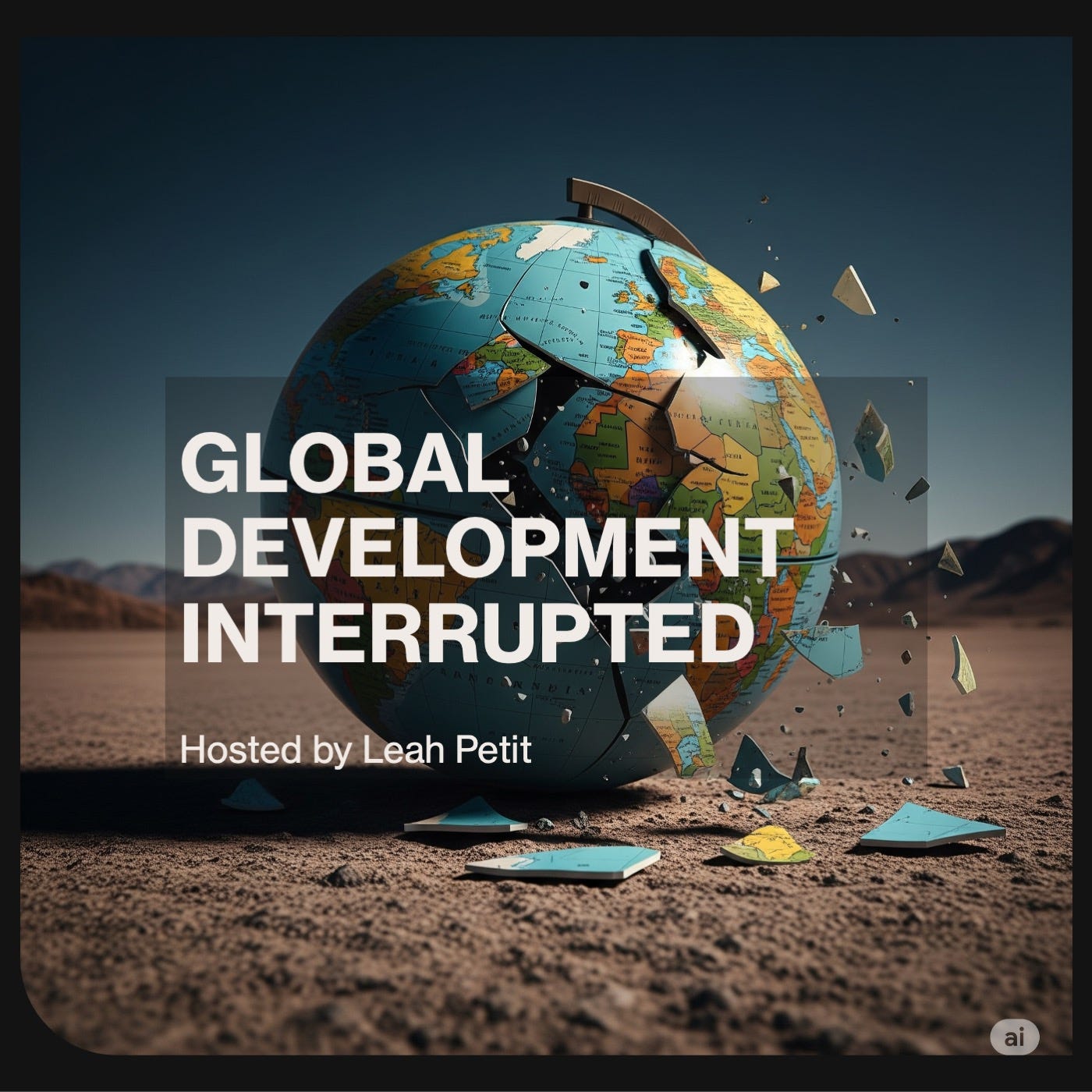
Global Development Interrupted Podcast cover
Podcast

Global Development Interrupted Podcast

von The People, the Work, and What Was Lost When America Stepped Back

Global Development Interrupted Podcast hatte in den letzten 12 Monaten 14 bestätigte Gäste in 12 Folgen. Zuletzt: Eric Pelofsky, 19. Nov. 2026.

Website der SendungApple PodcastsSo werden Gäste bestätigt

Global Development Interrupted creates space for voices, perspectives, and critical reflection on global development. By amplifying the experiences of people who have built their careers in public service and global work, it invites learning, dialogue, and reimagining of what global development is, was, and could be…

Gäste der Sendung

Do19Nov
Global Development Interrupted PodcastEP

Eric PelofskyGast

The World Isn’t Waiting for America.

When the United States stepped back from foreign assistance and diplomacy in 2025, it raised questions about America’s role in the world. A new global survey captures a striking finding: people still want countries to work together, but many aren’t sure they want America leading the way. In this episode, I talk with Eric Pelofsky, vice president of international policy at the Rockefeller Foundation, about Seeking Security and Opportunity in a Stormy World, the foundation’s survey of more than 35,000 people across 34 countries. The findings are hard to ignore. Only 39% of people surveyed are comfortable with the U.S. playing a leading role in world affairs, nearly even with China at 37%. In 22 of 32 countries, more people see the U.S. as a major threat than China, including 14 of 16 developing economies. And 61% would support a coalition of countries tackling global problems without either one. This Substack is reader-supported. To receive new posts and support my work, consider becoming a free or paid subscriber. What would it take for the United States to reestablish itself as a reliable global partner? The work starts at home. The new bipartisan Commission on the Future of Foreign Assistance, convened by the Rockefeller Foundation, the Packard Foundation and other partners, is aiming its recommendations at the broader American political conversation, not just lawmakers. Its goal is not simply to restore what existed before, but to help shape an effective, accountable and widely supported system for delivering U.S. assistance around the world, one that strengthens national security. Eric also argues that American moral leadership goes well beyond humanitarian aid. It’s about being a reliable ally in the face of autocracy, showing up for the people we defend and helping governments strengthen their capacity to serve their citizens. People around the world still believe in international cooperation. But they are prepared to move forward without the United States. If America wants to help shape what comes next, it will have to reengage, show up consistently and work with other countries as partners. Guest: Eric Pelofsky, vice president of international policy, the Rockefeller Foundation Topics: Global public opinion, U.S. global leadership, international partnerships, foreign assistance cuts, diplomacy, American moral leadership, the Commission on the Future of Foreign Assistance, bipartisanship Learn more: * Read the survey: Seeking Security and Opportunity in a Stormy World: A 34-Country Survey (conducted by Focaldata for the Rockefeller Foundation) * About the commission: Commission on the Future of Foreign Assistance * Share your ideas with the commission: smartideas@coffa.org * Rockefeller Foundation and Echelon Insights survey on U.S. views of foreign assistance: An American Perspective on Foreign Aid Listen, Watch, Follow Listen & Watch on: Apple Podcasts | Spotify | Youtube Follow on: Instagram: @globaldevinterrupted | Facebook: Global Development Interrupted This Substack is reader-supported. To receive new posts and support my work, consider becoming a free or paid subscriber. This is a public episode. If you'd like to discuss this with other subscribers or get access to bonus episodes, visit globaldevinterrupted.substack.com/subscribe
41 minAbspielen in:

Do22Okt
Global Development Interrupted PodcastSP

Samantha PowerGast

Samantha Power: “They Moved Fast and They Broke Everything”

Ambassador Samantha Power, former war correspondent, U.S. ambassador to the United Nations, and the last administrator of USAID, joins Global Development Interrupted to discuss what she witnessed inside government, what the dismantling of USAID means for American power, and what comes next. She shares stories of USAID teams at work, from helping young people in the Dominican Republic plan for their futures to responding to the earthquake in Haiti and supporting Armenians fleeing Nagorno-Karabakh. By her last year as administrator, 70% of the places USAID operated were in some form of crisis, whether political upheaval, natural disaster, or conflict. She describes a workforce driven by a sense of vocation, one that was not only dismantled but disparaged. She explains why she sees USAID’s dismantling as a canary in the coal mine for American checks and balances, and what happens when the tech ethos of “move fast and break things” is applied to an agency that people’s lives depended on. She sees the same lack of guardrails in technology today as a warning. She describes what the abrupt cuts meant in practice: textbooks promised for the next school year, contraceptives incinerated in a warehouse instead of distributed, and antiretroviral treatment cut off. She also reflects on the trust that has been broken, what it will take to begin rebuilding it, and what gives her hope: nearly 30 USAID veterans now at Harvard, sharpening their tools and preparing to get back out there. The agency was dismantled. The workforce wasn’t. Guest: Ambassador Samantha Power, former U.S. ambassador to the United Nations and former USAID administrator Topics: USAID dismantling, the USAID workforce, American foreign policy, checks and balances, rebuilding trust, foreign assistance Listen, Watch, Follow Listen & Watch on: Apple Podcasts | Spotify | Youtube Follow on: Instagram: @globaldevinterrupted | Facebook: Global Development Interrupted This is a public episode. If you'd like to discuss this with other subscribers or get access to bonus episodes, visit globaldevinterrupted.substack.com/subscribe
34 minAbspielen in:

Do30Jul
Global Development Interrupted PodcastAH

Amy HamelinGast

Democracy Is Never Finished

Democracy is never finished. No country has gotten it perfect—not even here at home. In this episode of Global Development Interrupted, Leah talks with Amy Hamelin, a former USAID Democracy Officer who spent her career working across South Asia and sub-Saharan Africa. Drawing on her experiences in countries where democracy has been hard won and often tested, Amy shares what she learned about the people, communities, and institutions that keep it alive. Their conversation explores what democratic resilience looks like in practice: the importance of strong institutions, the role ordinary citizens play in sustaining democracy, and what we can learn from countries navigating democratic challenges—including lessons that matter here at home. Because democracy isn’t something we build once and then move on from. It is a work in progress, sustained by people who show up and institutions worth showing up for. This Substack is reader-supported. To receive new posts and support my work, consider becoming a free or paid subscriber. Guest: Amy Hamelin, former USAID Foreign Service OfficerTopics: Democracy, democratic resilience, institutions, civic participation, USAID, international development, South Asia, Kenya, South Sudan Listen, Watch, Follow Listen & Watch on: Apple Podcasts | Spotify | Youtube Follow on: Instagram: @globaldevinterrupted | Facebook: Global Development Interrupted This is a public episode. If you'd like to discuss this with other subscribers or get access to bonus episodes, visit globaldevinterrupted.substack.com/subscribe
31 minAbspielen in:

Do21Mai
Global Development Interrupted PodcastAC

Alicia Contreras-DonelloAllison EriksenTracy StarrGast

From USAID to the Ballot Box

Three former USAID officers. Three Maryland races. One mission: keep serving. In this episode of Global Development Interrupted, host Leah Petit sits down with Alicia Contreras-Donello, running for Maryland House of Delegates District 14; Allison Eriksen, running for Montgomery County Council District 3; and Tracy Starr, running for US House of Representatives District 5. Together they share their stories of humble beginnings, careers defined by public service, and the moment they decided that the best way to keep serving was to change the system from the inside. From economic development and renewable energy to food security and human rights, these women are bringing the skills that USAID built — and the communities that shaped them — directly to the ballot box. If you believe that government should be representative of the people it serves, this episode is for you. Maryland early voting runs June 11th through 18th. Primary Election Day is June 23rd. This Substack is reader-supported. To receive new posts and support my work, consider becoming a free or paid subscriber. Interested in learning more about these candidates? Check them out below! Alicia Contreras-Donello - Maryland House of Delegates District 14 📸 Instagram/TikTok: @aliciaformaryland 👍 Facebook/LinkedIn: Alicia for Maryland 🌐 Website: aliciacontrerasdonello.com Allison Eriksen - Montgomery County Council District 3 📸 Instagram: @allisonformoco 🌐 Website: allisonformoco.com Tracy Starr - Maryland’s 5th District 📸 Instagram: @tracyforcongress26 🌐 Website: friendsoftracy.com Stay connected with Global Development Interrupted Apple Podcasts | Spotify | Youtube Instagram: @globaldevinterrupted | Facebook: Global Development Interrupted This is a public episode. If you'd like to discuss this with other subscribers or get access to bonus episodes, visit globaldevinterrupted.substack.com/subscribe
41 minAbspielen in:

Do7Mai
Global Development Interrupted PodcastSF

Siena FleischerGast

From Learning to Leadership: What USAID Made Possible

A career spent investing in global education didn’t just build schools. It built futures. In this episode, former USAID Foreign Service Officer and Education Specialist Siena Fleischer shares what it takes to create opportunity through education: from teaching children to read, preparing youth for the workforce, and building global research partnerships. But this isn’t just about what worked. It’s about what’s now at risk. Siena was days away from boarding a plane to lead a flagship youth leadership program when everything stopped. With the dismantling of USAID, entire education systems are losing support. Siena explains what “learning loss” really means: not just missed school days, but lost generations, stalled economies, and fewer leaders equipped to shape the future. Education isn’t optional. It never was. And right now, it’s disappearing. Interested in learning more? Resources Siena Recommends * The Science of Reading * Balanced vs. Structured Literacy * Phonics vs. Whole Language * Dyslexia and The Reading Wars * Brookings Global Task Force on AI in Education * Educating Kids in the Age of AI Making People Visible This space exists to make room for more voices and perspectives from people who worked in global development, and to show why that work mattered in the United States and around the world. Help us keep telling these stories. Your support makes Global Development Interrupted possible. Stay connected with Global Development Interrupted Instagram: @globaldevinterrupted | Facebook: Global Development Interrupted This is a public episode. If you'd like to discuss this with other subscribers or get access to bonus episodes, visit globaldevinterrupted.substack.com/subscribe
30 minAbspielen in:

Do23Apr
Global Development Interrupted PodcastCG

Cynthia GillGast

Unleashed: Reimagining Global Conservation After the USAID Shutdown

What do malaria rates, indigenous forests in Peru, and elephant tusk trafficking have in common? They’re all part of what USAID’s conservation work actually looked like. And what we’ve lost. Cynthia Gill spent 32 years building USAID’s conservation programming. Weeks watching it dismantled. And then the question: now what? The former Director for USAID's Center for Natural Environment joins Leah to talk about the shutdown, what was lost, and why she's just getting started through the Reimagining Global Conservation Initiative, a bipartisan playbook that reimagines how the US government contributes to global conservation, strengthening international stability and security while honoring nature as an American core value. To learn more about the Reimagining Global Conservation Initiative and join the coalition, visit their website and add your name to the mailing list. If you’d like to support the work, you can contribute here. To see a summary of the conservation and development legacy of USAID, see the Guardian’s coverage or read more deeply on Biographic. To reach Cynthia directly, email her at cynthia@focuscoaching.net. Making People Visible This space exists to make room for more voices and perspectives from people who worked in global development, and to show why that work mattered in the United States and around the world. Help us keep telling these stories. Your support makes Global Development Interrupted possible. Stay connected with Global Development Interrupted Instagram: @globaldevinterrupted | Facebook: Global Development Interrupted This is a public episode. If you'd like to discuss this with other subscribers or get access to bonus episodes, visit globaldevinterrupted.substack.com/subscribe
34 minAbspielen in:

Do9Apr
Global Development Interrupted PodcastKR

Kelli RogersGast

Bearing Witness

What does it feel like to edit the word "equality" out of a US government document? To watch global development programs you believed in disappear overnight? Kelli Rogers knows. A global development journalist who moved from the newsroom to the State Department and back again, she's now leading the Aid Report at DevEx — documenting the real human cost of the foreign assistance cuts and the dismantling of USAID, one story at a time. We talk about what journalism looks like right now, the people behind the numbers, what gives her hope, and yes, even Bad Bunny. Listen to the Episode & Read the Aid Report: www.theaidreport.us Making People Visible This space exists to make room for more voices and perspectives from people who worked in global development, and to show why that work mattered in the United States and around the world. Help us keep telling these stories. Your support makes Global Development Interrupted possible. This is a public episode. If you'd like to discuss this with other subscribers or get access to bonus episodes, visit globaldevinterrupted.substack.com/subscribe
33 minAbspielen in:

Do26Mär
Global Development Interrupted PodcastKB

Kathleen BorguetaGast

Forced Into Hope

She was a new mom, weeks postpartum, when she got fired. No warning. No plan. Just a career she’d spent 18 years building — gone. Kathleen Borgueta wasn’t supposed to become a founder. She was supposed to go back to work at USAID, where she’d overseen global health programs across 15 countries in East and Central Africa, managed COVID vaccine rollouts, and built cold chain infrastructure in Somalia. She had a plan for what kind of working mother she was going to be. Then the dismantling started. In this episode, Kathleen joins host Leah Petit to talk about what it really feels like to be fired, publicly called a villain, and left to rebuild your identity — while keeping a newborn alive. She also talks about what she built from the rubble: Pivoting Parents, a 1,200-member global community for laid-off parents refusing to disappear quietly. This is a conversation about agency — in foreign aid, in motherhood, and in deciding what you do when the thing you built your life around is taken from you. “There are a lot of days that hope feels false. But having a child and being invested in my community and invested in the global community forces me to have hope for the future.” Follow Kathleen: LinkedIn, Instagram, and www.pivotingparents.com Making People Visible This space exists to make room for more voices and perspectives from people who worked in global development, and to show why that work mattered in the United States and around the world. Help us keep telling these stories. Your support makes Global Development Interrupted possible. This is a public episode. If you'd like to discuss this with other subscribers or get access to bonus episodes, visit globaldevinterrupted.substack.com/subscribe
34 minAbspielen in:

Do26Feb
Global Development Interrupted PodcastMO

Marian OstertagGast

Food Security Is Global Security

What does food security really have to do with global stability and everyday life? In this episode, I’m joined by Marian Ostertag, a former USAID Foreign Service Officer who spent her career working on agriculture and food security. Marian explains why effective development work focuses on long-term systems — food, markets, and institutions — so countries can withstand shocks without constant emergency aid. We talk about how food systems connect far beyond borders, why global supply chains are more fragile than we like to admit, and how agriculture quietly underpins everything from economic resilience to security. Along the way, Marian breaks down why pigs can be a matter of national security, why Paraguay keeps coming up, and what’s lost when long-term development work disappears. This is a grounded, thoughtful conversation about prevention over reaction, systems over short-term fixes, and why food stability matters far more than most of us realize. Making People Visible This space exists to center voices from global development and public service. Your support keeps Global Development Interrupted going and helps ensure these stories are told. This is a public episode. If you'd like to discuss this with other subscribers or get access to bonus episodes, visit globaldevinterrupted.substack.com/subscribe
37 minAbspielen in:

Do15Jan
Global Development Interrupted PodcastCW

Chris WurstGast

When Diplomacy, Development, and Defense Worked Together

In the Season Two premiere of Global Development Interrupted, host Leah Petit is joined by Chris Wurst, a former Foreign Service Officer with the U.S. Department of State and the creator and host of the podcast SoftPower/Ful Stories. Chris spent more than two decades working in public diplomacy and communications, where he helped bridge the gap between data and lived experience by telling the human stories behind American engagement abroad. That perspective gave him a firsthand view of how the three Ds of diplomacy, development, and defense once worked together in practice. He reflects on moments when agencies brought distinct but complementary expertise to the table, including the response to the 2004 Indian Ocean tsunami and, during the response to the 2005 Pakistan earthquake, when U.S. agencies were working side by side on the ground. These experiences shaped his understanding of how coordination across institutions helped stabilize communities, save lives, and contribute to a safer world for everyone. Today, that system looks very different. With USAID dismantled and the State Department significantly weakened, this conversation offers a clear-eyed look at what has been lost, why those institutions mattered, and what their absence means for both global stability and the United States. Chris and Leah explore why storytelling is essential in moments of disruption, how soft power operates beyond official policy, and why communication and public understanding are central to rebuilding trust and engagement. Making People Visible This space exists to make room for more voices and perspectives from people who worked in global development, and to show why that work mattered in the United States and around the world. Help us keep telling these stories. Your support makes Global Development Interrupted possible. This is a public episode. If you'd like to discuss this with other subscribers or get access to bonus episodes, visit globaldevinterrupted.substack.com/subscribe
31 minAbspielen in:

Do11Dez 25
Global Development Interrupted PodcastMK

Mananza KonéGast

“It’s Not Over Yet.”

In our last episode, Ben Eveslage described what happened when U.S. global assistance suddenly stopped. Programs froze, but local partners kept showing up. Community organizations, peer educators, community volunteers, and community health workers were the ones who held things together when everything else fell away. This episode with Mananza Koné, USAID Côte d’Ivoire’s first Localization Officer, helps explain why that was possible. Known as “Mama Localization,” she spent years strengthening the systems, trust, and leadership that helped local organizations in Côte d’Ivoire expand their programs and deepen their impact as they partnered with USAID. Her work shows what it looks like when investments are made not just in projects, but in people and the systems they carry. When the funding ended, it was those community networks that kept care moving. The referral system, made up of volunteers and community health workers who made sure people got to the clinic, received medication, kept appointments, and stayed in care, continued on even with little to no pay or support. It is exactly the kind of community-driven structure localization was meant to reinforce and one that proved its strength when everything else fell apart. Listening to Ben and Mananza together shows both sides of this moment. Ben saw the resilience of local partners in real time. Mananza helped build the foundation that made that resilience possible. Her message is clear. The talent, systems, and networks built over decades still exist. They are not a waste, and now is the time to listen to communities, invest in them, and invest in the systems that have proven to endure. Thank you for listening and supporting these stories. If you’re able, becoming a paid subscriber helps sustain this work. This is a public episode. If you'd like to discuss this with other subscribers or get access to bonus episodes, visit globaldevinterrupted.substack.com/subscribe

25 minAbspielen in:

Do4Dez 25
Global Development Interrupted PodcastBE

Ben EveslageGast

Holding the Line: The People Keeping HIV Care Alive

As we close out our focus on World AIDS Day, we talk with Ben Eveslage about a path that starts in suburban Michigan and extends across Ghana, Iraq, East Africa, and beyond, and the photography project he created to capture the people behind the HIV response. Ben shares how coming of age online opened his world and connected him to people far outside the borders of the United States. That instinct to seek out real stories shaped his decade working on HIV programs supported by the U.S. Government, where he helped move outreach into digital spaces that offered safety, belonging, and accurate information to communities often pushed into the shadows. We also talk about the moment that changed everything. After the 2025 stop-work order, the immediate halt of U.S.-funded global assistance, Ben watched appointments collapse in real time as clinics shut down, outreach ended, and staff lost their jobs. Rather than step back, he got on a plane. This Substack is reader-supported. To receive new posts and support my work, consider becoming a paid subscriber. What followed became Holding the Line, his storytelling and photography project documenting the frontline health workers and local organizations who continued serving their communities even after U.S. funding disappeared. Ben traveled through Ghana, Rwanda, Uganda, Kenya, Mauritius, Mozambique, and South Africa, sitting with people who had every reason to give up and yet kept going. Through these stories, we talk about what it means to meet people where they are, how stigma can be more dangerous than disease, and why treatment alone cannot replace trust, dignity, or hope. Ben’s journey reminds us that global development is not defined by budgets or policy memos. It is defined by people, their resilience, their belief in one another, and their refusal to stop showing up. About Holding the Line Documentary photography from the frontline of the global response to HIV.Ben took time away from his formal role to travel across seven African countries to meet with local organizations and document their ongoing work. His photography captures the people who kept delivering HIV services after U.S. funding stopped.Explore the project and subscribe at holdingtheline.blog. This is a public episode. If you'd like to discuss this with other subscribers or get access to bonus episodes, visit globaldevinterrupted.substack.com/subscribe

30 minAbspielen in:

Gäste, die länger als 12 Monate zurückliegen, gibt es mit Pro. Pläne ansehen