
New China Literacy cover
Podcast

New China Literacy

by Yaqi Li

New China Literacy has had 3 confirmed guests across 3 episodes in the last 12 months. Latest: Kaize Zhu, Oct 26, 2026.

Show websiteApple PodcastsHow guests are confirmed

Young analysts with Chinese educational backgrounds, trained inside and outside the system, sit down to make sense of the country that made them. yaqil.substack.com

Guests on the show

Mon26Oct
New China LiteracyKZ

Kaize ZhuGuest

Learning to Ask Better Questions with Kaize Zhu

How do we learn to ask better questions about China, both inside and outside academia? And how much of what we think we know about a country depends on where we happen to stand? In this episode of New China Literacy, I sit down with Kaize Zhu (朱凱澤), a PhD candidate in international relations at the City University of Hong Kong, whose personal journey has taken him across more than sixty countries. Kaize grew up in Xining, the multicultural capital of China’s northwestern Qinghai province. He later taught piano in Portugal, volunteered in Ukraine, and interned at the United Nations in Vienna. Somewhere along the way, he noticed something seemingly ordinary: people from vastly different countries were all speaking English to one another. Why English? What made that possible? And what did it reveal about the international system governing our everyday lives? That simple observation became an entry point into international relations. Our conversation begins with the experiences that shape intellectual curiosity. Kaize recalls an unusual internship interview in Finland, conducted over a game of Texas Hold’em, that challenged his assumptions about authority and hierarchy. We then explore a paradox familiar to many Chinese who have spent time abroad: distance can make the structures shaping Chinese society easier to recognize, even as it makes the texture of everyday Chinese life harder to understand. We also discuss Kaize’s research on international organizations and China’s growing role in global governance. What happens after Beijing announces another international initiative? How do such proposals become functioning institutions? And why should someone with little interest in international politics care about the organizations that shape the world around them? Inevitably, we turn to artificial intelligence. If AI can increasingly perform the analytical and writing tasks once associated with higher education, what remains valuable about studying international relations? Kaize draws on his own teaching experience to argue that access to the same AI tools does not produce equally good research. Knowing what to ask, how to evaluate an answer, and when to challenge its assumptions remains crucial. But perhaps the most interesting question comes at the end: Who is China? When we say China wants to reform an international institution, who exactly is acting? The Ministry of Foreign Affairs? A provincial government? A city competing to host a UN office? And beyond the machinery of policymaking, what does it mean for people across different regions, generations, and social backgrounds to speak of themselves collectively as we? This is a question about more than Chinese foreign policy. It is about the difficulty of studying a country that is simultaneously a political actor, an institutional system, a society of extraordinary internal diversity, and an evolving idea of itself. In this episode * 00:00 — Asking better questions about China: Introducing Kaize and his unconventional journey into international relations. * 02:18 — From Portugal to the United Nations: How a simple question about the global dominance of English sparked a deeper curiosity about international systems. * 07:59 — Growing up in Xining: How multicultural childhood experiences shaped his understanding of difference, identity, and China itself. * 15:48 — A poker game in Finland: What an internship interview taught him about power, hierarchy, and authority. * 19:34 — Seeing China from abroad: Why distance can clarify systemic patterns while obscuring everyday realities. * 27:30 — Why international organizations matter: China’s emerging institutions and the distance between global governance initiatives and their implementation. * 33:18 — Research and education in the age of AI: Why better tools do not eliminate the need for intellectual judgment and better questions. * 40:52 — Who is China? The difficulty of treating China as a unitary actor, and the deeper question of national identity. About the guest Kaize Zhu (朱凱澤) is a PhD candidate in the Department of Public and International Affairs at the City University of Hong Kong. He holds an MA in International Affairs from the Lee Kuan Yew School of Public Policy at the National University of Singapore and a BSc in International Business Administration from Nankai University. His research interests include Chinese foreign policy, grand strategy, global governance, and international institutions. His professional experience spans several United Nations organizations and research institutions in China and abroad. His writing has appeared in The Diplomat, East Asia Forum, and other publications. You can learn more about Kaize and follow his work here: * Academic profile: City University of Hong Kong * Professional updates: Kaize Zhu on LinkedIn A question to leave you with Throughout the conversation, we return to an idea that lies at the heart of New China Literacy: understanding China is not simply a matter of acquiring more facts about it. It also requires examining the categories, assumptions, and lived experiences through which we make sense of those facts. We often ask what China wants, what China thinks, or what China will do next. Perhaps we should first ask whom we are talking about when we say “China.” I hope this conversation encourages you to reflect not only on China, but also on how your own experiences have shaped the questions you consider worth asking. If you have thoughts or questions for Kaize, please share them in the comments. I’d be particularly interested to hear what living inside or outside China has helped you see—and what it may have made harder to understand. Thank you for listening to New China Literacy, a space for more thoughtful conversations about China and its place in the world. If you find these conversations worthwhile, please consider becoming a paid subscriber. Your support helps me keep this project independent, bring more diverse voices into the conversation, and continue asking questions about China that deserve closer attention. Get full access to New China Literacy at yaqil.substack.com/subscribe
48 minPlay in:

Sat18Jul
New China LiteracySC

Siyao ChenGuest

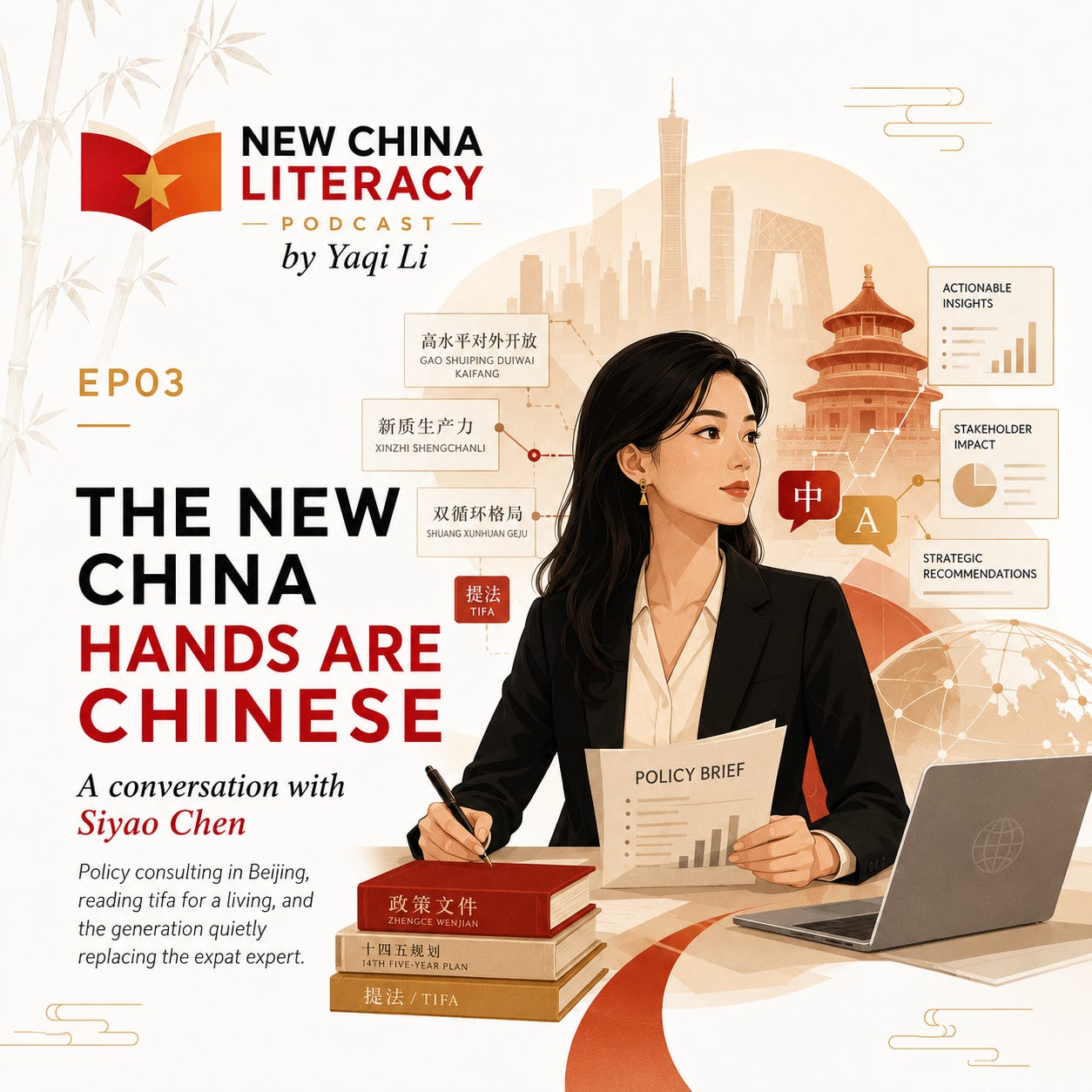
The New China Hands Are Chinese

For decades, the job of explaining China to the world belonged to a specific kind of person: the foreign correspondent, the visiting scholar, the expat adviser reading Chinese publication from the outside in. That model is aging out. What is replacing it is harder to name, and this episode is a portrait of it. My guest is Siyao Chen, a graduate of China Foreign Affairs University and the London School of Economics and Political Science, now a policy consultant at a multinational public affairs firm in Beijing. Her job, at its core, is translation in the strategic sense: taking what Beijing says and turning it into what a client can act on. Her path there runs through an unusual sequence of rooms. A foreign language school in Changchun, where Spanish and English arrived at the same time. A provincial foreign affairs office in her home province, where she first encountered diplomacy as something local and concrete rather than ministerial and abstract. The China Development Research Foundation, where supporting the China Development Forum gave her a network that later became her professional asset. A stint at the United Nations, then a master’s degree at the LSE. Each step widened the aperture: local, national, international, and now the space in between, where multinationals try to make sense of the Chinese state. Three threads from the conversation stayed with me. Tifa is a skill. Ask Siyao how she reads Chinese policy and she does not talk about leaked documents or insider whispers. She talks about compiling readouts across years and watching for the moment a phrase changes. The difference between two near-identical diplomatic formulations can carry more signal than an entire white paper. This is philology deployed as market intelligence, and it is a skill the Chinese education system produces almost by accident, through a thousand years of training in reading political texts closely. There is no revolving door, and something else grew in its place. In Washington, the pipeline from government to consultancy is an institution. In Beijing, it barely exists, and what substitutes for it is personal network, accumulated early and carried across. Siyao’s junior-level internships turned out to be exactly the asset that a formal revolving door would have provided. Though she corrected one of my assumptions on air: people do resign from the ministries and enter the private sector. The system is less of a one-way door than I had imagined. Judgment, not knowledge, is the scarce resource. Siyao opened the conversation with an observation about AI that most senior analysts are only now arriving at: finding information is no longer the hard part of policy work. Knowing what matters to this client, at this moment, against this decision, is. That is not something a curriculum teaches. It is formed in client work, and she is forming it right now, at the very start of a career, which is exactly why the conversation is worth your time. These habits are usually reconstructed in memoirs decades later. Here they are being described as they set. Underneath all of it sits the larger claim of the episode: a generation of professionals trained inside the Chinese system, fluent in both political contexts, is becoming the connective tissue between China and the multinationals that operate in it. Not a replication of the Western model. Something new, still without a name. What this show is — and is not New China Literacy is a podcast by young Chinese-background analysts who move between China’s policy world and international environments, and try to make sense of both on the record. In English, with Chinese where it is the only word that works. We are selling insight, not emotion. Each episode should leave you understanding something you did not before. What would you want us to ask next? If you work in or around China-facing public affairs, what do you think outsiders most misunderstand about the field? Drop it in the comments. Get full access to New China Literacy at yaqil.substack.com/subscribe

49 minPlay in:

Mon27Apr
New China LiteracyYH

Yichao HouGuest

Inside the Beat: A Decade of Foreign-Affairs Reporting from a Chinese Newsroom

A common assumption among English-language readers of China is that Chinese journalism is what the state allows it to be. The model is straightforward: instructions come down, journalists comply or work around the edges, and what survives is what the system permits. This model is not wrong. It is, however, incomplete in ways that matter for anyone trying to understand how Chinese audiences actually receive information about the world. I spent the last week recording a conversation with Yichao Hou, who goes by Henry, on what a decade of foreign-affairs reporting from inside a major Chinese commercial newsroom actually looked like. Henry was a senior editor at Phoenix New Media (鳳凰新媒體) from 2015 to 2025, covering US elections on the ground, the Two Sessions, EU-China dialogues, and conducting more than thirty interviews with ministers, diplomats, and scholars. He left Phoenix last year and is now my classmate in the IPE master’s program at RSIS in Singapore. The conversation we had is one we could not have had five years ago, when both of us were still inside our respective parts of the Chinese knowledge-production system. What struck me, listening back to the recording, is that the most interesting constraints Henry described were not the political ones. The political ones existed and he was direct about them. What dominated the structural picture of his career was something else. The shape of the work Henry’s working week did not follow a script. It followed the news cycle of countries other than his own. He described being woken at one in the morning when South Korea’s then-president declared martial law, conducting a follow-up interview with a Korea specialist by three, sleeping briefly, and resuming at eight. Other weeks, in the quiet between Western news events, the desk was as slow as any office. The texture of the job was one of asymmetric attention: a Beijing newsroom locked into the rhythm of Washington, Brussels, Seoul, Tehran. When he covered the 2024 US election on the ground, he visited seven states and more than ten cities in three weeks, a coverage radius that most American political reporters cannot replicate because they are tied to a city or a beat. He arrived with an explicit framework borrowed from Tocqueville, asking county-level Republican and Democratic officials about the actual mechanics of local democracy rather than the horse race. The Republican chair of an Erie County, Pennsylvania party committee told him, in his account, that the party had no quarrel with Chinese people in general, only with the asymmetry that allowed Chinese citizens to buy land in the United States while Americans could not buy land in China. That single grievance, narrowly defined, was the entire substance of the conversation. This is the kind of observation that does not travel through standard wire copy. It is not a quote that confirms a narrative, on either side. It is the texture of how a particular interlocutor in a particular county had organized his view of US-China relations down to one issue, and was willing to share that view with a foreign reporter precisely because the foreign reporter was Chinese rather than American. Henry described being treated as more welcome by ordinary Americans during election coverage than during security forums. At Aspen-style security conferences in Washington, conversations with him would last one or two sentences before the American interlocutor remembered an appointment elsewhere. At a Democratic gala on voting night, volunteers actively sought him out, told him not to believe the negative coverage, invited him to stay. The same country, the same trip, two opposite social registers depending on which professional subculture he was reporting on. The constraint that displaced the constraint The more analytically interesting part of the conversation was Henry’s description of what shaped his work from outside the room. There are political constraints in Chinese commercial journalism. He acknowledged them directly: certain topics are bounded, certain framings around the leadership are not available, the macroeconomic conversation has become increasingly sensitive because expectations affect markets and media shape expectations. He described the second category of political regulation, less remarked on in English coverage, as a kind of paternalistic expansion in which the Chinese state treats adult readers somewhat the way American regulation treats children. His example was the requirement that video games change the color of in-game blood from red to green, a request that would be absurd in any other regulatory framework but is structurally consistent with treating the audience as in need of protection. What Henry argued, however, is that for the foreign-affairs desk specifically, the dominant constraint over the last decade has not been political. It has been the collapse of long-form text consumption. He came back from three weeks of US election reporting with the material for several substantive feature articles. He wrote almost none of them. The reason was not censorship. The reason was that by 2024, a five-thousand-word feature on American local democracy from a Chinese reporter had no audience inside China. The mobile-first short-video transition, accelerated by Douyin and the broader 4G-then-5G rollout, had done to Chinese long-form journalism what it had also done to American long-form journalism, but on a faster timeline and from a smaller starting base. What survived was the one-minute clip of him standing at a Trump rally narrating who was on stage. The market disciplined the work more thoroughly than any propaganda department could. This is not a story unique to China. The decline of long-form journalism is a global phenomenon with a more or less continuous timeline across most major media markets since roughly 2010. What is specific to Chinese commercial journalism is that the political constraint and the market constraint have moved in roughly the same direction at roughly the same time. A reporter at Phoenix who wanted to write a careful, contextual, county-by-county analysis of American electoral mechanics would have run into both constraints simultaneously. The market constraint would have hit first. The implication for English-language readers of China is uncomfortable. If you read Chinese coverage of foreign affairs and conclude that the depth deficit comes from political control, you are getting the story partly right and partly wrong. The political control is real. But the immediate cause of why a Chinese journalist who has spent three weeks talking to American voters does not write the long article those weeks deserve is the same cause that explains why the equivalent American journalist does not get to write theirs. The audience moved. The pivot We spent the last third of the conversation on the question of why Henry left. The answer was not dramatic. He described the decade at Phoenix as a tunnel where he could see the end. He could remain in the senior editor role, write commentary on the news cycle, attend the same dinners, hold the same position, and the life would be steady and recognizable. The phrase he used, which struck me, was that the work had become a form of burning yourself. Information accumulated faster than it could be processed. The brain came home overloaded each evening with material that had no outlet. Singapore, RSIS, the formal training in IPE, were not a credentialing exercise. They were a way to convert ten years of accumulated observation into something that could be analyzed rather than just experienced. I pushed him on a view that circulates in English China-watching circles, that mid-career Chinese professionals leaving the system to study abroad are essentially performing exit, that the academic training is a credentialing layer on a path already chosen. He pushed back without performance. His answer was that he was trying to figure out how to remain useful as a journalist r… Get full access to New China Literacy at yaqil.substack.com/subscribe

1 h 00 minPlay in:

Guests from more than 12 months ago are part of Pro. See plans