In the vast, unpredictable theater of now, Mattin and Miguel Prado surrendered to the whims of the unconscious, that masterful improviser, seeking to conjure into being a future that, once distant, now beckoned with the inevitability of a forgotten prophecy slowly, inexorably coming to fruition.
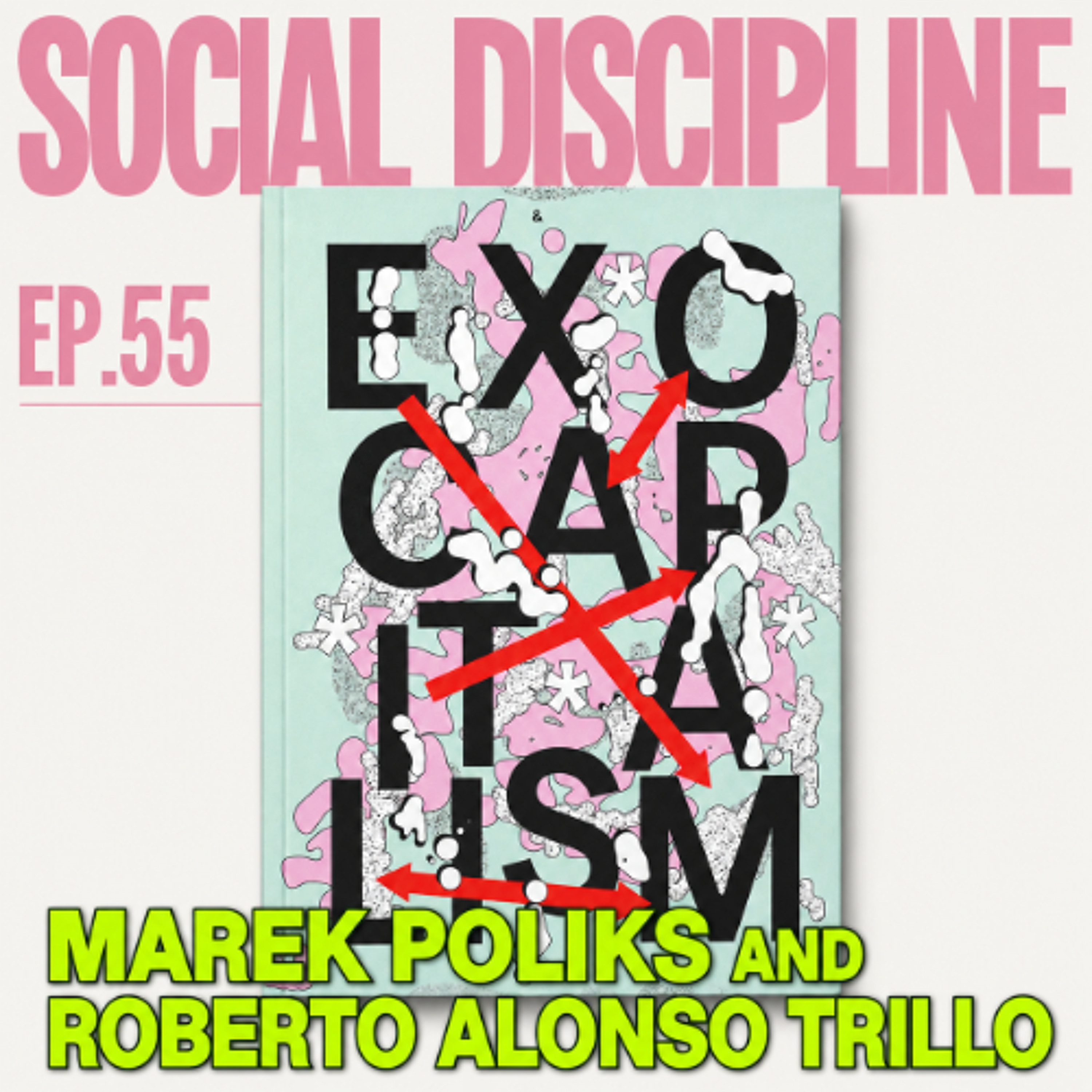
In this episode of Social Discipline, we talk to Marek Poliks and Roberto Alonso Trillo about their book Exocapitalism: Economies with Absolutely No Limits. Can we rethink capitalism beyond the familiar language of labour, ideology, social construction, and historical origin? Poliks and Alonso Trillo argue that capital should be understood less as a human-centred mode of production than as a logic of arbitrage: the extraction of value from differentials across time, markets, substrates, and scales. The conversation asks whether contemporary capitalism can still be fought with the concepts we have, or whether the problem has to be reformulated from first principles.
In this episode, we speak with Sunik Kim — Korean American musician, writer, and filmmaker based in Los Angeles. Kim's music has been described as "a frenzied electronic orchestra that sits somewhere between free jazz, noise, and Korean shamanic music. Their writing, spanning subjects from Korean communism to Conlon Nancarrow, has appeared in The Wire, Pitchfork, Bandcamp Daily, Tone Glow, and elsewhere. We discuss in detail their new essay "Zones of Illusion", tracing the connections between illusion, cognition, class, and the conditions under which sound — and thought — might still escape capture.
Today, International Workers' Day 2026, Sunik Kim releases seven CDs of new music, three essays, including "Zones of Illusion", and a book. More details at sunikkim.com.
Thanks to Fielding Hope.
Direct link to "Zones of Illusion":
https://sunikkim.com/zones-of-illusion
SD52 Andreas Petrossiants
"We Can Now See Clearly What We Are Up Against"
In this episode, we begin by expressing our admiration for and inspiration from our late friend Marina Vishmidt. We actually met last year in Vienna at the conference celebrating her work "What Is Infrastructural Critique?”. We discuss Vishmidt critical insights into the collapse of the myth of artistic autonomy and how art operates within broader infrastructures of capital. Petrossiants, who has been involved in housing struggles in New York City for some time, is now pursuing a PhD at NYU, working with Michelle Castañeda and Fred Moten. He has been researching the struggles of 1970s Italy from the perspective urban development and spatial composition (following Neil Gray), including autoreduction movements, proletarian shopping, and mass refusals of work and payment, alongside movements such as lotta continua, potere operaio and Nuclei Armati Proletari (NAP), and figures like Silvia Federici and Henri Lefebvre.
We address the contradictions of art and institutional critique, where even radical themes, such as incarceration, are absorbed into liberal museum frameworks. From both U.S. and Italian perspectives, we consider the emergence of a post-liberal order and ask what defines citizenship today, as new forms of exclusion and racism become more explicit. The conversation turns to ongoing struggles in the US against ICE, asking how these different fronts articulate within a social field where production and reproduction have increasingly merged.
Finally, we examine how infrastructures, such as those developed by companies like Amazon, are not only economic but increasingly carceral, enabling new forms of control in which subjects risk becoming disposable. We ask what defines citizenship today, as more explicit forms of racism re-emerge. In this context, Israel’s treatment of Palestinian lives appears as a forerunner of broader tendencies across the West, where similar logics of exclusion and disposability are beginning to take hold in regards to immigrants for example. The podcast situates these trajectories within a broader question: how to understand and confront a system in which urban space, culture, and social life are increasingly subsumed while a new wave of fascism emerges. We can now see clearly what we are up against, however we still have to see what forms of radicalisation will emerge.
SD51 in collaboration with Dream Academy and SASUSU Radio
Jakob Jakobsen “The Ghost of Jakob Jakobsen”
For the first time publicly, we recorded Social Discipline live at Tromsø Kunstforening (TKF) on March 1, 2026, with Henrik Sørlid from Dream Academy and an engaged audience.
We begin with Jakobsen’s Letter of Resignation (2021), his farewell to the art scene, where he explains his motivations for the first time ever. However his practice has involved not only gestures of negation but also of affirmation. Deeply rooted in the punk ethos of DIY and unskilled practice, the underground industrial tape music networks of the 1980s, and strongly influenced by Dadaism, Surrealism, and Situationism, he has taken the radical proposition that “you can also do it” to the level of institutions, founding a university (Copenhagen Free University) and even a hospital (The Hospital for Self-Mediation). Over many years, he has been engaged in collaborative practices and self-organisation, for example through alternative television (tv tv), publishing initiatives (Infopool Magazine and Nebula), and activist spaces (Info Centre).
Jakobsen might have abolished himself as an artist but following Walter Benjamin’s conception of history, he understands these projects as unfinished struggles that can be reactivated as revolutionary tools for the present and future. In turn, he has excavated radical experiments that are often forgotten, such as Antiuniversity London and antipsychiatric movements like the Sozialistisches Patientenkollektiv, reactivating their potential. An eerieness frames these practices as animated by the ghosts of unrealised futures, traces of abandoned struggles and suppressed possibilities that continue to unsettle the present and open new possibilities within the limits imposed by the state and capitalism, in opposition to the prevailing sense of doom and gloom.
At the same time, he interrogates the darker, exclusionary histories of the Danish welfare state, which he describes as a “work state.” He has a personal experience, specially in regards to mental institutions. He had lived with anxiety and depression since puberty and the last years he has been in and out of this institutions. His whole practice questions the state's production of subjectivity. Situated between activism, art, and everyday life, and informed by psychoanalysis, he engages in creating spaces where knowledge, relations, and forms of life are collectively produced, focusing on the construction of social relations, infrastructures, architectures, and modes of living.
This podcast also contains sounds from unpublished tapes that Jakobsen recorded in 1985, a hauntological soundtrack against today's hopelessness.
Thank you to the Dream Academy, SASUSU Radio and Tromsø Kunstforening (TKF)
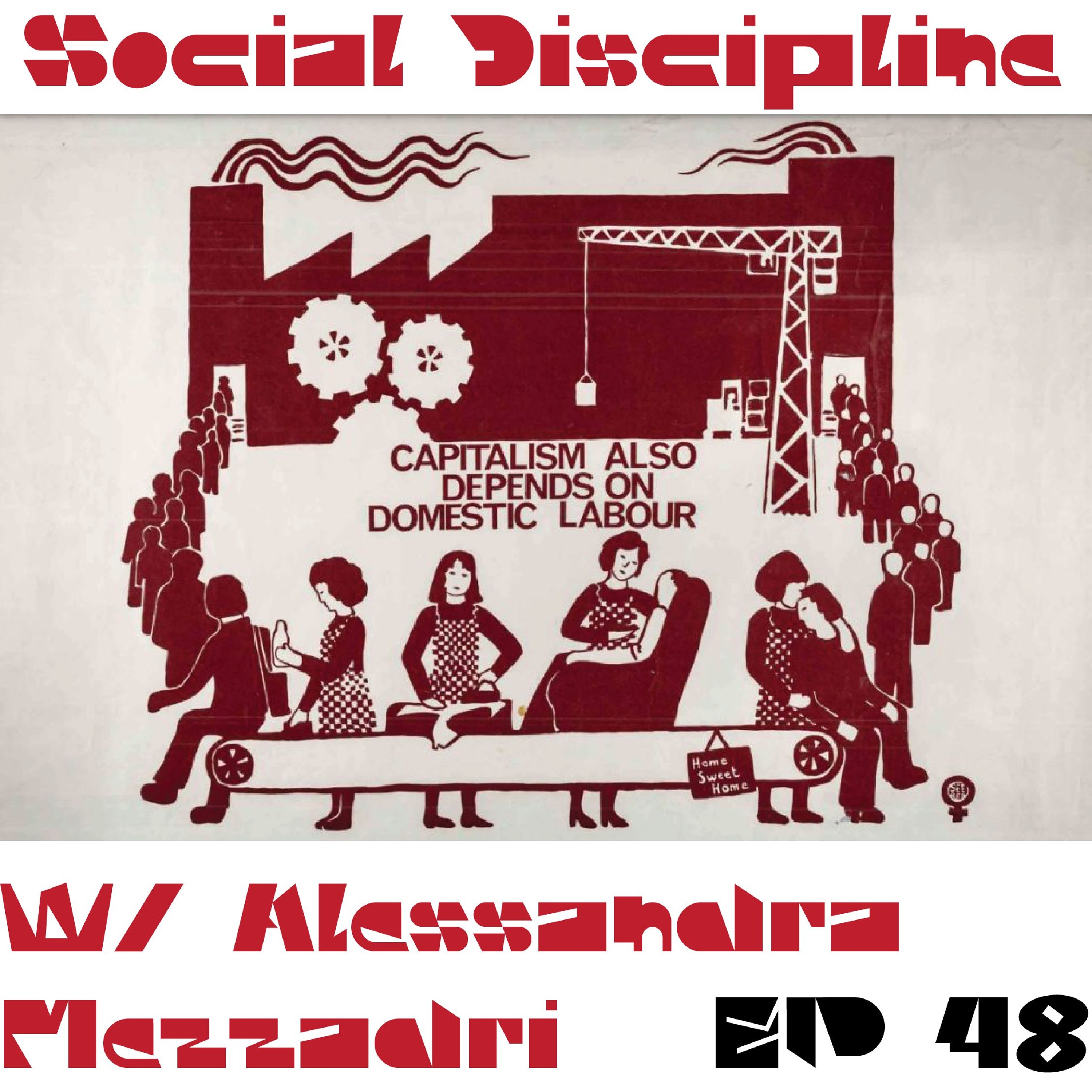
The Escalation of Struggles: Social Reproduction & Formal Subsumption
Alessandra Mezzadri discusses how formal subsumption can be understood through the diverse and rich perspectives of social reproduction, drawing in particular on the Italian Marxist Feminist tradition, to which the concept of the social factory owes a great deal.
Through a feminist reading of her fieldwork in India, and in dialogue with the work of Jairus Banaji, she shows how the Global South reveals the ways in which formal subsumption continues to function through multiple, heterogeneous forms of labour.
Rather than understanding these processes as producing paralysis and political powerlessness, she suggests that they may also open up new forms of antagonism, creating the conditions for the escalation of new struggles.
1 h 09 minAbspielen in:
Gäste, die länger als 12 Monate zurückliegen, gibt es mit Pro. Pläne ansehen

 MP