IEM Unscripted: DisasterSmiths™ cover
Podcast

IEM Unscripted: DisasterSmiths™

IEM Unscripted: DisasterSmiths™ hatte in den letzten 12 Monaten 11 bestätigte Gäste in 6 Folgen. Zuletzt: Kyle Spencer, 4. Nov. 2026.

Website der SendungApple PodcastsSo werden Gäste bestätigt

IEM Unscripted presents DisasterSmiths™, a dynamic podcast that dives into the heart of disaster resilience. Join us as we explore the practical solutions, innovative programs, and dedicated service delivery crafted to aid disaster survivors and fortify communities. Our mission is clear – to make our communities more…

Gäste der Sendung

Mi4Nov
IEM Unscripted: DisasterSmiths™JF

Jane FrantzKyle SpencerGast

AI for Resilience: From Prediction to Action

In this episode of DisasterSmiths®, hosts Chris Smith and Diana Rothe-Smith move beyond the AI hype to examine what the technology can actually do for emergency managers. They are joined by Kyle Spencer, Chief Resilience Officer for the City of Norfolk (VA), and Jane Frantz, Section Leader for Preparedness and Recovery Analytics at Argonne National Laboratory, managed and operated by UChicago Argonne, LLC, for the U.S. Department of Energy. Together, they explore how predictive models can inform real-world flood decisions, strengthen resilience, and help resource-constrained communities put AI into practice. What does that look like when a county has just one emergency manager? Jane Sibley Frantz, Section Leader, Preparedness and Recovery Analytics, Argonne National Laboratory, managed and operated by UChicago Argonne, LLC, for the U.S. Department of Energy Jane serves as the Section Leader for Preparedness and Recovery Analytics at Argonne National Laboratory, where she leads recovery and resiliency projects nationwide. Part of Jane’s work included FEMA’s National Resilience Guidance. She has also supported several post-event impact assessments and targeted analyses in Hawaii and the U.S. Virgin Islands. Prior to joining Argonne, Jane served as the Vice President of Resilience Solutions Group with Dewberry. Kyle Spencer, Chief Resilience Officer, City of Norfolk, VA Kyle Spencer is the Chief Resilience Officer for the City of Norfolk, Virginia. He is responsible for implementing the City’s resilience strategy by managing complex projects in water management, environmental, urban planning, and smart cities. He regularly collaborates with regional partners on resilience innovations to support research projects with universities and develops business solutions in the resilience sector by turning Norfolk into a coastal community laboratory. His work on resilience has been featured in the Wall Street Journal, the Washington Post, NPR’s Market Place, and the Weather Channel.
33 minAbspielen in:

Di6Okt
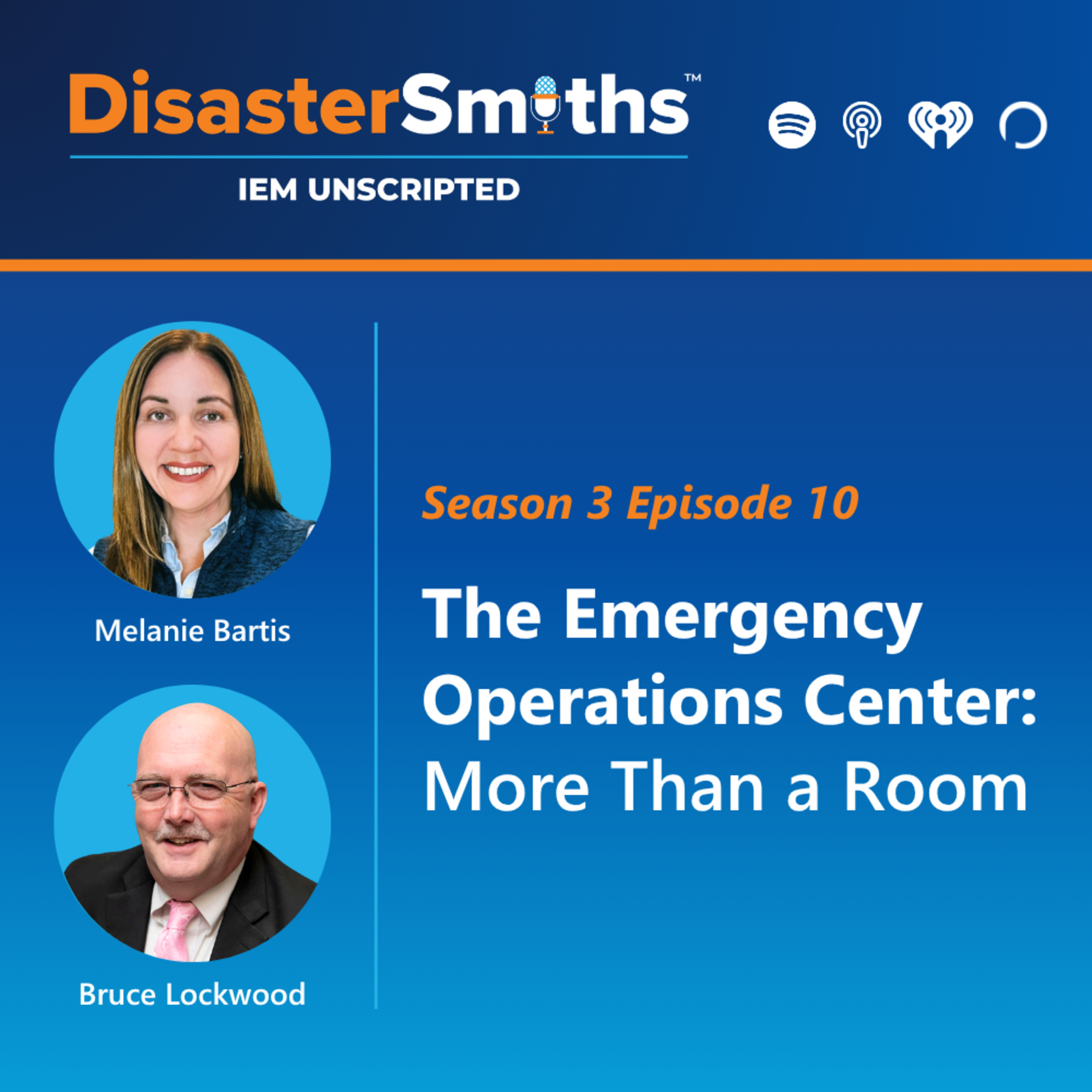
IEM Unscripted: DisasterSmiths™BL

Bruce LockwoodMel BartisGast

The Emergency Operations Center: More Than a Room

What makes an Emergency Operations Center succeed when the pressure is highest? In this episode of DisasterSmiths®, hosts Chris Smith and Diana Rothe-Smith sit down with emergency management veterans Mel Bartis and Bruce Lockwood to pull back the curtain on EOC operations. They explore who needs aseat at the table, how leaders and elected officials should engage during an incident, how emergency managers build situational awareness amid uncertainty, and what separates high-performing EOCs from those that struggle. Drawing on decades of experience responding to disasters and complex emergencies, Bruce and Mel share practical lessons on leadership, coordination, communication, anddecision-making when communities need it most. If you have ever wondered what really happens inside an EOC and what it takes to make one work, this episode is for you.

34 minAbspielen in:

Mi5Aug
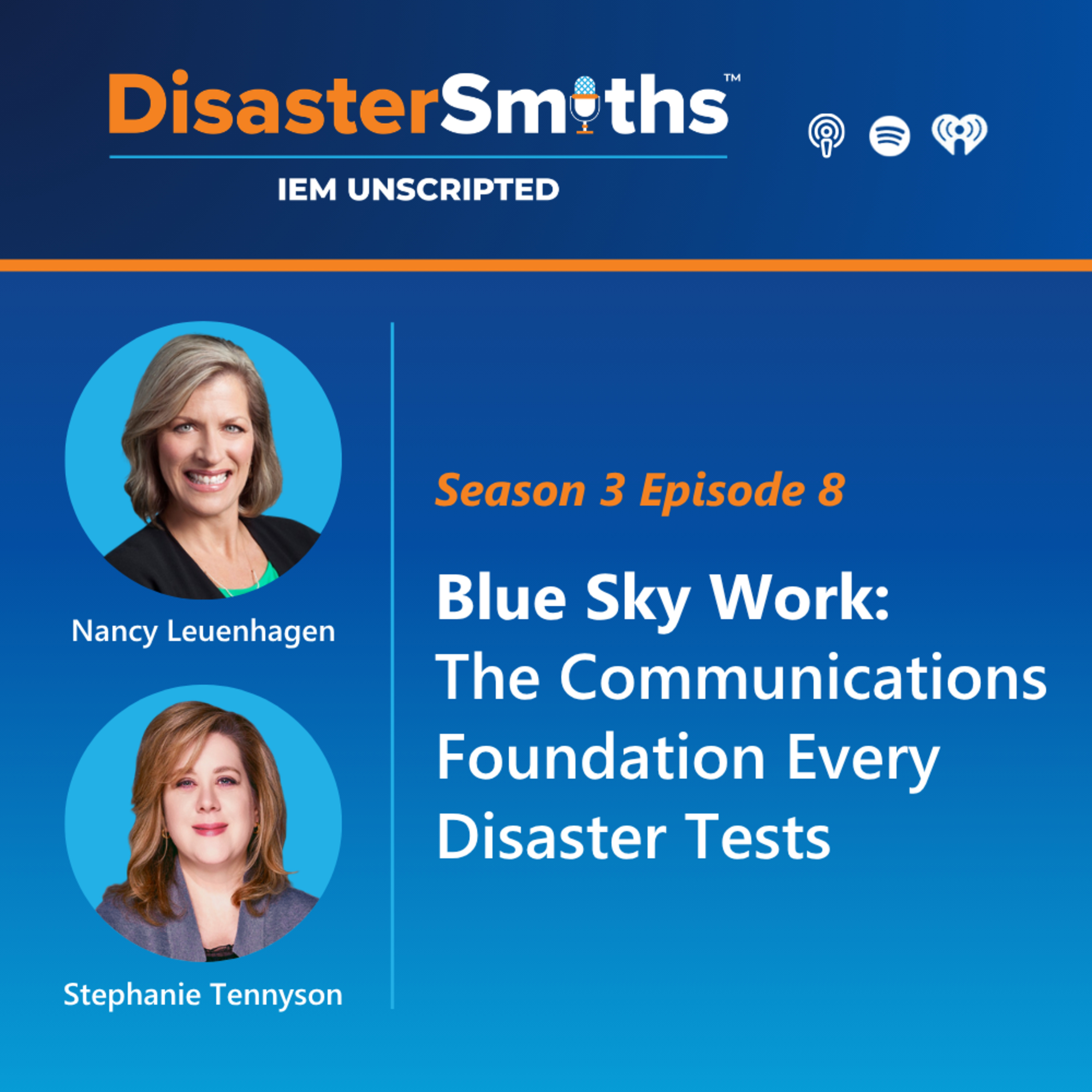
IEM Unscripted: DisasterSmiths™NL

Nancy LeuenhagenStephanie TennysonGast

Blue Sky Work: The Communications Foundation Every Disaster Tests

Silence is never neutral. When official information lags during an emergency, something rushes in to fill the void, and it is rarely anything an agency would have chosen. In this DisasterSmiths episode, our guests, Nancy Leuenhagen, Communications Director for Washoe County, Nevada, and Stephanie Tennyson, Chief Communications Director at IEM, make the case that the most consequential communications work happens on blue sky days. Blue sky time is construction time, when relationships get built, andagencies earn the right to be believed. Together with our hosts, they explore how agencies build credibility before an emergency ever occurs, why consistent communication matters when there is no immediate threat, and how to makepreparedness resonate with people who assume disaster will never reach them.They also examine common pitfalls in preparedness messaging, the challenge of competing voices, and practical ways to adapt when misinformation spreads faster than facts. Whether you lead a communications shop or wear every hat in a one-person office, you will come away with ideas for building credibility, countering misinformation, and reaching the people who need your message most.

35 minAbspielen in:

Di21Jul
IEM Unscripted: DisasterSmiths™MM

Marion McFaddenGast

Faster Recovery, Stronger Communities: Inside the 21st Century ROAD to Housing Act

In this episode of DisasterSmiths, we explore one of the most significant changes to disaster recovery policy in decades. The newly enacted 21st Century ROAD to Housing Act establishes a more predictable framework for Community Development Block Grant–Disaster Recovery (CDBG-DR) funding, with the goal of accelerating recovery, reducing administrative burdens, and helping communities rebuild faster after major disasters. Joining our hosts is Marion McFadden, IEM Vice President of Disaster Recovery and former HUD Principal Deputy Assistant Secretary for Community Planning andDevelopment, to discuss what this landmark legislation means for state, local, tribal, and territorial governments. Together, we unpack the authorization of CDBG-DR, new expectations for planning and accountability, and the steps communities can take today to be better prepared for tomorrow’s disasters. Whether you’re responsible for housing, recovery, resilience, or grants management, this conversation offers critical insights into how the new lawcould reshape long-term disaster recovery nationwide.

22 minAbspielen in:

Di2Jun
IEM Unscripted: DisasterSmiths™ES

Elizabeth SancheyYolanda JacksonGast

Resilience Before Disaster: Lessons from the Yakama Nation

This episode of DisasterSmiths spotlights how resilience is built long before disaster strikes. Featuring Elizabeth Sanchey, Emergency Environmental Management Director for the Yakama Nation, and Yolanda Jackson, IEM’s Manager of Mitigation and Resilience Program, the conversation explores how FEMA’s BRIC program supported proactive wildfire mitigation efforts that helped protect homes, infrastructure, and culturally significant resources during the Slide Ranch Fire.

30 minAbspielen in:

Mi4Feb
IEM Unscripted: DisasterSmiths™CL

Chuck LaneTim LagudiGast

From Allocation to Action: What Comes Next?

The award letter arrives. The headlines hit. The community exhales. Your agency has been allocated CDBG-DR funds. Now what? In this boots-on-the-ground episode, we sit down with Chuck Lane, Director of Disaster Recovery Resources for Pasco County, Florida, recently awarded its CDBG-DR allocation, alongside IEM leader and subject matter expert Tim Lagudi. Together, they unpack what happens after the celebration fades: navigating public outreach, untangling the regulatory maze, managing expectations, and building compliant programs that serve real people in real time. They also share how strategic planning, data analysis, partnerships, and capacity building before the award became the blueprint for success after the award. Because the myth is that funding solves the problem. The truth? Funding exposes your readiness. If your community has received—or hopes to receive—CDBG-DR dollars, this conversation is your roadmap for what comes next. Less theory. More reality. Fewer assumptions. More strategy. The money is just the beginning.

27 minAbspielen in:

Gäste, die länger als 12 Monate zurückliegen, gibt es mit Pro. Pläne ansehen