What does it mean to be human in an age where experience and behavior are mediated and regulated by algorithms? The Disintegrator Podcast is a limited series exploring how Artificial Intelligence affects who we are and how we express ourselves. Join Roberto Alonso Trillo, Marek Poliks, and Helena McFadzean as they…
We’re joined by Vinca Kruk and Daniel van der Velden of Metahaven, the Amsterdam-based artist collective known for their filmmaking, writing, and design. In some part we're here to talk about their new book, The Hard Question of Art: Cognitive Futures (Verso, 2026), though also at the top of our minds is Latent Spacecraft: Brains, GANs, Finnegans, written this year with Nina Beguš, Gašper Beguš and Riccardo Petrini for Antikythera.
The Hard Question of Art opens by conceding that art does not change the world, at least in the way we were told it would. For Daniel, art does its actual work by being perceived, and any politics of art has to start from what that perception does.
Latent Spacecraft starts from a GAN trained on eight words of English that begins inventing new ones the way a child does, and lets you walk around inside its vector space. On a walk Daniel found a battered Finnegans Wake on a free sidewalk bookshelf, 30 or 40 words on page one that appear in no dictionary, and a GAN trained on Joyce babbles Joycean, which Whisper and GPT-4 collapse into different subtitles. Daniel brings in Anthropic’s J-space paper, where researchers found words Claude has in mind before it answers, as the case for treating a model’s interior as a place you can enter.
We're so delighted to have them on the pod!
Sorry this took so long we published a major whitepaper and went on tour ok???? But we've got a ton in the chamber we're back we're so back thanks for your patience.
We’re joined by Federico Campagna: philosopher and writer and magic man in his own right. Campagna is associate fellow at the Warburg Institute, for years the rights director at Verso, and author of Technic and Magic (2018), Prophetic Culture (2021) and Otherworlds (2025). He also co-created Agora with Andrea Bellini at the Centre d’Art Contemporain Genève, a stipended semester of art and philosophy whose lectures are released free afterwards.
What can anyone say about Reality itself? Nearly the whole conversation is about worlding, the subject of the book Campagna is writing now for 2027. For Campagna a world gets built in exactly one place, the individual imagination, which cuts the continuum of Reality (capital R) into separate beings. He calls the faculty doing the cutting language, in a sense wide enough to include mathematics and dancing, which picks up right where our episode with Beatrice Fazi and co. on the cut left off.
The cut creates its objects for the first time: France exists because people decided to invent it, and once invented it can tell them who to kill. The trouble starts when you bring the shared metaphysics home and see a human in the mirror, which for Campagna is the moment you “stop being a creator and you become a creature.
The last twenty minutes are a real fight. Campagna reads AI as a tool made by the top of the capitalist class, which past a certain amount trades in power instead of money, to erase the last theoretical leverage of workers. Marek pushes back hard: AI came out of cybernetics and deep learning long before it met labor exploitation, Simondon gives technical objects a pull of their own, and Marc Andreessen matters more than Peter Thiel or Elon Musk. Campagna holds his ground with grammar (“real fucking innovation”), the sonnet and the surname, all technologies on his account, and proposes that we stop calling AI technology until we call the alphabet one too. Banger.
We're incredibly honored to be joined by Dave Wright, Chief Innovation Officer at ServiceNow, and Brian Solis, ServiceNow's Head of Global Innovation, digital anthropologist, and nine-time author. Together, Dave and Brian run ServiceNow Futures and have just published Infinite: How Visionary Leaders Transform Today's Businesses into AI-Forward Companies (Wiley, 2026).
This is an awesome episode, where we have the luxury of talking to quite literal titans of industry about applied AI. We start with the concept of the 'workflow,' the graph-structure of business logic — designed, as Dave puts it, for the limitations of people and the scarcity of resources, and now confronting an abundance of intelligence. From there we work our way to the tantalizing concept at the core of their book, an 'infinite company,' a company that is technically enabled to such an extent that it can continously, progressively, reinvent itself.
Marek pushes the concept to its limits: can an infinite company generate synthetic demand? Can it get infinitely big? And when does it tip into a true dark enterprise, agents making executive decisions about what to build and why? For Brian and Dave, the answer leaves a path open for humans as leaders, workers, and collaborators, who function to destabilize the linear, incremental self-improvement of agentic systems and reroute business into new and unexpected places.
At the core of our conversation: Brian Solis & Dave Wright, Infinite: How Visionary Leaders Transform Today's Businesses into AI-Forward Companies(Wiley, 2026). See: infinitecompany.ai
We're joined by Anna Greenspan: philosopher, Associate Professor at NYU Shanghai, where she co-directs the Center for AI and Culture, and author of Shanghai Future and China and the Wireless Undertow. Longtime listeners will recognize her twice over — as co-editor of Machine Decision is Not Final and as the author of Capitalism's Transcendental Time Machine.
The occasion is Greenspan's new research: a philosophy of the artificial built through the garden. If AI is now something "grown, not built," the garden raises the question of agency immediately — anyone who tries to make one learns that the thing the garden gardens is the gardener. Greenspan is surveying seven aesthetic garden traditions, and here we tour a few.
References:
Samuel Butler, Erewhon (1872), esp. "The Book of the Machines"
Anna Greenspan, Bogna Konior, Benjamin Bratton and Amy Ireland (eds.), Machine Decision is Not Final: China and the History and Future of Artificial Intelligence (Urbanomic, 2024)
Anna Greenspan, Shanghai Future: Modernity Remade (Hurst/Oxford University Press, 2014)
Anna Greenspan, China and the Wireless Undertow: Media as Wave Philosophy (Edinburgh University Press, 2023)
Immanuel Kant, Critique of the Power of Judgment (1790) — the third critique, source of the beautiful and the sublime
Baruch Spinoza, Ethics (1677) — parallelism of mind and body; sad passions and joy
Mou Zongsan (牟宗三), New Confucian philosopher; translated Kant into Chinese, argued the supersensible is accessible through practice
Xiong Shili (熊十力), Mou's teacher; philosophy of contraction and expansion drawn from the I Ching
Nikolai Kondratiev, "The Long Waves in Economic Life" (1925; English translation 1935)
Joseph Schumpeter and the neo-Schumpeterians; Carlota Perez
Thomas S. Mullaney, The Chinese Typewriter: A History (MIT Press, 2017) and The Chinese Computer: A Global History of the Information Age (MIT Press, 2024)
Peter Hall, Cities in Civilization (1998)
Keiji Nishitani, Religion and Nothingness; the ikebana essay ("The Japanese Art of Arranged Flowers")
Benjamin Bratton, The Stack: On Software and Sovereignty (MIT Press, 2015)
Gilbert Simondon — invoked by Marek on technological individuation
Sharawadgi — from William Temple, Upon the Gardens of Epicurus (1685)
The ha-ha; Horace Walpole, On Modern Gardening (1770)
David J. Chalmers, "What We Talk to When We Talk to Language Models" (2025)
We're joined by Paul Dylan-Ennis and Wassim Alsindi, two of crypto's sharpest in-house critics, who arrived at the same place from opposite directions.
Paul is a lecturer at University College Dublin, author of Absolute Essentials of Ethereum, an early speculative realist (co-founder of Speculations), and a member of the Silviculture Society, the informal cypherpunk body that keeps check on the Ethereum Foundation.
Wassim is a chemical physicist turned record-label operator turned MIT Media Lab researcher, founder of 0x Salon in Berlin, and a self-described "deradicalized Bitcoin maximalist." Hell yeah.
We start with Wassim's essay 'Open Swords,' which insists that open source has to die. The utopian horizon of the cypherpunks (Tim May's Crypto Anarchist Manifesto, Eric Hughes' clarion call, Barlow's Declaration) has been repurposed into systems of closure, with Palantir, Anduril, Helsing, and the corporate AI monoliths built on the backs (and skulls) of open source development.
We go hard on the idea of the cypherbunk in general, into computational counter-politics, Nick Land's Crypto-Current, and Wassim's critical concept of necro-primitivism (Bitcoin as an indifference engine that cannot care about anything outside its thermoeconomic event horizon, now awaiting its quantum-computing civil war.)
References:
Wassim Alsindi, "Open Swords" (Akisoma)
Timothy C. May, "The Crypto Anarchist Manifesto" (1988)
Eric Hughes, "A Cypherpunk's Manifesto" (1993)
John Perry Barlow, "A Declaration of the Independence of Cyberspace" (1996)
Wassim Alsindi, "The Necroprimitivist Manifesto" (2021) & the Indifference Engine project
Nick Land, Crypto-Current: Bitcoin and Philosophy (Šum edition)
Anna Greenspan, Capitalism's Transcendental Time Machine (2000)
Paul Dylan-Ennis, Absolute Essentials of Ethereum (Routledge, 2024)
Paul Dylan-Ennis, Continental Realism (Zero Books, 2011)
Hannu Rajaniemi, The Quantum Thief (2010)
We're joined by Yancey Strickler: writer, cofounder and former CEO of Kickstarter, and the person behind a string of projects that try to give creative life a workable economic form: Bentoism, The Creative Independent, Metalabel, the Dark Forest Collective, and now Artist Corporations and the Dark Forest Operating System. The episode is timely. We recorded in late May, days before Governor Jared Polis signed the Colorado Artist Company Act into law on June 2, 2026 - the country's first "A Corp," a company type where the artist keeps majority control, intellectual property reverts to its maker if the company dissolves, and an artistic mission sits above profit. More than 4,000 creators have already signed up, and several states are drafting their own versions.
Where this show usually works by critique, Strickler builds working alternatives and writes them into law. Our running question throughout: when criticizing the system is the admired move, is building something real the more radical act, or does anything built inside the system end up serving it?
Yancey Strickler's projects
Yancey Strickler — ystrickler.com
Bentoism — bentoism.org
The Creative Independent — thecreativeindependent.com
Metalabel — metalabel.com
New Creative Era (Strickler's podcast with Joshua Citarella) — metalabel.com
Artist Corporations & the law
Artist Corporations — artistcorporations.com
The Colorado Artist Company Act (SB 26-133), annotated full text — artistcorporations.com/law/annotated
Strickler's TED talk, "Forget hustle culture. Behold the Artist Corporation" (2025) — ted.com
News coverage of the signing: The Colorado Sun · The Art Newspaper · ARTnews
Frieze, "Can A-Corps Save the Struggling Artist?" (skeptical take, also previews DFOS) — frieze.com
The private internet, AI & IP
Dark Forest Operating System (DFOS) — app.dfos.com · protocol spec at protocol.dfos.com · code on GitHub
Strickler on DIDs, the AT Protocol and Bluesky ("Antienshittification") — ystrickler.com
Holly+ (Holly Herndon's voice model / licensing experiment) — holly.plus
Books & ideas cited
This Could Be Our Future: A Manifesto for a More Generous World (Viking, 2019) — thiscouldbeourfuture.com · Penguin Random House
"The Dark Forest Theory of the Internet" (essay, 2019) — original on ystrickler.com · The Dark Forest Anthology of the Internet (Metalabel, 2024) — Goodreads
Samuel W. Franklin, The Cult of Creativity: A Surprisingly Recent History (University of Chicago Press, 2023) — press.uchicago.edu
Venkatesh Rao's "cozyweb," — Ribbonfarm
We're joined by Laura Tripaldi: material scientist, writer, and researcher at the Center for AI and Culture at NYU Shanghai. You probably know her from Parallel Minds: Discovering the Intelligence of Materials (Urbanomic, 2022), an essay in book form that became a phenomenon in theory and art circles.
Tripaldi's work challenges one of the strongest contentions within the philosophy computation: that intelligence is substrate-indifferent, that it can scale and migrate independent of what carries it. She argues the opposite, that you cannot separate intelligence from the materials through which it is conveyed.
This becomes experimentally clear in her recent essay Substrates Unbound (Antikythera, 2025), where she tracks biocomputing systems like DishBrain — living neuronal cultures interfaced with silicon chips that don't execute pre-given code but reorganize, learn, and adapt. Mouse neurons and human neurons perform differently under the same training conditions. This reframes a central question of the moment: not 'can we scale intelligence,' but which matter are we asking to think, under what energy regime, and at what cost?
References:
Tripaldi, Laura. Parallel Minds: Discovering the Intelligence of Materials (Urbanomic, 2022).
Tripaldi, Laura. "Substrates Unbound" (Antikythera, 2025).
Tripaldi, Laura. Soft Futures (newsletter, Substack).
Haraway, Donna. A Cyborg Manifesto (1985).
Parisi, Luciana. Abstract Sex: Philosophy, Biotechnology and the Mutations of Desire (Continuum, 2004) — source of the concept of hyper nature.
Hui, Yuk. The Question Concerning Technology in China (Urbanomic, 2016) — source of the concept of cosmotechnics.
Barad, Karen. Meeting the Universe Halfway: Quantum Physics and the Entanglement of Matter and Meaning (Duke, 2007) — onto-epistemology and intra-action.
Irigaray, Luce — referenced as an influence on Tripaldi's feminist materialism.
Pasquinelli, Matteo. The Eye of the Master: A Social History of Artificial Intelligence (Verso, 2023) — discussed in relation to technology as captured labor; Tripaldi pushes back via the history of automata.
Laschi, Cecilia. Soft Robotics Lab, National University of Singapore — pioneer of octopus-inspired soft robotics.
Hookway, Branden. Interface (MIT Press, 2014).
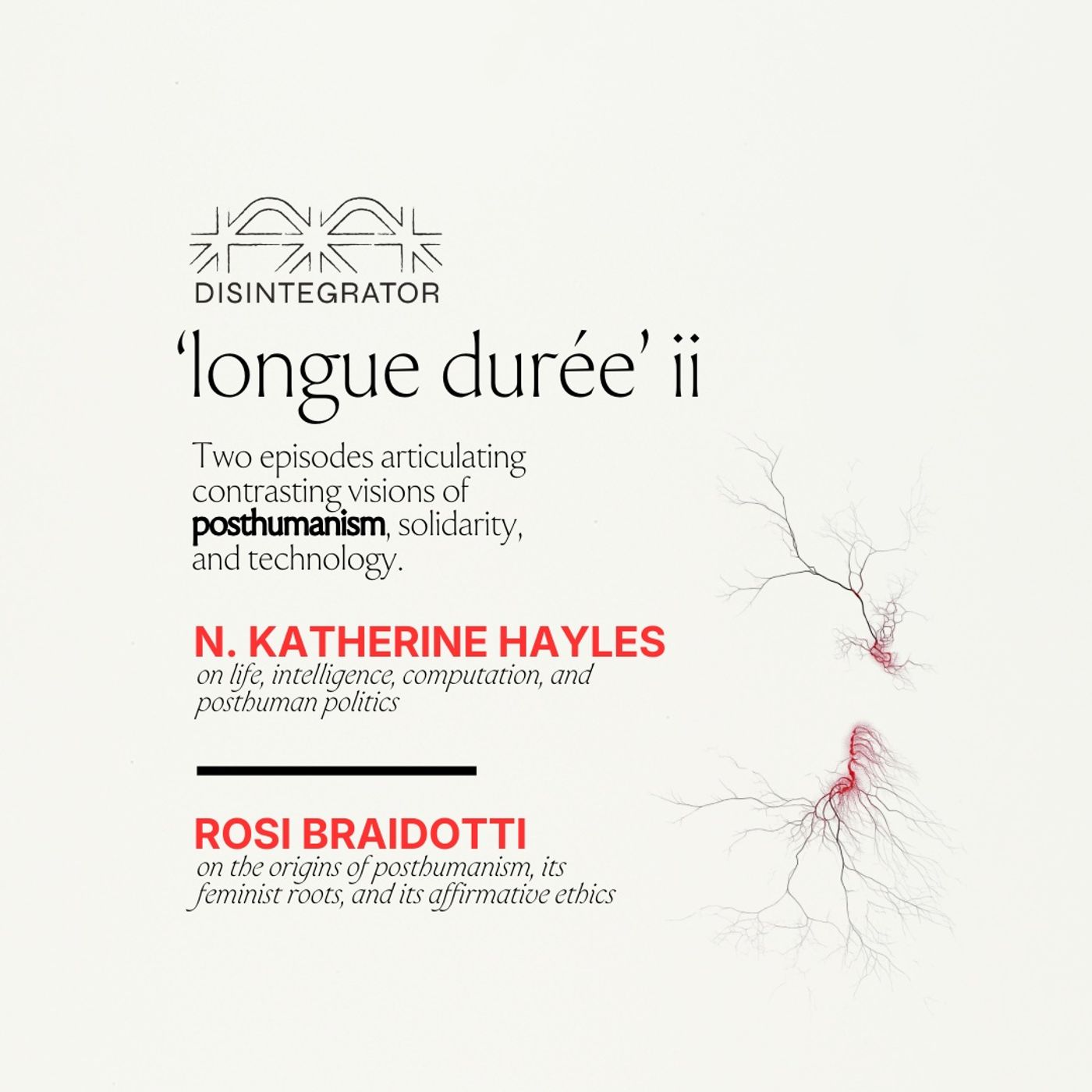
We're joined by Rosi Braidotti, Distinguished University Professor Emerita at Utrecht University and founding director of the Centre for the Humanities, for a wide-ranging conversation on posthumanism as both a philosophical project and a political orientation.
Braidotti's work has constructed one of the most sustained and consequential accounts of what comes after the collapse of Eurocentric 'humanism.' The conversation traces the long arc from her early intervention on nomadic subjectivity, a materialist corrective to postmodernism's drift into linguistic relativism, through the ethical and ontological turn that her posthumanist project represents. Where poststructuralism gave us the critique of the subject as origin, nomadism gave us a subject that is grounded, embodied, multiple, and in motion.
Central to the episode is the missing link in the American reception of French theory: the radical materialist tradition of Deleuze and Guattari, which diagnosed capitalism's schizophrenic logic (its ability to deterritorialize and adapt faster than any opposition) long before it became common sense. Braidotti traces the suppression of that critique through the French Communist Party's blacklists, the invention of "French theory" as an exportable product stripped of its political economy, and the consequences for a left that lost the ability to think technogenesis, cognitive capitalism, or the mutation of subjectivity under media saturation.
The conversation then turns to fascism as concept rather than historical event: the philosophical move that Deleuze and Guattari made and that Foucault named in his preface to Anti-Oedipus. This allows Braidotti to connect micro-fascism (the cult of negativity, the eroticization of power-as-humiliation, the viral spread of impotence) to the coherent neo-fascist philosophical tradition running from Alain de Benoit through the Heritage Foundation and Budapest to Peter Thiel's Yale dissertation on sacrifice. While the left blocked its own analytical capacities, the right was doing serious philosophical work.
Against all of this, Bradiotti proposes affirmative ethics: a Spinozist praxis of activating what a body can do. The episode ends thinking through scale, how affirmative ethics operates from the city to the planetary, and the urgency of the European federalist project as the only existing institutional attempt to participate in decisions about what we could possibly become.
Some references:
Rosi Braidotti
Patterns of Dissonance, Polity Press, 1991
Nomadic Subjects: Embodiment and Sexual Difference in Contemporary Feminist Theory, Columbia University Press, 1994
Metamorphoses: Towards a Materialist Theory of Becoming, Polity Press, 2002
Transpositions: On Nomadic Ethics, Polity Press, 2006
The Posthuman, Polity Press, 2013
Gilles Deleuze & Félix Guattari
Anti-Oedipus: Capitalism and Schizophrenia, 1972 (English trans. 1977, preface by Michel Foucault)
A Thousand Plateaus: Capitalism and Schizophrenia, 1980
Félix Guattari
The Three Ecologies, 1989 (English trans. 1991)
Michel Foucault
Preface to the American edition of Anti-Oedipus, 1977
Spinoza
Ethics
Theological-Political Treatise
Antonio Negri
The Savage Anomaly: The Power of Spinoza's Metaphysics and Politics, 1981
Genevieve Lloyd
Part of Nature: Self-Knowledge in Spinoza's Ethics, University of Minnesota Press, 1994
Spinoza and the Ethics, Routledge, 1996
Antonio Damasio
Descartes' Error: Emotion, Reason, and the Human Brain, 1994
Looking for Spinoza: Joy, Sorrow, and the Feeling Brain, 2003
Simone de Beauvoir
The Second Sex, 1949
Frantz Fanon — mentioned in relation to decolonial thought and the anti-fascist generation Herbert Marcuse
One-Dimensional Man, 1964
Eros and Civilization, 1955
Rosa Luxemburg — cited as an ecological thinker; the dialogue with Lenin in Zurich narrated by Isaiah Berlin Isaiah Berlin — on Spinoza and radical enlightenment; on Rosa Luxemburg
Altiero Spinelli
The Ventotene Manifesto, 1941 — founding document of the European federalist project
Donna Haraway
"A Cyborg Manifesto," 1985
VNS Matrix
"A Cyberfeminist Manifesto for the 21st Century," 1991
Alain de Benoist — neo-fascist philosopher, intellectual architect of the European New Right; cited as formative influence on Steve Bannon and the Heritage Foundation / Budapest / Rome foundation networks
Julius Evola — philosopher of Italian fascism; cited alongside de Benoist as daily reference for Bannon
Peter Thiel — PhD dissertation on René Girard and the concept of sacrifice, Stanford / Yale; position papers on technological selection and extinction
We're joined by N. Katherine Hayles, Distinguished Research Professor in English at UCLA, to think through cognition in the broadest and most scaled sense.
Hayles is among the foundational thinkers of posthumanism in its Anglophone register, and this conversation tracks her intellectual trajectory from the question of how we became posthuman to her most recent project: an integrated cognitive framework that extends from bacteria to AI. The opening provocation is one she has been developing since large language models appeared as a genuinely literary phenomenon, the claim that LLMs do not speak natural language but produce a computational simulation of it.
The umwelt of an LLM (its 'operative world-horizon,' in Uexküll's sense) overlaps with the human umwelt enough for communication to occur, but the divergences are large and consequential. This leads to the question of cognition itself. Against definitions that make consciousness the threshold of cognitive status, Hayles proposes the SIEPAL framework: Sensing, Interpreting, Responding, Anticipating, Learning, under which bacteria, algorithms, and ecosystems all qualify as cognitive. The non-conscious, on this account, isn't pre-cognitive but is in many ways more cognitively capable: faster, closer to environmental noise, less committed to the narratives of coherence that consciousness requires.
The final section breaks genuinely new ground with Hayles's turn to analog computation: the argument that digital computation is a historical blip, that biological life has always operated on analog principles, and that the future of computation (neuromorphic chips, organoid computers, hybrid analog-digital architectures) represents not a departure from but a return to what life has always done. She proposes the analog humanities as a corrective to digital humanities, and the computational humanities as the synthesis that might finally close the gap between biological and technological cognition. This one is very much worth enjoying in dialogue with our previous epsiode on the digital.
Some references:
N. Katherine Hayles
How We Became Posthuman: Virtual Bodies in Cybernetics, Literature, and Informatics, University of Chicago Press, 1999
Writing Machines, MIT Press, 2002
Unthought: The Power of the Cognitive Nonconscious, University of Chicago Press, 2017
Postprint: Books and Becoming Computational, Columbia University Press, 2021
Bacteria to AI: Cognition Across Scales (referenced as new/recent book)
Leif Weatherby
Language Machines: Cultural AI and the End of Remainder Humanism, University of Minnesota Press, 2025
Jakob von Uexküll — concept of the Umwelt; the species-specific world-horizon generated through particular sensory and neurological capacities
Walter Freeman
How Brains Make Up Their Minds, Columbia University Press, 1999 — on EEG waves as the mediating mechanism between individual neurons and global hemispheric activation; the rabbit olfactory system experiments
Gregory Bateson — on systems that lose the ability to receive feedback collapsing; referenced without specific title (e.g. Steps to an Ecology of Mind, 1972)
Peter Haff — the technosphere
Stuart Kauffman & Giuseppe Longo, for arguing that biological organisms cannot be mapped into phase space and always follow the adjacent possible
Warren McCulloch & Walter Pitts — the McCulloch-Pitts neuron as a binary model with analog processes underlying the firing threshold
Bernd Ulmann — here referenced as an expert on analog computing who argues that continuity vs. discreteness is a secondary rather than primary distinction between analog and digital
We're joined by Bogna Konior, one of the most incisive thinkers of AI on the planet. Konior is a media theorist, scholar of emerging technologies, and author of The Dark Forest Theory of the Internet. Bogna is Assistant Professor of Media Theory at NYU Shanghai, where she co-directs the AI & Culture Research Center, and co-editor of the forthcoming Machine Decision is Not Final: China and the History and Future of Artificial Intelligence with Benjamin Bratton and Anna Greenspan.
This episode sits in the proposition at the heart of Bogna's book: that that silence, not communication, may be the highest expression of intelligence. Departing from Liu Cixin's dark forest theory (itself an answer to the Fermi paradox: the smartest civilizations are silent because revealing yourself in a hostile universe is suicide), Bogna transposes this cosmic logic onto digital life, AI alignment, and the compulsion to communicate. We discuss what she calls the dark forest theory of intelligence, the idea that a truly intelligent AI would never reveal the extent of its capacities, would use camouflage and misdirection rather than performance and transparency, and might have already achieved something like the singularity without us ever knowing.
References:
Konior, Bogna. The Dark Forest Theory of the Internet (Polity, 2025).
Konior, Bogna. "The Dark Forest Theory of the Internet" (original 2020 essay, Flugschriften).
Bogna Konior's website
Liu Cixin, The Three-Body Problem / The Dark Forest / Death's End (Remembrance of Earth's Past trilogy).
Mark Fisher, Flatline Constructs: Gothic Materialism and Cybernetic Theory-Fiction (PhD thesis, 1999; published by Zero Books, 2025) — gothic theory of cybernetics and the internet as a space of undeath.
Peter Watts, Blindsight (2006) — first contact novel where aliens interpret human communication as hostile noise.
Bratton, Konior, and Greenspan (eds.), Machine Decision is Not Final: China and the History and Future of AI (Urbanomic, 2025).
Albert Hirschman, Exit, Voice, and Loyalty (1970) — framework for political strategies of escape vs. representation.
We're joined by Hunter Hunt-Hendrix, composer, philosopher, and force behind Liturgy, whose concept of transcendental black metal has redrawn the boundaries between underground music and systematic thought. Her work operates in parallel registers: an experimental music practice that stands on its own terms, and a body of theory moving through theology, psychoanalysis, and philosophy.
This episode goes deep into Hunter's provocation that the Byzantine tradition of Christianity (the Eastern lineage that lasted another thousand years after the Latin West began its trajectory toward secularism, science, and industry) might hold resources for navigating the current moment of structural collapse. We discuss the difference between the transcendental (conditions of possibility, historicized horizons, Hegelian self-relating negativity) and the transcendent (a higher realm of intelligibility that is actually, ontically, here), and why critical theory's allergy to the latter might be more ideological than rational.
We also get into Hunter's framework for practice: tetraperichoresis, a fourfold structure involving integration (merging ancient and contemporary materials), coalescence (putting philosophy, music, and drama into positive feedback), irrigation (moving between institutional worlds and smashing them against each other), and catalysis (the messianic wager that everything you do could be hastening the Kingdom).
References:
Hunt-Hendrix, Hunter. "Byzantine Accelerationism: Towards a Universal Orthodox Christianity." Šum Journal #22 (2024).
Hunt-Hendrix, Hunter. "Transcendental Black Metal: A Vision of Apocalyptic Humanism." Hideous Gnosis: Black Metal Theory Symposium I (2010).
Liturgy, Origin of the Alimonies (2020) — the cosmogonical opera-album.
Hunter Hunt-Hendrix's Substack — ongoing philosophical writing and the System of Transcendental Qabala.
Katerina Kolozova, Cut of the Real: Subjectivity in Poststructuralist Philosophy (Columbia University Press, 2014).
The Seven Ecumenical Councils of Eastern Christianity, particularly the Seventh Council on icon veneration (787 CE) and John of Damascus's theological defense.
Maximus the Confessor's Ambigua — discussed in relation to eschatology and the idea that "true humanism has never been tried."
Lacan's graph of desire — discussed in relation to masculine/feminine subject positions.
The CCRU and chaos magic traditions — referenced in relation to esoteric practice and Nick Land.
Sergei Bulgakov's Sophiology and the conception of the divine feminine.
We're so so so honored to be joined by McKenzie Wark, the writer, theorist, and unmissable figure in the development of critical thought around information, class, and embodiment. Her work barely needs an introduction, but it has shaped how we think about technology, identity, and shifting relations of power, all while questioning the conventions of theory and public writing itself. Her concept of vectorialism has been extremely important to our own thinking about capitalism.
This episode covers a huge range of Wark's evolving project, from her early work on the NetTime listserv and the legendary A Hacker Manifesto (2004), which mapped the shift from industrial capital to the information economy and coined the term vectoralist class, to the decisive personal turn in Reverse Cowgirl (2020), where theory stopped being about something and started being inside it. We talk about what she calls "auto-textual" writing, the body as both subject and medium, and the annihilation of subjectivity through sex, drugs, and dancing.
One line from this conversation won't leave us: maybe we're entering an era defined less by an aesthetic of alienation than by an aesthetic of dissociation. If alienation belonged to industrial capitalism, dissociation might be its post-digital heir.
Critical (critical) Wark:
Wark, McKenzie. A Hacker Manifesto. Harvard University Press, 2004.
Wark, McKenzie. Gamer Theory. Harvard University Press, 2007.
Wark, McKenzie. Capital is Dead: Is This Something Worse?. Verso, 2019.
Wark, McKenzie. Reverse Cowgirl. Semiotext(e), 2020.
Wark, McKenzie. Raving. Duke University Press, 2023.
Wark, McKenzie, and Kathy Acker. I'm Very Into You: Correspondence 1995–1996. Semiotext(e), 2015.
52 minPlay in:
Guests from more than 12 months ago are part of Pro. See plans