Explore how the latest technologies are shaping our world, from groundbreaking discoveries to transformative sustainability efforts. The NVIDIA AI Podcast shines a light on the stories and solutions behind the most innovative changes, helping to inspire and educate listeners. More information: https…
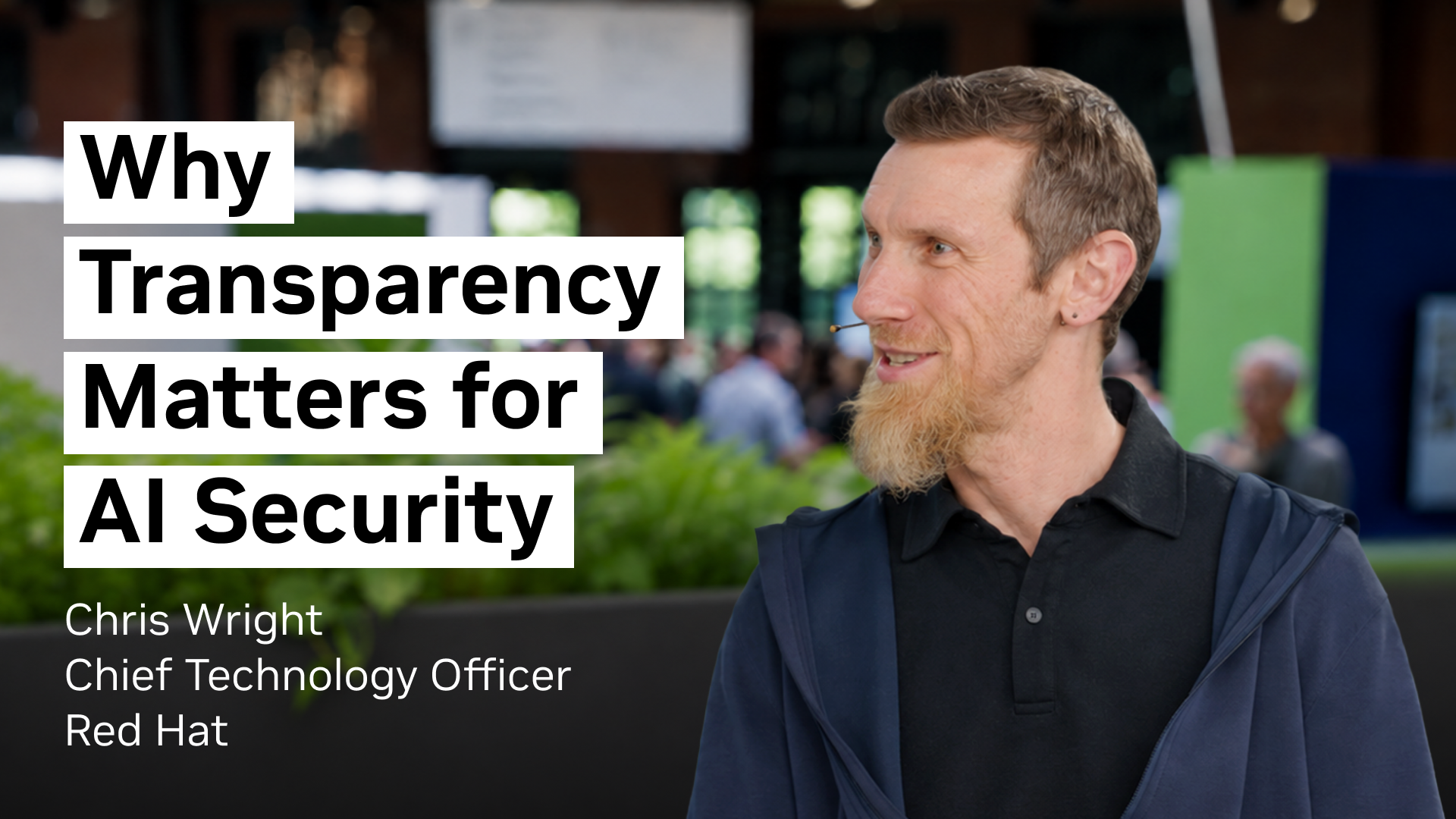
Red Hat CTO Chris Wright joins the NVIDIA AI Podcast at GTC Berlin to explain why open source is the foundation for secure AI agents. From Linux in the 1990s to agent security today, he shares what has changed, what hasn’t, and why “governance is what made us go faster.”
Guest: Chris Wright, CTO, Red Hat
CHAPTERS
00:00 Chris Wright and Linux's enterprise journey
02:19 Why open source still needs evangelizing
03:14 Open source in AI vs. Linux: what's the same, what's new
04:48 Defense in depth for AI agents
08:38 OpenShell and the open collaboration coalition
11:38 Why open standards beat silos
13:21 AI security as an engineering problem
15:52 From OpenClaw to OpenClaw Enterprise
19:23 How governance helps teams move faster
21:42 Why transparency matters for security
23:36 Using AI to find vulnerabilities
26:32 Giving agents clear limits
Follow on Apple Podcasts: https://podcasts.apple.com/us/podcast/nvidia-ai-podcast/id1186480811
Learn more: https://blogs.nvidia.com/blog/ai-security-agent-stack/?ncid=so-yout-497446
Instacart has 1.6 billion lifetime grocery orders—and is now using that data flywheel to digitize the physical store itself. In this episode, David McIntosh, Chief Connected Stores Officer at Instacart, explains how the Caper Cart—powered by an NVIDIA Jetson™ board and a sensor fusion system combining cameras, weight sensors, and location data—is bringing edge AI to the grocery aisle. He shares what's driving double-digit sales lift for retailers, how AI agents are beginning to automate store operations, and why in-store and online shopping will merge into a single unified experience within the decade.
🔬Topics covered:
How Caper Carts use NVIDIA Jetson and sensor fusion to identify items in real time
Why edge AI matters: hundreds-of-milliseconds response vs. seconds in the cloud
Double-digit sales lift from personalized in-cart recommendations
Building a grocery foundation model from 1.6B orders and live in-store data
AI agents for store ops: proactive out-of-stock alerts and CPG shelf optimization
Chapters:
00:00 – Introduction and the Connected Store vision
04:00 – Caper Cart: NVIDIA Jetson, sensor fusion, and edge AI
08:06 – How basket recognition and recommendations work
15:53 – Double-digit sales lift and what shoppers actually want
22:25 – Store ops, employees, and the real-time data flywheel
28:26 – AI agents, the grocery foundation model, and what's next
Snap processes more than 10 petabytes of experimentation data every single morning—and with NVIDIA GPU-accelerated Apache Spark on Google Cloud, Snap cut job costs by 76%, reduced memory usage by 80%, and eliminated 120 terabytes of disk spill from its pipelines.
Prudhvi Vatala, head of engineering platforms at Snap, joins the NVIDIA AI Podcast to break down how he and his team completely modernized data infrastructure for a social platform serving nearly a billion monthly active users—using NVIDIA cuDF plugin (formerly referred to as NVIDIA RAPIDS plugin) for Apache Spark on Google Kubernetes Engine, with zero application code changes.
🔬Topics covered:
How Snap runs A/B tests at planetary scale using rigorous statistical methods like heterogeneous treatment effect detection and variance reduction
Why Snap reuses idle inference GPUs between 1–5 a.m. for batch data processing—and how it built a Kubernetes-based platform to do it
How NVIDIA cuDF delivered 3x+ speedups on join-heavy Spark jobs with no code rewrites
The full business impact: 76% cost reduction, 62% fewer cores, 80% less memory, 120 TB of spill eliminated
How a three-way partnership between Snap, NVIDIA, and Google Cloud made it possible in just 8–9 months
Chapters:
0:00 Introduction and Snap overview
3:35 What is Snap’s experimentation platform?
4:05 Why experimentation, safety, and privacy are core at Snap
4:52 How A/B testing works at billion-user scale
8:14 Discovering NVIDIA cuDF plugin
9:06 Benchmarking results: join, union, and aggregation jobs
12:00 Reusing idle GPUs overnight via GKE
13:24 Building a bottom-up GPU data platform at Snap
17:48 Results: 76% cost reduction and partnership impact
20:56 Snap’s evolution and what’s next
Learn more:
NVIDIA cuDF: https://developer.nvidia.com/topics/ai/data-science/cuda-x-data-science-libraries/cudf#accel-apache
What happens when you combine AI with quantum computing? NVIDIA's Nic Harrigan joins the AI Podcast to break down the state of quantum, explain why error correction is the pivotal challenge, and reveal how NVIDIA Ising—the world's first open AI model family for quantum—is changing the game.
🔗 Resources mentioned:
► Read our NVIDIA Ising announcement
► Learn more about NVIDIA Ising
► Learn more about NVIDIA Quantum Computing
Chapters:
0:00 Intro
0:55 What is quantum computing?
4:00 Qubits, noise, and error correction
5:26 How AI helps quantum error correction
10:57 Applications: drug discovery and materials
15:33 NVIDIA Ising announcement
20:35 Scaling quantum hardware
27:31 Algorithm development with generative AI
AI is reshaping electricity demand. What does increased demand, and the shape of that demand, mean for the electric grid? Ben Sooter, Director of R&D at EPRI joins the podcast to explain why most of an AI model’s lifetime energy use comes from inference rather than training, and how micro data centers located near underutilized substations can help deliver low‑latency AI services while strengthening grid resilience.
How can AV teams stop drowning in petabytes of data and actually ship safer autonomy faster? Fortellix’s Rohan Bhasin and Voxel51’s Dan Gural explain how neural reconstruction, scenario-driven data curation, and NVIDIA-powered pipelines turn ordinary drive logs into high-fidelity simulations that close the last-mile gap in AV performance.
GTC is the premier global AI conference. Learn more at nvidia.com/gtc
How are real‑time 4K holograms that look, sound, and respond like people changing fan engagement? Jia Li, co‑founder, president, and chief AI officer of LiveX AI, shares how human‑like AI agents bridge the digital and physical worlds—from greeting travelers at airports to guiding fans through fan zones and supporting wayfinding at major sports events.
Join the world's premier AI conference: NVIDIA GTC
GiveDirectly president and CEO Nick Allardice explains how his team uses AI, mobile money, and satellite imagery to send cash directly to people living in poverty and crisis, often within days of a disaster. He describes how AI-powered tools help forecast floods in places like Nigeria, Bangladesh, and Mozambique, and how “anticipatory action” can get money to families before disaster strikes.
Learn more about the AI Podcast: ai-podcast.nvidia.com
49 minAbspielen in:
Gäste, die länger als 12 Monate zurückliegen, gibt es mit Pro. Pläne ansehen