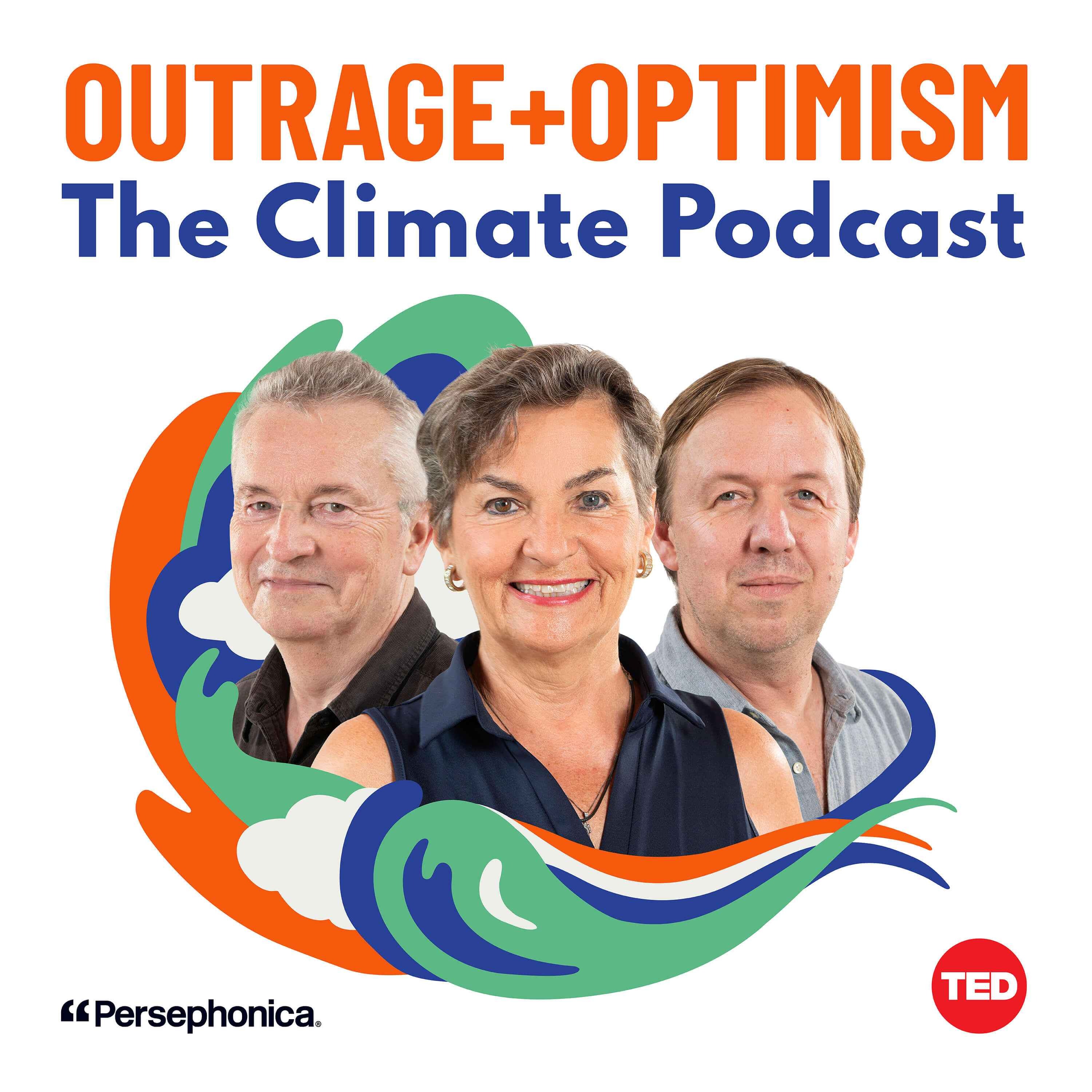
Outrage + Optimism cover
Podcast

Outrage + Optimism

by Persephonica and Global Optimism

Outrage + Optimism has had 9 confirmed guests across 7 episodes in the last 12 months. Latest: Surangel Whipps Jr., Oct 8, 2026.

Show websiteApple PodcastsHow guests are confirmed

Outrage + Optimism is for anyone who is not ready to give up on making the world a better place. For unrivalled conversations with decision makers, visionary thinkers and a community of like-minded climate optimists, join former UN climate chief Christiana Figueres, political strategist Tom Rivett-Carnac and…

Guests on the show

Thu8Oct
Outrage + Optimism

Surangel Whipps Jr.Guest

How Can a Country Survive Losing Its Land?

A ship rams a canoe. The canoe starts to sink. The ship's crew lean over the rail and offer a loan to repair it. That is how Surangel Whipps Jr., President of Palau, describes climate finance in the Pacific, a region responsible for around 0.03% of global emissions. He speaks to Christiana Figueres a few weeks into his year as Chair of the Pacific Islands Forum, and as pre-COP talks wrap in in Fiji and Tuvalu ahead of COP31. In Palau, on his islands, high tides are already flooding the taro patches with saltwater, and the main hospital sits at the water's edge. This week, Christiana returns to the fight that wrote 1.5°C into the Paris Agreement, a limit the small island nations won while most of the world's biggest economies pushed for two degrees. A decade on, the UN expects the world to overshoot it. What does this mean for entire countries that sit just a few metres above sea level? President Whipps explains why diesel power costs his country close to 30 cents a kilowatt hour, when solar is the cheapest energy in the big markets, and what he says to young Palauans who are no longer sure they should have children. And, Tom Rivett-Carnac joins Christiana to ask what is actually required of the rest of us. Last year, the world's highest court sided with the islands. Last month, the UN agreed that a country does not stop being a country once the sea takes its land. Why hasn't the money followed? Thanks to our friends at BE HOPE Podcast Takeover, bringing podcasts around the world together to explore the theme of hope and how we can continue to make progress in a rapidly changing world. Learn More 🎬 Watch All Rise, the documentary narrated by Christiana that follows the Pacific law students who took climate change to the world's highest court 🎟️ Register for our Bath Abbey event livestream on 14 October, Powering the Next Generation to Lead Climate Action 🎧 Listen back to our earlier episodes on the road to the world court: Sovereignty and Survival: A Spotlight on Vanuatu, The Climate Case of the Century, and The ICJ Climate Opinion Explained ⚖️ Read the ICJ advisory opinion on the Obligations of States in respect of Climate Change, the unanimous July 2025 ruling that named 1.5°C the primary temperature goal under the Paris Agreement 🌺 Read the Palau Pledge, the promise every visitor signs to the children of Palau on arrival, and the text that has inspired a movement in Costa Rica to write its own 🌊 Understand the UN's first declaration on sea-level rise, Just Security's analysis of what its presumption of continued statehood means for countries that could lose their land 🛂 Learn more about the Australia-Tuvalu Falepili Union, the treaty behind the climate visa ballot that most of Tuvalu's population entered 🌡️ Read UNEP's Emissions Gap Report 2025, which found the world will very likely pass 1.5°C within the next decade, and why the size of the overshoot still matters Join the conversation 🎤 Leave us your voice notes and questions for upcoming episodes on SpeakPipe Instagram @outrageoptimism LinkedIn @outrageoptimism YouTube @OutrageandOptimism Or get in touch with us via this form. Production credits Senior Producer: Ben Weaver-Hincks Assistant Producer: Saoirse Wilson Showrunner: Caitlin Hanrahan Palau birdsong recorded by JVMoore via xeno-canto This is a Persephonica production for Global Optimism and is part of the Acast Creator Network. Hosted on Acast. See acast.com/privacy for more information.

40 minPlay in:

Thu10Sep
Outrage + Optimism

Christiana FigueresGuest

Blocker or Blueprint? India on the World Stage

At COP26 in Glasgow, India famously asked to change one word in the final text. ‘Phase out’ became ‘phase down’. The COP President fought back tears, as country after country branded this a moment of shame. For many, India has been a villain of that story ever since. But like all stories about this country, the truth is far more complex. In the last of three episodes from India, Tom Rivett-Carnac asks what the world gets right and wrong about the pivotal role that India is playing on the global climate stage. And Christiana Figueres returns to the microphone to trace the argument India has been making in every negotiating room for three decades - and where it might go next. We meet Ambassador Manjeev Singh Puri, who was at Copenhagen in 2009, when the rich world promised billions of climate finance to the developing world. But much of that money never came, and what did arrive came mostly as debt. He has a theory about why India still doesn't get the credit he believes it deserves, and it has nothing to do with the climate. Harjeet Singh, who has campaigned on this for twenty years, shares why his own government treats coal as a matter of national security rather than energy policy. And Dia Mirza tells us what she did when the Chief Justice of India called people like her a ‘lobby’. So is India the blocker, or the blueprint? And what happens to the rules when the countries that wrote them stop keeping them? Learn More 📄 Read Carbon Brief's analysis of India's new climate pledge, filed after the country hit its non-fossil target five years early 🔨 Revisit how COP26 ended in Glasgow - the compromise deal, the last-minute change from phasing coal out to phasing it down 💰 Understand what the $100 billion was actually worth, the Oxfam analysis finding that of $83.3 billion reported for 2020, the real value was at most $24.5 billion 📉 Check the Climate Target Update Tracker, the running record of every 2035 climate target filed so far ⚖️ Read the International Commission of Jurists on India's foreign funding law, under which thousands of organisations have lost their licences 🎤 Leave us your voice notes and questions for upcoming episodes on SpeakPipe Join the conversation: Instagram @outrageoptimism LinkedIn @outrageoptimism YouTube @OutrageandOptimism Or get in touch with us via this form. Senior Producer: Ben Weaver-Hincks India Producer and translator: Adnan Bhat Show Runner: Caitlin Hanrahan Exec Producer: Ellie Clifford This is a Persephonica production for Global Optimism and is part of the Acast Creator Network. Hosted on Acast. See acast.com/privacy for more information.

41 minPlay in:

Thu27Aug
Outrage + Optimism

Dia MirzaShyla RaghavAdnan BhatGuest

India: Life Inside Delhi's 'Airpocalypse'

In Delhi, lung cancer is no longer a smoker’s disease. It’s a breather’s disease. But the most polluted capital on earth sits in a country running five years ahead of its Paris clean power target. In the first of three dispatches from India, Tom Rivett-Carnac is joined by Dia Mirza, one of the biggest names in Indian cinema and a UN Environment Goodwill Ambassador, and Shyla Raghav, formerly Chief Climate Officer at TIME, who describes "a mix of pride, a mix of heartbreak, and, as well, possibility." With Delhi-based journalist Adnan Bhat guiding and translating, Tom traces the path India is trying to build - development founded on renewable energy, clean transport, and a refusal to accept that getting richer has to cost the earth. We meet Bhavreen Kandhari, who stopped relying on the government's air quality figures and started keeping her own. Now, she says, every citizen is a scientist. On a good day, indoors, her monitor reads six times the safe limit. And, Dr Arvind Kumar, who has been operating on Delhi's lungs since the 1980s. Here, he says, “a child becomes a smoker from the first breath.” But he has yet to see dirty air written onto a death certificate in India. And in Old Delhi, Bilkis drives a lavender electric rickshaw. She switched because it was cheaper and easier to drive, she says. Which may be how this actually gets done. Can India grow, bring a fifth of humanity with it, and build a better road than the one the West took and then closed behind it? Learn More 🌍 Read IQAir's World Air Quality Report, which has ranked New Delhi the world's most polluted capital for eight years running 📈 Understand what air pollution costs India on the Lancet Countdown's India data sheet 👩‍👧 Explore Warrior Moms, the network Bhavreen Kandhari co-founded in 2020, now 38,000 mothers across 19 states, with guides on filing air quality RTIs and writing to your MLA 🩺 Learn more about the Lung Care Foundation, set up by Dr Arvind Kumar after black deposits started appearing in the lungs of patients who had never smoked ⚖️ Read about Ella Adoo-Kissi-Debrah, the first person anywhere to have air pollution recorded as a cause of death, the precedent Dr Kumar wants India to follow 🛺 Get up to date on Delhi's switch to electric autos, under which only electric three-wheelers can be newly registered in the city from January 2027 ⚡ See how India passed 50% non-fossil power capacity in July 2025, five years ahead of the target it set under the Paris Agreement 🎤 Leave us your voice notes and questions for upcoming episodes on SpeakPipe Join the conversation: Instagram @outrageoptimism LinkedIn @outrageoptimism YouTube @OutrageandOptimism Or get in touch with us via this form. Senior Producer: Ben Weaver-Hincks India Producer and translator: Adnan Bhat Show Runner: Caitlin Hanrahan Exec Producer: Ellie Clifford This is a Persephonica production for Global Optimism and is part of the Acast Creator Network. Hosted on Acast. See acast.com/privacy for more information.

39 minPlay in:

Thu13Aug
Outrage + Optimism

Christiana FigueresPaul DickinsonTom Rivett-CarnacGuest

Beyond Politics: Should we take the heat out of the climate crisis?

Somewhere along the way, acting on a threat to all of humanity became a political act. Not a simple matter of science and economics, but a signal of whose side you are on. So, what would it take to change the political narrative around climate? This week, Christiana Figueres, Tom Rivett-Carnac and Paul Dickinson answer some difficult questions gathered for our live event at Bath Abbey, postponed when extreme heat made the venue unsafe - as if we needed another reminder of the urgency of this crisis. They ask: can we lift the climate out of party politics altogether? Does real leverage sit with the decisions made in national capitals, or is it only on the COP conference floor while the cameras are rolling? And if vested interests and lobbying can’t be removed, how do we meet them head on, with an equal and opposite force. This episode tries to answer the challenge we all face: do we seek to depoliticise this crisis, or fight for it in the open? And, now that the climate crisis has become a political hot potato, can we change course in time? Learn More 🌍 Explore the Earthshot Prize, Prince William's platform for scaling climate solutions 🗳️ Read about Climate Assembly UK, the citizens' assembly that brought 100+ people together to shape how the country reaches net zero, and why the format keeps vested interests at the door 🚭 Understand Article 5.3 of the WHO Framework Convention on Tobacco Control, the treaty clause Paul points to that shields health policy from the tobacco industry 📢 Read how The Hague banned fossil fuel advertising, a world-first local law that survived a court challenge in 2025 💸 Revisit the fossil fuel divestment movement, the student-led campaign, which pushed institutions holding trillions to pull money out of coal, oil and gas 🎬 Watch The People's Emergency Briefing, the film built to give the public the same starting picture of the crisis their governments often will not explain 🎤 Leave us your voice notes and questions for upcoming episodes on SpeakPipe Join the conversation: Instagram @outrageoptimism LinkedIn @outrageoptimism Or get in touch with us via this form. Senior Producer: Ben Weaver-Hincks Edited by: Miles Martignoni Show Runner: Caitlin Hanrahan Exec Producer: Ellie Clifford This is a Persephonica production for Global Optimism and is part of the Acast Creator Network. Hosted on Acast. See acast.com/privacy for more information.

46 minPlay in:

Thu9Jul
Outrage + Optimism

Trixy ElleGuest

Whose Side Is the Law On? How the Courts Became a Climate Battleground

"Even if you are small in this society, there is something you can do." Those are the words of Trixy Elle, a mother and a fisherwoman from the Philippines, and one of the claimants from the Odette case, named for the super typhoon she lived through. She may never win in court, but she says that isn’t the point. She is one of more than 100 claimants suing the energy giant Shell, demanding justice and accountability for the losses she has experienced as a result of climate change. This week, Christiana Figueres sits down with Joana Setzer and Catherine Higham, two of the authors of the ninth annual Global Trends in Climate Change Litigation report from the Grantham Research Institute at LSE and the Sabin Center at Columbia Law School. And what they find is complex. There have been cases that have captured the world’s attention. Last year’s ICJ advisory opinion on the obligations of states. The Inter-American Court of Human Rights’ landmark advisory opinion establishing a human right to a healthy climate. Or the 2015 case brought by the Urgenda Foundation, where a Dutch court told the government it had a legal duty to protect its citizens from climate change, and ordered it to cut emissions faster. But beneath the headlines, courts on every continent have been litigating how far that duty of care goes and what it looks like. More than 3,600 cases filed across 62 countries - last year at a rate of five a week. And of the 215 that have reached the highest national courts, more than half have gone in a direction favourable to climate action. But a maturing field cuts both ways: for every Urgenda-style case there is now a countermove - laws to shield companies from liability, suits designed to stop protest, even governments weighing whether to walk away from their commitments altogether. So what happens when the law gets ahead of the politics? And who holds the structure together when, as Christiana puts it, nobody is orchestrating the Jenga game? Learn More: 🔎 Read the executive summary of Global Trends in Climate Change Litigation: 2026 Snapshot - or the full report (Grantham Research Institute, LSE / Sabin Center) ⚖️ Urgenda Foundation v. State of the Netherlands - the 2015 ruling, upheld in 2019, that a government has a legal duty to protect its citizens from climate change 📋 Our recent episodes on the ICJ advisory opinion, the Revolution Wind lawsuit, and the New Zealand pushback 🎤 Leave us your voice notes and questions for upcoming episodes on SpeakPipe Join the conversation: Instagram @outrageoptimism LinkedIn @outrageoptimism Or get in touch with us via this form. Producer: Ben Weaver-Hincks Editing by: Miles Martignoni Planning: Caitlin Hanrahan Exec Producer: Ellie Clifford This is a Persephonica production for Global Optimism and is part of the Acast Creator Network. Hosted on Acast. See acast.com/privacy for more information.

50 minPlay in:

Thu11Jun
Outrage + Optimism

Christiana FigueresPaul DickinsonGuest

Extreme Heat Breaks: The hidden climate story behind the World Cup

For the first time, all 104 matches at the Men's Football World Cup will be stopped for a mandatory three-minute hydration break, halfway through each half. For the first time, a global audience of billions will watch climate adaptation happening in real-time. This week, Tom Rivett-Carnac, Christiana Figueres and Paul Dickinson look at what a football tournament, a transit scandal, and an oil war have in common. Around a quarter of World Cup matches played over the next few weeks are projected to be played in conditions that exceed recommended heat safety limits - twice the risk of the last US-based World Cup, in 1994. Only three of the sixteen stadiums across the US, Mexico and Canada are climate-controlled. This will be a trial for elite players, who can adapt up to a point, but what does this mean for the parks, cages and school pitches where the ‘beautiful game’ actually begins? The Count Us In campaign, Where Football Lives, hopes that this can bring about a conversation: one about how extreme heat will change how we live, and what we love. So, should those three-minute breaks be called what they actually are: extreme heat breaks? And a World Cup falling during a moment of rising fuel prices is exposing more than just the changing climate. When NJ Transit announced return tickets from central New York City to the nearby MetLife Stadium at $150, up from under $15, it laid bare how poorly served the US public is for transportation. The collision of surge pricing and rising pump prices may not be the catalyst anyone planned - but could it help highlight the benefits that a properly funded public transport system could have? Elsewhere, the Iran war and the fragility it has exposed in global fossil fuel supply chains may be doing more to accelerate the clean energy transition than any policy has managed. Two forces are driving it: Chinese manufacturing dominance, and what we're calling ‘American foreign policy chaos’. Neither is acting for climate reasons. But the case for a post-carbon future has never been stronger. None of this looks like the transition we imagined. The question is, are we ready to recognise the moment for change when it arrives, in whatever form it takes? And if change happens, does it matter how we get there? Learn more: 🌍 Check out Where Football Lives, Count Us In's campaign on extreme heat and grassroots football ⚽ Learn how to do a keepy-uppy / juggle a football on the Where Football Lives record attempt page - or simply learn what we’re talking about 🌡️ Read more from Reuters on the threat of extreme heat at this World Cup ⚡ Read the latest on US transit ticketing prices around the tournament 🔎 Listen to Ian Bremmer on the Ezra Klein Show 🎤 Leave us your voice notes and questions for upcoming episodes on SpeakPipe Join the conversation: Instagram @outrageoptimism LinkedIn @outrageoptimism Or get in touch with us via this form. Producer: Ben Weaver-Hincks Planning: Caitlin Hanrahan Exec Producer: Ellie Clifford This is a Persephonica production for Global Optimism and is part of the Acast Creator Network. Hosted on Acast. See acast.com/privacy for more information.

38 minPlay in:

Thu30Apr
Outrage + Optimism

David ShukmanGuest

“This is civilisation changing stuff”: Is AMOC the hardest climate story to tell?

Europe plunged into a deep freeze. Life as we know it upended. The 2004 film ‘The Day After Tomorrow’ gave a generation of terrified journalists an impossible task: how do you communicate the counter intuitive threat of dramatically colder winters caused by global warming? David Shukman was one of them. This week, Tom Rivett-Carnac is joined by the veteran BBC Science Editor and author of the upcoming ‘The Response’, to explore the Atlantic Meridional Overturning Circulation, or AMOC: the vast system of currents that helps regulate weather, rainfall and temperature across the Atlantic and far beyond. Recent research suggests it may be weakening faster than previously understood - with potentially profound consequences for food systems, ecosystems and global stability. They speak with Dr Willem Huiskamp of the Potsdam Institute for Climate Impact Research, who explains what AMOC does, and what a much weaker system could mean in practice. Then Tom and David reflect on the harder questions. How do we communicate a risk this vast and uncertain without paralysing people or losing them entirely? Are we socially and politically prepared for -50C winters in parts of Europe? And are we even capable of responding to a threat that may unfold over decades rather than across news cycles and political terms? Learn More: 🌊 Discover more about the Atlantic Meridional Overturning Circulation and why scientists are watching it closely 🔎 Read the latest paper referenced in this episode, which projects an approximate 50% weakening of AMOC by the end of the century 📘 Check out David’s book, The Response, which will be published by Witness Books on 7th May 🎤 Leave us your voice notes and questions for upcoming episodes on SpeakPipe Join the conversation: Instagram @outrageoptimism LinkedIn @outrageoptimism Or get in touch with us via this form. Producer: Ben Weaver-Hincks Edited by: Miles Martignoni Planning: Caitlin Hanrahan Exec Producer: Ellie Clifford This is a Persephonica production for Global Optimism and is part of the Acast Creator Network. Hosted on Acast. See acast.com/privacy for more information.

46 minPlay in:

Guests from more than 12 months ago are part of Pro. See plans