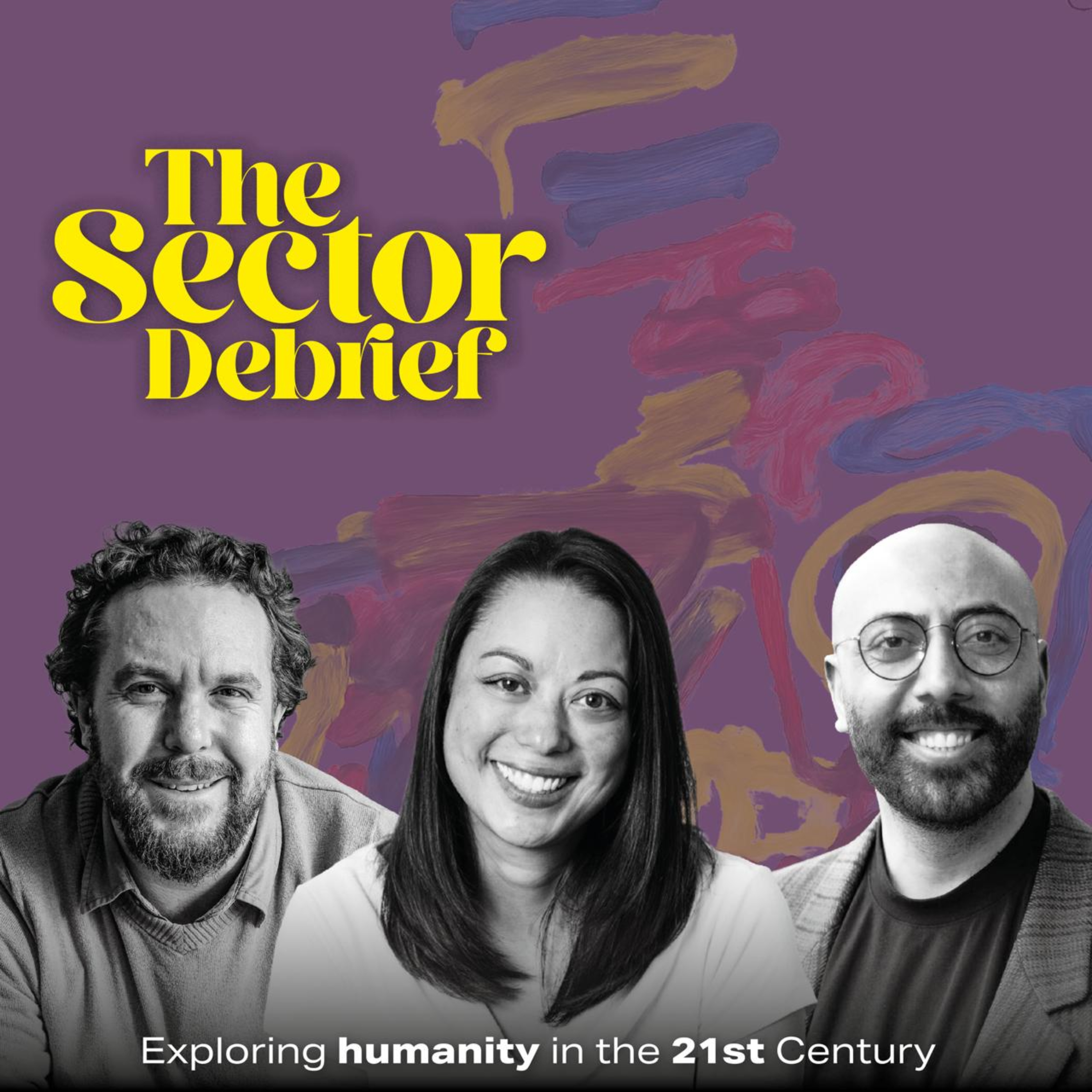
The Sector Debrief brings you inside the real conversations that shape the humanitarian and development world. No polished lines. No scripted answers. Just honest discussions about politics, funding, power, localization, pressure, and the future of crisis response. Hosted by Ali Al Mokdad, Kim Kucinskas, and Thomas…
"We are practising our way into what the future will look like."
In this episode, Kim Kucinskas, Thomas Jepson-Lay, and Ali Al Mokdad are joined by Vanessa Self, Project Director of the Impact Alliance, the collaboration between CARE, Mercy Corps, and Save the Children, created when three CEOs, Michelle Nunn, Tjada D'Oyen McKenna, and Janti Soeripto, came together aiming for deeper collaboration and efficiency.
Vanessa Self is honest about the initiative: collaboration is slower, harder, and less intuitive than the slogans suggest. And about what it opened: while the sector talked about what to cut, this became a space for what could be. She walks through the three workstreams that survived the testing of 81 possibilities: collaborative procurement, with potential savings she puts at around ten million dollars over the coming year, a community insights engine she calls accountability, but not as you know it, and scale works, which takes interventions that already have an evidence base and helps governments scale them. Along the way, partnership mapping revealed the organisations share only around 2% of their partners.
Ali Al Mokdad asks what it takes to scale the collaboration that already exists at country and field level, and draws the line between efficiency and transformation. Kim Kucinskas presses on how change happens in a system designed to keep organisations fragmented. Thomas Jepson-Lay calls the Alliance a canary in the coal mine, and asks why agility still needs a CEO.
And when the conversation ends, the microphones stay on. Kim, Thomas, and Ali stay behind for a debrief: what excited them, what frustrated them, and what the Impact Alliance really signals about how willing the sector is to change.
Honest thinking, shared without scripts and without talking points.
-------------------
Learn more about the Impact Alliance:
The three CEOs on why they are uniting (Devex): https://www.devex.com/news/we-are-uniting-to-change-the-future-of-aid-and-hope-funders-will-follow-112655
CARE: https://www.care.org/about-us/strategic-partners/impact-alliance/
Mercy Corps: https://www.mercycorps.org/who-we-are/impact-alliance
Chapters:
(00:00) Cold open
(01:16) Where the Impact Alliance began
(04:43) How the idea landed with staff
(09:31) Practising, not theorising
(15:53) Is this a merger?
(17:25) From 81 possibilities to three workstreams
(23:35) What it looks like at country level
(27:10) The Somalia procurement story
(30:28) Not survivalism
(35:04) Just starting to start
(41:29) Efficiency and transformation
(45:09) Small-t transformation
(47:22) A canary in the coal mine
(49:24) The message to funders
(51:38) Taking the Alliance to UNGA
(55:59) The Hot Debrief
(59:31) Panarchy and feedback loops
(1:03:36) Wishing the Alliance well
In this episode, Kim Kucinskas, Thomas Jepson-Lay, and Ali Al Mokdad are joined by Sabrina M. Segal, Director of The Risk Collaborative, who has spent years working on how organisations in the humanitarian and development sector actually think about risk. Her argument: risk is not compliance. It is the effect of uncertainty on objectives, and most of the sector has been doing it backwards, starting from a list of everything that might go wrong instead of from what the work is trying to achieve.
The conversation moves between the practical and the structural, and Sabrina does not stop at the critique. She offers the tools. Start from the objective, then treat risk as a two-sided coin of threats and opportunities, because a sector that only looks at the downside loses half its creativity. Do the analysis upstream while the objective is still being designed, so the numbers can defend a budget when a funder reaches for the red pen. Run a three plus three strategy instead of a five year plan nobody can escape two years in. Replace endless prediction with organisational fragility work, her phrase is "don't predict, prepare", because over-reliance on one big funder sat on every risk register for years and the registers saved no one. And use the three P framework, Project, Partner, Patron, which reframes a women's organisation in Sudan judged high risk for lacking an insurance market that does not exist, and plots funders on a line from command and control to trust to see how far they will actually bend.
Ali Al Mokdad reflects on how risk gets branded to win attention from headquarters, and why what a process leaves out often says more than what it includes. Kim Kucinskas builds on this with the idea of risk as a crack of opportunity, a language people in power actually listen to. Thomas Jepson-Lay presses on competing objectives and the fear of failure, and what happens when protecting the organisation quietly replaces protecting its purpose. It lands on what Ali calls the generational fight: clearing out the inherited compliance, outdated governance, and habits that drain the sector's energy, so the people who come next can spend theirs on the things that actually matter, climate, hunger, health, rather than the machinery around them.
Honest thinking, shared without scripts and without talking points.
What does it mean to truly know who you are — and how you show up — in the spaces you occupy?In Episode 5 of The Sector Debrief, Kim Kucinskas, Thomas Jepson-Lay, and Ali Al Mokdad are joined by Aisha Tambajang, a humanitarian and development leader who has navigated identity, race, positionality, and belonging across The Gambia, Denmark, and the UK.The conversation moves between the deeply personal and the structurally urgent. Aisha Tambajang unpacks the difference between identity and positionality — what you carry versus where you stand in relation to power — and shares what it felt like to be seen as a Black woman in Denmark when she saw herself as Danish, and what it meant to return to The Gambia and occupy an entirely different position in the same system. Thomas Jepson-Lay reflects on ancestral guilt, the discomfort of transition, and what it means to leave the formal humanitarian system while still holding humanity as a core value. Kim Kucinskas builds on this with a sharp observation — that leaders who have never had to think about how they show up are now experiencing that discomfort for the first time, and it is jarring.Ali Al Mokdad brings reflections from Dubai, where leaders are responding to institutional shock not by rushing to survive, but by investing in values-based leadership and the kind of moral clarity the sector rarely prioritizes. Contrasted with Geneva, where too many conversations, he observes, are still starting from guidelines written for a world that no longer exists. As Ali Al Mokdad put it — "I feel like I spent my time at HQ level explaining HQ to the field, and the field to HQ." A tension that defines the sector, and one that this episode does not shy away from.Thomas Jepson-Lay captures the sharpest contrast of the episode in one line. There is a rush to fix. And there is a curiosity to solve. They are not the same thing. And which one you default to says everything about where you are standing, and who you think you are in the room.Honest thinking, shared without scripts, without talking points, and with reflections.Aisha Tambajang profile:https://www.linkedin.com/in/aisha-tambajang-81129b1b0/
55 minAbspielen in:
Gäste, die länger als 12 Monate zurückliegen, gibt es mit Pro. Pläne ansehen

 VS