The Vault Unlocked cover
Podcast

The Vault Unlocked

von Kayvon Kay

The Vault Unlocked hatte in den letzten 12 Monaten 11 bestätigte Gäste in 11 Folgen. Zuletzt: Sean Campbell, 8. Okt. 2026.

Website der SendungApple PodcastsSo werden Gäste bestätigt

Vault Unlocked is for founders who don't want to learn the hard way. If you're building something real and you care about growing revenue faster, cleaner, and with fewer blind spots, this podcast is your unfair advantage. Hosted by Kayvon Kay, Vault Unlocked brings elite founders and operators into conversations they…

Gäste der Sendung

Do8Okt
The Vault UnlockedSC

Sean CampbellGast

How AI is Raising the Bar at Every Job (Most People Haven't Felt It Yet)

Your team is already being measured against a standard you didn't set. AI raised the bar, and the founders who haven't noticed are about to miss opportunities because of it. Kayvon sits down with Sean Campbell, who has spent three decades watching how people adopt technology, who embraces it and who stalls. Sean sees the pattern in his classroom, in boardrooms and in the companies he helps rebuild around AI. He gives Kayvon the one question he would ask to predict who wins with it, and it has nothing to do with how technical you are. It comes down to how you manage people. Sean is the CEO of Cascade Insights, and author of The Art of Asking: Collaborating Effectively with AI. He helps leaders redesign work with AI and understand how it is changing their market. Sean gave a room of future sales reps 30 minutes to pitch a university on a new cafeteria supplier. Within five minutes, some teams wanted to hand in a finished email. Others used AI to attack their own work, found the holes and ended up better prepared than reps who started before AI existed. Same tool, same clock. Completely different outcome. Sean breaks down why that split shows up inside every company, including yours. From there Kayvon and Sean go after the questions most leaders avoid. Why a great-looking deck or email no longer sets anyone apart. Why this round of job disruption plays out in about a year when the last ones took generations. Why knowing what great work looks like is starting to matter more than having done every step by hand. And what happens to your sales process when a meeting ends with the proposal already written. Kayvon adds his own experience building with AI with zero development background, and the two get into why AI can be your best intern or your worst one depending on you. This episode is for founders, operators and executives who are responsible for how a team performs over the next five years. If AI is still a search bar in your business, you are leaving growth on the table and your competitors know it. The conversation also covers how AI is reshaping business growth and sales performance. Sean explains why business owners often see the upside before their employees do, and why delegation and clear context have become core leadership skills in an AI-driven company. They talk about deciding each morning what to give AI and what to keep, how AI slop raises the value of real creative talent, how to keep up when something new launches daily, and why building software for an audience of one is turning into a real edge. Sean closes with what to watch next, and it is robotics. Questions Answered How is AI raising the bar at every job? What skill predicts whether someone will succeed with AI at work? Why do good delegators get better results from AI? How should leaders decide what to give AI and what to keep for humans? Will AI replace jobs faster than past technology shifts? How is AI changing sales roles and proposals? Should schools and universities ban AI? Does learning a craft by hand still matter when AI can do the work? How can leaders keep up when AI changes every day? What is "software of one," and why does it matter for business owners? Why should founders watch robotics alongside AI? Looking to dive deeper into these conversations and connect with our host and guest? Follow Sean Campbell: Instagram Facebook LinkedIn Website Follow Kayvon: Instagram Facebook LinkedIn TikTok Want to go deeper with Kayvon? Subscribe to the newsletter Book a discovery call Get your Revenue Engine Scorecard™️ Hire the right salespeople

42 minAbspielen in:

Mi12Aug
The Vault UnlockedJT

Josh TroyGast

Why the Setter-Closer Model Still Wins (And How to Build One That Actually Scales)

Josh Troy, co-founder of Curvion Blue and 12-year high-ticket sales operator, joins Kayvon Kay on to break down what a real sales operation looks like from the inside, and why most founders have never actually built one. Most sales problems are not sales problems. They are infrastructure problems dressed up as performance problems. You hired the wrong person, handed them the wrong metrics, and wondered why nothing scaled. Josh has seen it hundreds of times. So has Kayvon. This conversation is two operators comparing notes without cleaning it up for the audience. The episode opens on the setter-closer model. Why it still wins, and why it has nothing to do with preference and everything to do with leverage. From there, Josh introduces the golden formula: lead flow multiplied by sales performance equals revenue. Two variables. Two sides of the table. A feedback loop most businesses have never actually built. The conversation moves into the validation sequence, a diagnostic framework that identifies exactly where a revenue operation is breaking down before anyone blames the wrong variable. Lead quality first. Rep performance second. Pitch design third. Offer design last. Run it in order, document it in a validation matrix, and you stop having the marketing-versus-sales argument and start having a data conversation. They also cover why close rate is the wrong primary metric, what collected dollars per booked call actually measures, how the funding waterfall increases average sales price without burning the deal, and what a technical close is and why tracking it separately protects your reps and your client relationships. The episode closes on conviction. A rep with modest skill and full conviction will outsell a rep with all the right skills and zero belief every time. If close rate is still your primary rep metric, this episode will change how you run the numbers. Questions Answered Why does the setter/closer model outperform the full-cycle rep model at scale? What is the validation sequence and how does it replace "lead quality" as a diagnostic? What is the golden formula and how do you use it to find where revenue is leaking? What is a SIP and how does it differ from a PIP? What is the funding waterfall and how does it protect average sales price? What is a technical close and why should it be tracked separately? Why does a good rep with great systems beat a great rep with bad systems? What is CDPBC and why is close rate the wrong primary metric? Looking to dive deeper into these conversations and connect with our host and guest? Follow Josh Troy: Instagram LinkedIn TikTok YouTube Learn more about Curvion Blue Follow Kayvon: Instagram Facebook LinkedIn TikTok Want to go deeper with Kayvon? Subscribe to the newsletter Book a discovery call Get your Revenue Engine Scorecard™️ Hire the right salespeople

1 h 14 minAbspielen in:

Mi5Aug
The Vault UnlockedME

Meir EzraGast

Inner Empire: Why Unfinished Tasks Are Quietly Draining Your Income

Meir Ezra, entrepreneur, speaker, and founder of Guaranteed Prosperity, sits down with Kayvon Kay for part two of a three-part series called Inner Empire. Every task you have not finished is still running in the background of your mind. It is pulling your attention, your energy, and your money without you noticing. Meir names exactly what is happening inside your head when you stall, freeze, or half finish something, and exactly what it is costing you. This is not a mindset conversation. It is a mechanism, and once you see it, you cannot unsee it. The episode opens with a distinction most people have never made: the difference between operating as cause and operating as effect. Meir breaks down what the mind actually is, a rapid series of pictures running in the background, not a personality trait or a mindset setting, and why trying to fix your mindset is often solving the wrong problem entirely. From there the conversation moves into a full reframe of insanity. Not the definition everyone repeats, but a sharper one: attention stuck in the past. Meir ties this directly to why smart, capable founders stay stuck long after they already have the knowledge to move forward. The middle of the episode gets uncomfortable in the right way. Meir tells two real stories, one involving a physical ailment tied to unresolved grief, another about a man whose career stalled for decades over a decision made at seven years old, to show how unclosed emotional loops physically show up in the body and in the business. He also shares his own story of closing a hundred million dollar deal in South Africa with no money, no English, and no track record, to prove the difference between believing something is possible and knowing it. The episode closes with the most practical section of the conversation, a three step method, start, change, stop, for identifying and closing every open loop currently draining your attention. Meir makes the case, directly and without hedging, that control equals income, and that every task left unfinished is a leak in both. Who this is for: Founders and operators who already have the knowledge and still cannot execute. Anyone running a business who has noticed the same pattern repeating, the same procrastination, the same unfinished task, the same excuse, and suspects it is not a discipline problem. This is not for anyone looking for a quick affirmation or a surface level productivity hack. This is a mechanism, not a pep talk. The conversation touches directly on business growth and why so many founders plateau despite having the right strategy, the right offer, and the right market. Meir connects personal control to income and leadership capacity, arguing that the systems most entrepreneurs build to scale a business are secondary to the internal system running their own decision making. He also addresses the difference between mindset work and actual behavioral change, a distinction that matters for anyone trying to lead a team, close high ticket sales, or build sustainable business systems without burning out in the process. For operators who understand the mechanics of growth but keep hitting an invisible ceiling, this conversation names the ceiling directly. Questions Answered: What is the real definition of insanity, according to Meir Ezra? Why do unfinished tasks and open loops drain your income and focus? What is the difference between the mind, the spirit, and the body? Why does knowing something feel different from believing it? How did Meir Ezra close a $100 million deal with no money and no English? What is the Start, Change, Stop method for closing open loops? How does unresolved emotional pain show up as physical or business limitation? Why does control equal income? Looking to dive deeper into these conversations and connect with our host and guest? Follow Meir Ezra: Instagram Facebook LinkedIn X TikTok Website Follow Kayvon: Instagram Facebook LinkedIn TikTok Want to go deeper with Kayvon? Subscribe to the newsletter Book a discovery call Get your Revenue Engine Scorecard™️ Hire the right salespeople

1 h 22 minAbspielen in:

Mi24Jun
The Vault UnlockedDL

Daniel LinaresGast

Why You Can't Outgrow Your Own Identity (The Real Reason Your Business Results Are Stuck)

Most people think their problem is strategy. It isn't. You can change your offer, your funnel, your team, and your calendar, and still land in the exact same place six months later. The reason is sitting underneath all of it, and almost nobody names it out loud.This episode names it. Daniel Linares, Founder & CEO of DLE Event Group joins Kayvon to break down why your identity is the ceiling on your results, and why no amount of tactics will move you past a self-image that says you don't belong at the next level. The conversation moves fast and stays concrete. Kayvon lays out the line that reframes the whole thing: you cannot outpace, outsell, or outgrow your own identity. Daniel shows how the people who keep leveling up are doing one thing differently, and it has nothing to do with talent. They get into how Kobe built the Black Mamba and how Beyonce built Sasha Fierce, not as nicknames but as a new set of operating rules they stepped into before the results arrived. They unpack the reversal most people get backwards, the belief that you have to acquire the thing before you can become the person, when it works the other way. They walk through the self-imposed rules that quietly cap a founder's growth, the difference between waiting in line and finding the third door, and David Cook's SFT framework for resetting back to baseline under pressure the way the one percent do. This is for founders, operators, and high-agency builders who have already done the obvious work and are still hitting the same wall. If you are looking for motivation, this is the wrong room. If you want to understand the actual mechanism behind why your results have plateaued, stay. The discussion connects identity, mindset, and self-belief to the hard mechanics of business growth: how high performers think under pressure, how to take radical responsibility for outcomes, how to become resourceful instead of stuck, and how to ship before you feel ready instead of waiting for a readiness that never comes. It is a conversation about the inner game that drives every outer result, and the leadership decisions that compound over time. Topics covered: Why identity sets the ceiling on results, income, and growth The Black Mamba and Sasha Fierce as built identities, not nicknames The Be, Do, Have reversal most founders get backwards The self-imposed rules quietly capping your growth Third door thinking and how to stop waiting in line David Cook's SFT framework for resetting under pressure Why shipping at 70 percent beats waiting until you feel ready The role of trust and faith when the outcome is uncertain Looking to dive deeper into these conversations and connect with our host and guest? Follow Daniel Linares @DanielLinaresTV Youtube Instagram Facebook LinkedIn TikTok Website Follow Kayvon: Instagram Facebook LinkedIn TikTok Want to go deeper with Kayvon? Subscribe to the newsletterBook a discovery callGet your Revenue Engine Scorecard™️Hire the right salespeople

42 minAbspielen in:

Mi10Jun
The Vault UnlockedJG

John GoldmanGast

Health Optimization for Business Owners: Why Biohacking Doesn't Work (And What Does)

Most people optimizing their health are spending the most and changing the least. They have the drawers full of nootropics, the cold plunge, the red light panel, the vagus nerve device that stopped working two weeks in. They have the data. They have the gadgets. And they still wake up feeling like garbage. This episode explains why. Kayvon sits down with John Goldman, founder and CEO of Rebel Health Alliance, who spent decades as an athlete and entrepreneur and still woke up at 46 prediabetic, with high blood pressure, fatty liver disease, and inflammation through the roof. He had no idea. The diagnostics put it in black and white, and what he did next became the basis for a company built on a single uncomfortable idea: the entire health optimization industry is selling people the wrong 5 percent. John breaks down where health optimization actually came from, why the traditional healthcare system was never built to make you healthy, and how a 1930s policy decision quietly split the treatment of disease from the generation of health. He explains why high agency operators keep buying more tests, more wearables, and more supplements while missing the boring fundamentals that drive 95 percent of the result. Then he names the one role almost nobody in your health actually plays: the fiduciary who has no product to sell you. This is also a conversation about money. The hundreds of billions spent treating preventable disease. The insurance math that has quietly changed underneath everyone. And why the new class of metabolic drugs is about to become the most widely used pharmaceutical in American history. This episode is for founders, operators, and executives who already know their business is only as optimized as they are. If you run hard, carry the weight, and have started to feel the ceiling in your own body, this is the diagnostic you have been avoiding. If you are looking for another supplement stack to buy, this is not for you. The conversation moves through what health optimization really means for people running businesses under pressure, why cardio respiratory fitness outranks nearly every other intervention for long term performance, how resistance training and sleep quietly outperform the expensive trends, and what it actually takes to build a system around your health instead of a shelf full of abandoned devices. It is a clear look at energy, longevity, and the link between physical condition and the capacity to lead, scale, and make sharp decisions. Topics covered: Why your business is only as optimized as you are The diagnostics most doctors never order, and why The Flexner Report and the system that splits health from treatment The "health fiduciary" and why no one in your current setup plays that role The boring fundamentals that drive 95 percent of results Where red light, cold plunge, peptides, and nootropics actually fit VO2 max, fat free mass index, and the metrics that predict longevity The metabolic drug wave and what it means for the economy and the country Looking to dive deeper into these conversations and connect with our host and guest? Follow John Goldman: Instagram LinkedIn X Learn more about Rebel Health Alliance Follow Kayvon: Instagram Facebook LinkedIn TikTok Want to go deeper with Kayvon? Subscribe to the newsletter Book a discovery call Get your Revenue Engine Scorecard™️ Hire the right salespeople

1 h 02 minAbspielen in:

Mi22Apr
The Vault UnlockedJM

Jeff MacPhersonGast

How to Actually Implement AI in Your Business Without Wasting Six Months

Most businesses are not behind on AI because they lack access. They are behind because they moved fast in the wrong direction. Six months. Tens of thousands of dollars. Tools that no longer exist. Teams that never bought in. This is the pattern, and it is more common than anyone is admitting. This episode is the correction. Kayvon Kay sits down with Jeff MacPherson, CEO of Cloud37 and one of the most clear-eyed operators in the AI implementation space. Jeff has spent four years inside the infrastructure of how businesses actually adopt AI, not how they talk about it on social media. What he has seen, and what he breaks down in this conversation, is the difference between businesses that are compounding and businesses that are quietly falling behind while convinced they are keeping up. The conversation moves fast and stays grounded. Kayvon built two full SaaS platforms with zero development experience. Jeff eliminated three engineers while growing. A client is generating seventy thousand dollars a month from two AI agents with near-zero fulfillment. These are not projections. They are current operating realities. What becomes clear is this: the businesses that win are not the ones with the most tools. They are the ones who understand the architecture underneath the tools. Process first. Knowledge base second. Agents third. Get that order wrong and you are rebuilding in six months. Jeff also draws a line that most people in the AI space are avoiding. The people who built audiences on manufactured credibility are being exposed. Not by critics. By the technology itself. When everyone has access to the same output capability, the only thing that differentiates is genuine expertise. You either have the depth or you do not. AI will make that visible faster than anything that came before it. This episode is for founders, operators, and executives who are past the question of whether AI matters and are now asking how to build with it correctly. It is not for people still deciding whether to start. That window is compressing. If you are running a knowledge-based business, a sales organization, a service company, or a team that relies on internal processes and repeatable delivery, this conversation applies directly to your next ninety days. The intersection of AI business strategy, workflow automation, sales systems, and subscription model design is where most of the real money is moving right now. The businesses scaling efficiently in 2025 and into 2026 are not adding more headcount. They are building AI architectures that extend expertise, reduce fulfillment cost, and create recurring revenue from intellectual property that already exists inside their organizations. That is what this conversation is about. Topics Covered Why most AI implementations fail within the first six months The three-layer architecture every business needs before buying tools How Kayvon built two SaaS platforms with zero development experience Why community is the only durable moat in an AI-saturated market The AI Architect role and why it is the most valuable hire of the next decade How to turn existing expertise into a scalable subscription model Why generic AI output will expose fake experts and reward real ones The $70K per month case study built on two agents and near-zero fulfillment How to implement AI without making expensive, irreversible decisions Looking to dive deeper into these conversations and connect with our host and guest? Follow Jeff MacPherson: Instagram Facebook LinkedIn YouTube Learn More Follow Kayvon: Instagram Facebook LinkedIn TikTok Want to go deeper with Kayvon? Subscribe to the newsletter Book a discovery call Get your Revenue Engine Scorecard™️ Hire the right salespeople

30 minAbspielen in:

Mi25Mär
The Vault UnlockedAB

Anders BoulangerGast

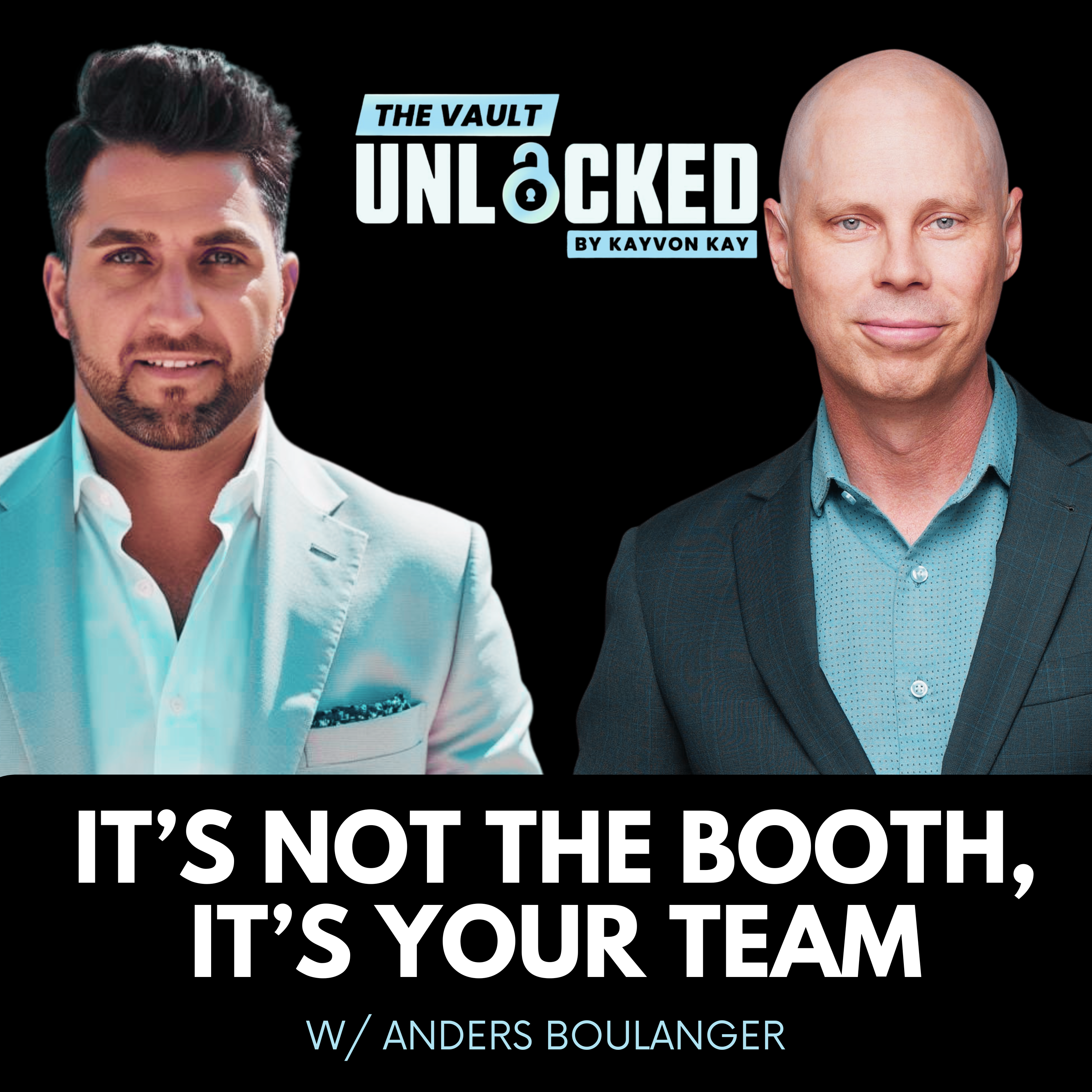
Why Your Trade Show ROI Is Suffering and How to Fix Your Sales Team's Booth Strategy

If you're spending $50K+ on a trade show and hoping it works… you've already lost. Most booths don't fail because of traffic. They fail because no one knows how to convert it. And the worst part? You won't even realize how much money you left on the floor. This episode breaks the illusion that trade shows are about "showing up." They're not. They're about engineered attention, controlled engagement, and conversion systems that most companies never install. Kayvon sits down with Anders Boulanger, a trade show performance specialist who's worked inside everything from $10K booths to million-dollar builds. What he exposes is simple: Most companies operate like booth buyers. They pay for space, stand around, and wait. The ones who win? They manufacture demand, control the crowd, and pre-frame every interaction before a sales conversation even begins. This conversation goes deep into the mechanics behind high-performing booths: Why passive traffic kills ROI, how psychology outperforms design, what actually makes people stop, stay, and buy, and how the best companies turn trade shows into predictable revenue channels instead of expensive brand plays. If you've ever questioned whether trade shows "work", this will show you why most don't. This episode is for: Founders investing in live events, expos, or trade shows, operators responsible for pipeline, lead generation, and conversion, sales leaders tired of low-quality event ROI, companies spending real money on visibility without measurable return. If you're not responsible for revenue, this isn't for you. Trade shows are one of the last true face-to-face sales environments where attention, influence, and execution collide in real time. This episode unpacks how business growth at events is driven by human behavior, not booth design. It shows how sales systems, buyer psychology, and real-time engagement determine whether you generate a pipeline or just collect badges. From lead capture failure rates to conversion gaps inside booth teams, this is a breakdown of how money is won or lost in live environments where most companies rely on hope instead of structure. Topics covered: Why most companies send their worst closers to their biggest opportunity The "booth buyer" mistake that kills ROI How to engineer crowd psychology and create a magnetic presence The 3-part model: attract, connect, convert Why 70–75% of trade show leads never get followed up The real role of booth staff in revenue generation How top companies generate 3x–4x ROI from the same events The difference between traffic and qualified attention Simple execution mistakes that cost companies millions Looking to dive deeper into these conversations and connect with our host and guest? Follow Anders Boulanger: Instagram Facebook LinkedIn Engagify.ai Follow Kayvon: Instagram Facebook LinkedIn TikTok Want to go deeper with Kayvon? Subscribe to the newsletter Book a discovery call Get your Revenue Engine Scorecard™️ Hire the right salespeople
40 minAbspielen in:

Mi18Mär
The Vault UnlockedMS

Mark SchaeferGast

How AI Is Rewiring Your Customers (And Why Most Businesses Aren't Ready)

Most businesses still think they're selling to people. They're not. They're selling to an algorithm that's already decided what their customer believes, buys, and trusts. If you don't understand that shift, you're already invisible. This conversation with Mark Schaefer goes straight at the real problem: AI isn't just changing marketing tactics. It's rewiring how humans think, decide, and relate to the world. He breaks down what happens when customers stop researching, stop comparing, and start defaulting to AI for answers. Not just for low-risk decisions, but for where to live, who to trust, and what to buy. The conversation moves from surface-level AI hype into the real consequences: Cognitive offloading, loss of human agency, AI becoming the primary decision-maker, and what that actually means for businesses trying to grow. Because when AI becomes the filter between you and your customer, traditional marketing doesn't just weaken, it becomes irrelevant. At the same time, this isn't a doomsday conversation, it's a recalibration. Brand, trust, and human signals are no longer "nice to have." They are the only leverage left when machines are making recommendations at scale. This episode is for founders, operators, and leaders who are already building or scaling businesses and can feel the shift happening underneath them. Not beginners.Not people looking for tactics. This is for people responsible for growth who need to understand where decision-making is actually moving. The discussion touches the real intersection of AI, business growth, and customer psychology. How decision-making authority is shifting from humans to systems. Why branding is becoming more important than performance marketing. How trust, authority, and reputation now determine whether AI recommends you at all, and why most companies focusing only on content volume, automation, or SEO shortcuts are setting themselves up to be ignored. This is not about tools, it's about power, influence, and control in a system where visibility is no longer earned the old way. Topics covered: • Cognitive offloading and the decline of independent thinking • Why AI is becoming the primary decision-maker in sales • The difference between low-risk and high-risk AI decisions • How branding overrides algorithmic recommendations • Why word-of-mouth is becoming more valuable than paid marketing • The hidden business model behind AI "trust" and "therapy" • How to position your brand to be chosen by AI Looking to dive deeper into these conversations and connect with our host and guest? Follow Mark Schaefer Instagram Facebook LinkedIn X Website Follow Kayvon: Instagram Facebook LinkedIn TikTok Want to go deeper with Kayvon? Subscribe to the newsletter Book a discovery call Get your Revenue Engine Scorecard™️ Hire the right salespeople

48 minAbspielen in:

Mi11Mär
The Vault UnlockedBA

Ben AlbertGast

How to Use a Local Podcast to Build Authority, Network with Influencers, and Win Clients

Most founders chase attention in crowded markets and wonder why nobody notices them. The smarter move is smaller. In this episode, we break down the overlooked strategy that quietly builds authority, relationships, and clients without ads, cold pitching, or a massive audience: becoming the center of gravity in your local market. Because the fastest way to get access to influential people isn't chasing their stage. It's building your own. This conversation with Ben Albert explores how a simple local podcast can turn into a powerful business engine. Ben started during the pandemic with no business experience, no audience, and no plan beyond learning from local entrepreneurs. One conversation at a time, that podcast became a gateway to relationships, mentorship, and opportunities that most founders spend years trying to reach. The strategy is deceptively simple: Invite local leaders onto your platform, build genuine relationships, turn conversations into a network, turn that network into trust, and let the ecosystem grow from there. What starts as a small local podcast can evolve into a powerful authority platform, a community, and a steady flow of business relationships that compound over time. This episode pulls back the curtain on the exact process that makes it work. Who This Episode Is For This episode is for: • Founders building service businesses • Consultants, marketers, and operators who rely on relationships • Entrepreneurs trying to stand out in crowded markets • Independent thinkers who want influence without chasing social media virality If your business depends on trust, relationships, and reputation, this conversation will land. Modern business growth is shifting. Buyers are overwhelmed by ads, automation, and AI-generated content. What cuts through today is trust, credibility, and real relationships. A podcast, blog, or collaboration platform gives you something most entrepreneurs never build: a reason for influential people to talk to you. Instead of cold outreach, you're offering visibility. Instead of pitching, you're creating conversations. Instead of chasing authority, you're building it. Over time, that platform becomes a relationship engine that drives referrals, partnerships, community, and long-term clients. And the best part? You don't need a big audience. You need the right conversations. Topics Covered • Why starting local creates faster authority than chasing global reach • The "center of gravity" strategy for building influence • How podcasts open doors to influential entrepreneurs and leaders • The exact outreach message that gets guests to say yes • Turning podcast guests into long-term relationships and business opportunities • Why niche podcasts with small audiences can outperform large shows • How community, trust, and platform-building drive modern business growth • Why authority compounds through relationships, not followers If you want to build authority without chasing attention, this episode shows a different path. Start smaller. Build the platform. Become the center of gravity. And let the relationships do the rest. Looking to dive deeper into these conversations and connect with our host and guest? Follow Ben Albert: Instagram Facebook LinkedIn YouTube Real Business Connections We All Grow Together Follow Kayvon: Instagram Facebook LinkedIn TikTok Want to go deeper with Kayvon? Subscribe to the newsletter Book a discovery call Get your Revenue Engine Scorecard™️ Hire the right salespeople

41 minAbspielen in:

Do5Mär
The Vault UnlockedWT

Wes TowersGast

SEO Is Dying? How to Win Search Everywhere in the Age of AI

If your traffic is down, your rankings are unstable, or ChatGPT can't even find your brand, this conversation matters. Search has changed faster in the last three years than it did in the previous twenty. If you're still playing by old SEO rules, you're already invisible. In this episode, Kayvon sits down with Wes Towers, a 20-year SEO operator who watched traffic drop, buyer behavior fracture, and AI reshape how decisions are made in real time. They break down what's actually happening behind the scenes: Why websites are getting fewer visitors but better leads. Why traditional lead magnets are losing power. Why backlinks don't carry the weight they used to. And why "ranking in Google" is no longer the full game. This is a conversation about Search Everywhere Optimization, showing up not just in Google, but inside ChatGPT, large language models, voice queries, YouTube, and scattered buyer journeys that no longer follow a clean funnel. You'll hear how AI is compressing the buying cycle, why trust signals like Google reviews now matter more than ever, how to create content LLMs actually surface, the difference between SEO tactics and authority positioning, and why the businesses winning aren't anti-AI, they're AI-leveraged. This isn't just theory. Wes shares real client examples, including a $140K deal closed because ChatGPT labeled his client "the best in Australia." If your revenue depends on being found, this is a strategic conversation about business visibility, authority, and survival in the AI era. This episode is for founders, operators, agency owners, service businesses who rely on inbound, and executives who care about predictable lead flow. If you're building real revenue and not chasing vanity metrics, this is for you. If you're looking for hacks, shortcuts, or black-hat tricks, it's not. Business growth today is no longer about ranking for a keyword. It's about building digital authority strong enough that search engines, AI systems, and conversational models surface you as the trusted option. The rules of digital marketing, sales funnels, and content distribution are being rewritten in real time. If you lead a company, ignoring this shift isn't neutral — it's expensive. Topics Covered: What "Search Everywhere Optimization" actually means Why AI isn't killing SEO — but it is exposing weak businesses How buyer behavior has changed in the last 2–3 years The death of traditional lead magnets Ranking inside ChatGPT and large language models Why human connection is still the conversion advantage How to use AI without becoming replaceable Looking to dive deeper into these conversations and connect with our host and guest? Follow Wes Towers and Uplift 360: Instagram Facebook LinkedIn X Website Follow Kayvon: Instagram Facebook LinkedIn TikTok Want to go deeper with Kayvon? Subscribe to the newsletter Book a discovery call Get your Revenue Engine Scorecard™️ Hire the right sales people

28 minAbspielen in:

Gäste, die länger als 12 Monate zurückliegen, gibt es mit Pro. Pläne ansehen