Clinical microbiology explained in simple terms, suitable for students and microbiologists alike. We discuss organisms, reactions, infectious diseases, and more. Hosted by Luis Plaza, a Medical Laboratory Scientist and microbiologist, who also shares his experiences in the field.
It's time to revisit acid-fast bacilli (AFB)!
What is acid-fastness? What stains are used to detect AFB, and how are AFB cultures processed?
In this episode of Let's Talk Micro, Luis revisits a conversation with Dr. Filipe Muniz (Cerqueira) about the fundamentals of AFB. They discuss acid-fast staining, specimen processing, culture media, and the Runyon groups. Dr. Muniz also discusses nontuberculous mycobacteria (NTM), including examples of clinically relevant organisms and their characteristics.
Whether you're new to clinical microbiology or looking for a refresher, tune in to this episode from the archives!
Note: This episode was originally released on January 30TH 2025. At the time of recording, Dr. Muniz was serving as a clinical microbiology laboratory director at the University of Alabama at Birmingham (UAB). He is no longer in that role and is currently a medical student at UAB.
Stay connected with Let's Talk Micro:
Website: letstalkmicro.com
Questions or feedback? Email me at letstalkmicro@outlook.com
Interested in being a guest on Let's Talk Micro? Fill out the form here: https://forms.gle/V2fT3asjfyusmqyi8
Support the podcast:
Venmo
Buy me a Ko-fi
As artificial intelligence (AI) becomes increasingly integrated into biological research, the quality of the data used to develop these technologies is more important than ever. But what exactly is digital biology, and why does data quality matter?
In this episode of Let's Talk Micro, Luis is joined by Jonathan Jacobs, PhD, Senior Director of Bioinformatics at ATCC, to explore digital biology and the challenges associated with biological and genomic data. Dr. Jacobs discusses the importance of metadata, common issues with publicly available genomic databases, and why connecting digital information to authenticated biological materials is essential for reproducibility and reliable research.
The conversation also explores how data quality can affect AI models, the role of existing standards, and what researchers can do to improve the accuracy, completeness, and usefulness of the data they generate and share.
And, as always, stay until the end to hear Dr. Jacobs' favorite microorganism and what makes it so fascinating to him!
Resources Learn more about ATCC: https://www.atcc.org/
Stay connected with Let's Talk Micro:
Website: letstalkmicro.com
Questions or feedback? Email me at letstalkmicro@outlook.com
Interested in being a guest on Let's Talk Micro? Fill out the form here: https://forms.gle/V2fT3asjfyusmqyi8
Support the podcast:
Venmo
Buy me a Ko-fi
Many microbiology professionals are familiar with ATCC strains used for quality control, validation, and verification—but what happens before those biological materials reach the laboratory? ATCC, the American Type Culture Collection, maintains biological materials used by scientists and laboratories around the world.
In this episode of Let's Talk Micro, Luis is joined by Dr. Shahin Ali, Senior Scientist at ATCC, to take a closer look at the work behind biological reference materials. Dr. Ali discusses how ATCC identifies and acquires microorganisms, what characteristics are considered when adding them to the collection, and how materials are authenticated, characterized, preserved, and maintained over time.
The conversation also explores expert curation and complete provenance, why authenticated reference materials are important for laboratory quality and reproducibility, and how individual strains of the same species can have meaningful differences. Luis and Dr. Ali also discuss antimicrobial resistance, the growing importance of genomic and metadata quality, and how curated biological collections may support AI-driven research in the future.
And, as always, stay until the end to hear Dr. Ali's favorite microorganism—and the personal connection behind his answer.
Resources Learn more about ATCC: https://www.atcc.org/
Stay connected with Let's Talk Micro:
Website: letstalkmicro.com
Questions or feedback? Email me at letstalkmicro@outlook.com
Interested in being a guest on Let's Talk Micro? Fill out the form here: https://forms.gle/V2fT3asjfyusmqyi8
Support the podcast:
Venmo
Buy me a Ko-fi
Originally published on September 28, 2022, this episode returns to the Let's Talk Micro feed in recognition of World Rabies Day.
Dr. Rodney Rohde joins the podcast to discuss rabies and his extensive experience working with the virus in public health. We start with the basics: What is rabies? How is it transmitted? What are the signs and symptoms? From there, we discuss potential exposures, post-exposure prophylaxis, vaccination, and ways to prevent rabies. Dr. Rohde also shares his experience working in rabies diagnostics and molecular epidemiology, as well as his involvement with wildlife rabies vaccination efforts.
We also discuss the importance of recognizing potential exposures, the role of wildlife—particularly bats—and considerations when traveling to areas where rabies may be more prevalent.
Finally, what is World Rabies Day, and why is it observed on September 28? Dr. Rohde discusses the history and significance of the day and the importance of education, prevention, and collaboration in the fight against rabies.
Tune in as we revisit this conversation and learn more about rabies.
Resources
World Rabies Day: https://rabiesalliance.org/world-rabies-day
Dr. Rohde's rabies book: https://www.elsevier.com/books/rabies/wilson/978-0-323-63979-8
Dr. Rohde's website: https://rodneyerohde.wp.txstate.edu/
Related publication: https://pubmed.ncbi.nlm.nih.gov/33659941/
Stay connected with Let's Talk Micro:
Website: letstalkmicro.com
Questions or feedback? Email me at letstalkmicro@outlook.com
Interested in being a guest on Let's Talk Micro? Fill out the form here: https://forms.gle/V2fT3asjfyusmqyi8
Support the podcast:
Venmo
Buy me a Ko-fi
MAD-ID (Making a Difference in Infectious Diseases) and the Society of Infectious Diseases Pharmacists (SIDP) have joined forces to create a new annual meeting focused on antimicrobial therapeutics, stewardship, infectious diseases, and more.
In this episode of Let's Talk Micro, Luis is joined by Dr. Erin McCreary and Dr. Mike Rybak to discuss the history of MAD-ID and SIDP, what brought the two organizations together, and highlights from their 2026 meeting. They also discuss sessions relevant to clinical microbiology, practical approaches to applying new science, opportunities for networking and trainees, and what attendees can expect as the meeting moves forward under its new name: Antimicrobials Conference.
Resources
MAD-ID: https://www.mad-id.org/
Society of Infectious Diseases Pharmacists (SIDP): https://sidp.org/
Information on upcoming Antimicrobials Conference meetings: https://sidp.org/annualmeetings
Want to check out the Breakpoints podcast? https://breakpoints-sidp.org/
Stay connected with Let's Talk Micro:
Website: letstalkmicro.com
Questions or feedback? Email me at letstalkmicro@outlook.com
Interested in being a guest on Let's Talk Micro? Fill out the form here: https://forms.gle/V2fT3asjfyusmqyi8
Support the podcast:
Venmo
Buy me a Ko-fi
Group A Streptococcus (GAS) is a common cause of pharyngitis, but deciding who should be tested and which testing method to use isn't always straightforward. In 2025, the Infectious Diseases Society of America (IDSA) released updated guidelines on Group A streptococcal pharyngitis, bringing renewed attention to diagnostic stewardship and the use of clinical scoring systems to help guide testing decisions.
In this episode of Let's Talk Micro, Dr. Christopher Doern returns to the podcast to break down the updated IDSA guidelines and what they may mean for clinical practice. We discuss clinical scoring systems such as Centor and McIsaac, antigen testing, culture, molecular diagnostics, and point-of-care testing. We also explore turnaround time and cost considerations, GAS carriage and the interpretation of positive results, and how diagnostic decisions connect with antimicrobial stewardship.
Tune in as we take a practical look at what's changing in Group A strep testing and how laboratories and clinicians can approach these updated recommendations.
This podcast episode is sponsored by Cepheid. The views and opinions expressed by the interviewer in this interview are their own and do not necessarily reflect the position of Cepheid.
Resources
IDSA Clinical Practice Guideline Update on Group A Streptococcal (GAS) Pharyngitis: IDSA 2025 Group A Streptococcal Pharyngitis Guideline
Current Laboratory and Point-of-Care Pharyngitis Diagnostic Testing and Knowledge Gaps: https://pubmed.ncbi.nlm.nih.gov/39688598/
Stay connected with Let's Talk Micro:
Website: letstalkmicro.com
Questions or feedback? Email me at letstalkmicro@outlook.com
Interested in being a guest on Let's Talk Micro? Fill out the form here: https://forms.gle/V2fT3asjfyusmqyi8
Support the podcast:
Venmo
Buy me a Ko-fi
Let's Talk Micro is back for a new season! In this season premiere, Luis is joined by Dr. Megan Amerson-Brown to discuss the important connection between clinical microbiology and infection prevention.
Dr. Amerson-Brown shares her career journey from the microbiology bench to infection prevention and ultimately laboratory leadership. She discusses how microbiologists contribute to infection prevention through surveillance, diagnostic stewardship, outbreak investigations, and collaboration with infection prevention teams.
The conversation also explores how laboratorians can become more involved in infection prevention while remaining in the laboratory, resources and certifications for those interested in the field, the importance of mentorship, and potential career pathways for microbiologists considering a transition into infection prevention.
Tune in to the season premiere and learn more about the role microbiologists play in infection prevention and the opportunities available both at and beyond the bench.
Additional Resources
a-IPC™ (Associate – Infection Prevention and Control) Examination — Information about the entry-level infection prevention and control certification discussed during the episode.
CIC® (Certification in Infection Control and Epidemiology) Examination — Information about the CIC certification examination.
APIC – Association for Professionals in Infection Control and Epidemiology — Education, career development, and other resources for infection prevention professionals.
Stay connected with Let's Talk Micro:
Website: letstalkmicro.com
Questions or feedback? Email me at letstalkmicro@outlook.com
Interested in being a guest on Let's Talk Micro? Fill out the form here: https://forms.gle/V2fT3asjfyusmqyi8
Support the podcast:
Venmo
Buy me a Ko-fi
What does it take to go from working at the bench to becoming a future clinical microbiology laboratory director?
In this episode, Luis is joined by Dr. Mackenzie Collins, a CPEP fellow at UCLA, to discuss her journey from Medical Laboratory Scientist (MLS) to PhD scientist and CPEP fellow. Mackenzie shares how she discovered laboratory medicine, her experience working as an MLS in molecular microbiology, and the mentors and opportunities that helped shape her career path.
The conversation explores the CPEP fellowship, the role of laboratory directors, and how MLS professionals can strengthen their applications through projects, research, presentations, and professional involvement. Mackenzie also discusses her PhD work involving HIV reservoirs and long-read sequencing, and why genomics and molecular diagnostics will continue to play an increasingly important role in clinical microbiology.
Whether you're considering graduate school, interested in the CPEP fellowship, or exploring career paths in laboratory medicine, this episode offers a firsthand look at one MLS's journey from the bench to clinical microbiology leadership.
Topics discussed:
The MLS-to-CPEP pathway and transitioning from the bench to graduate school
Mentorship, professional development, and building a competitive application
The role of clinical microbiology laboratory directors and career opportunities beyond the bench
Sequencing, genomics, and the future of clinical microbiology
Additional Resources
CPEP Fellowship Overview with Dr. Sam Goodfellow Interested in learning more about the CPEP Fellowship? In this episode, Dr. Sam Goodfellow discusses the structure of the program, the application process, and what to expect from CPEP training.
https://directory.libsyn.com/episode/index/id/36395120
Understanding the ABMM Certification Examination Learn more about the American Board of Medical Microbiology (ABMM) certification, its importance for future laboratory directors, and what candidates can expect from the examination process.
https://directory.libsyn.com/episode/index/id/35868345
Stay connected with Let's Talk Micro:
Website: letstalkmicro.com
Questions or feedback? Email me at letstalkmicro@outlook.com
Interested in being a guest on Let's Talk Micro? Fill out the form here: https://forms.gle/V2fT3asjfyusmqyi8
Support the podcast:
Venmo
Buy me a Ko-fi
In Part 2 of this hantavirus series, Luis continues the conversation with Dr. Ryan Relich and Dr. Stephanie Seifert by focusing on the recent Andes virus cruise ship outbreak and what makes this hantavirus different from others.
The discussion explores the outbreak investigation, the evidence for person-to-person transmission, and why the Andes virus has received so much attention from the public health community. Ryan and Stephanie also discuss diagnostic testing, including PCR and serology, the role of public health laboratories, current treatment options, prevention strategies, and how concerned the public should be about future outbreaks.
Tune in for a closer look at Andes virus and its role in the recent cruise ship outbreak.
Stay updated: https://www.cdc.gov/hantavirus/situation-summary/index.html
Stay connected with Let's Talk Micro:
Website: letstalkmicro.com
Questions or feedback? Email me at letstalkmicro@outlook.com
Interested in being a guest on Let's Talk Micro? Fill out the form here: https://forms.gle/V2fT3asjfyusmqyi8
Support the podcast:
Venmo
Buy me a Ko-fi
Hantaviruses have recently been in the headlines, but what exactly are they and how do they spread? In Part 1 of this hantavirus series, Luis is joined by Dr. Ryan Relich and Dr. Stephanie Seifert for a deep dive into the world of hantaviruses.
The conversation explores the basics of hantaviruses, including their ecology, rodent reservoirs, transmission, and the diseases they cause in humans. The guests also discuss Old World vs New World hantaviruses, hantavirus pulmonary syndrome (HPS), environmental risk factors, climate influences, and why these infections may be underdiagnosed.
From deer mice and spillover events to aerosol transmission and public health concerns, this episode breaks down the science behind these important zoonotic viruses in a practical and approachable way.
Stay tuned next week for an episode where our guests talk about the Andes virus.
Stay updated: https://www.cdc.gov/hantavirus/situation-summary/index.html
Stay connected with Let's Talk Micro:
Website: letstalkmicro.com
Questions or feedback? Email me at letstalkmicro@outlook.com
Interested in being a guest on Let's Talk Micro? Fill out the form here: https://forms.gle/V2fT3asjfyusmqyi8
Support the podcast:
Venmo
Buy me a Ko-fi
Workforce shortages continue to impact clinical laboratories across the country, especially in rural healthcare settings. In this episode of Let's Talk Micro, Luis is joined by Kenzi Haigler to discuss an innovative high school laboratory program designed to introduce students to laboratory medicine early and help strengthen the future workforce pipeline.
Kenzi shares her journey into the laboratory profession, her experiences working in rural healthcare, and the unique challenges small hospitals face when it comes to staffing, training, and retaining laboratory professionals. She also explains how her community came together to create a hands-on clinical laboratory assistant program that gives students exposure to phlebotomy, microscopy, waived testing, and laboratory workflows before graduation.
This conversation highlights the importance of mentorship, early exposure to laboratory medicine, and creative approaches to workforce development in clinical laboratory science.
Follow Kenzi on TikTok: @lablifewithmrsh
Stay connected with Let's Talk Micro:
Website: letstalkmicro.com
Questions or feedback? Email me at letstalkmicro@outlook.com
Interested in being a guest on Let's Talk Micro? Fill out the form here: https://forms.gle/V2fT3asjfyusmqyi8
Support the podcast:
Venmo
Buy me a Ko-fi
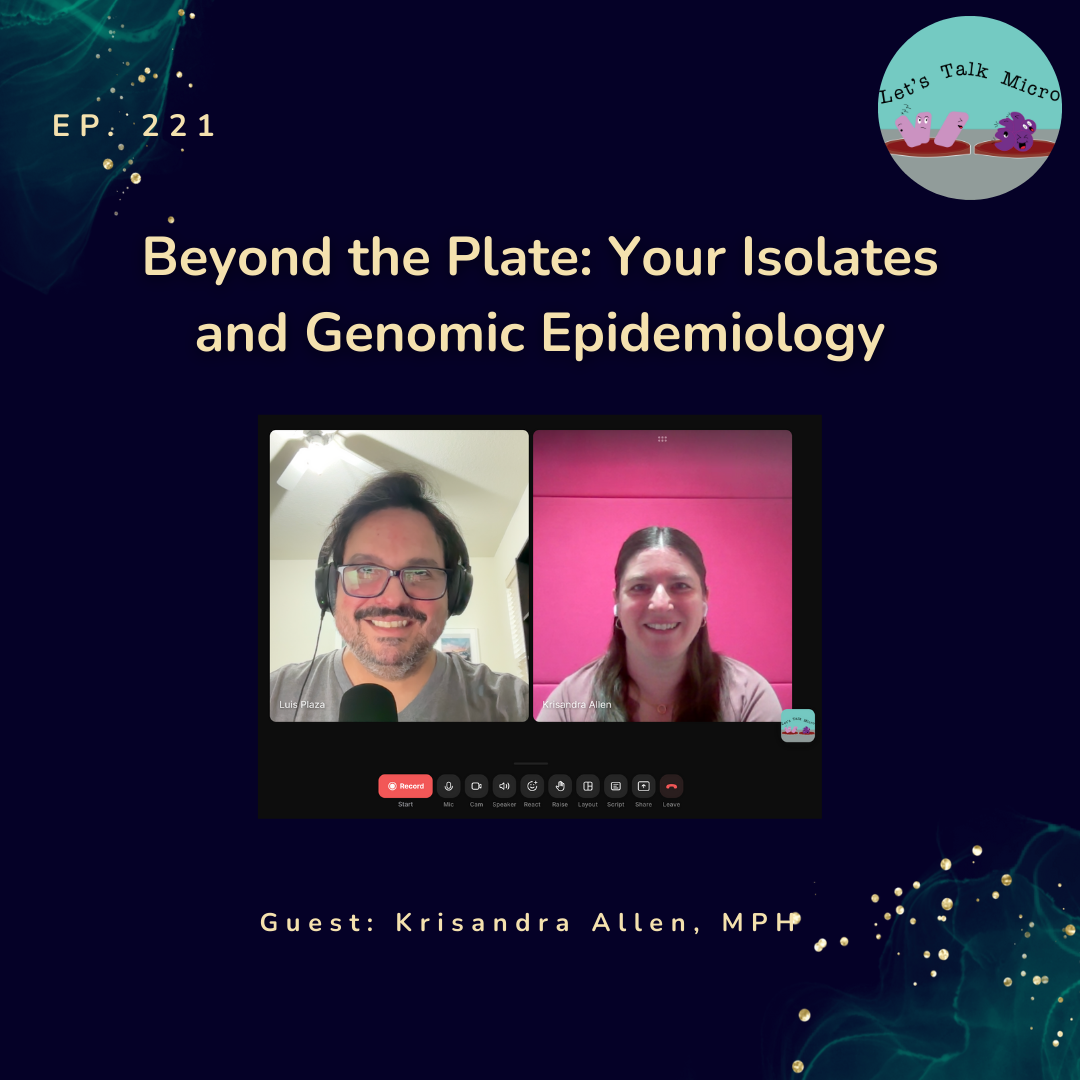
Genomic epidemiology is reshaping how we detect, investigate, and control infectious disease outbreaks—but what does that actually look like from the bench to public health? In this episode of Let's Talk Micro, Luis is joined by genomic epidemiologist Krisandra Allen for a practical, case-based conversation on how pathogen sequencing data is generated, analyzed, and paired with epidemiologic information to answer questions traditional methods can't. They discuss foodborne and hepatitis A outbreaks, geographically dispersed clusters, and how sequencing is being integrated into routine public health workflows, while highlighting the essential role of clinical microbiology labs in specimen submission and data quality. A timely episode for microbiologists, public health professionals, and trainees curious about how their lab work feeds into real-world surveillance and outbreak response.
Stay connected with Let's Talk Micro:
Website: letstalkmicro.com
Questions or feedback? Email me at letstalkmicro@outlook.com
Interested in being a guest on Let's Talk Micro? Fill out the form here: https://forms.gle/V2fT3asjfyusmqyi8
Support the podcast:
Venmo
Buy me a Ko-fi
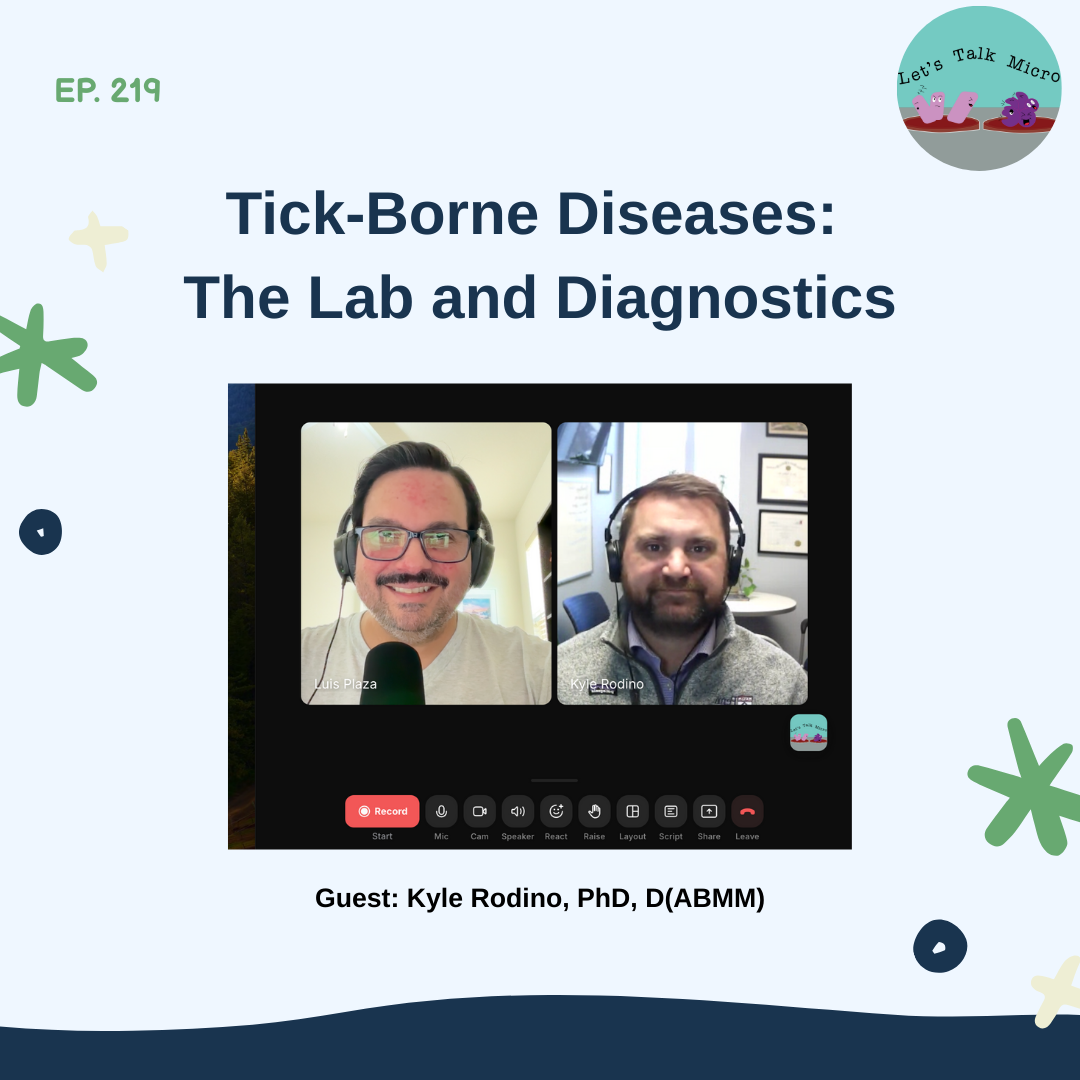
Tick-borne diseases continue to expand across North America, but diagnosing them in the clinical laboratory remains complex—especially when timing between symptom onset and testing isn't considered.
In this episode of Let's Talk Micro, Luis is joined by Kyle Rodino, Assistant Professor of Pathology and Laboratory Medicine at the University of Pennsylvania and Assistant Director of Microbiology, for a lab-focused discussion on tick-borne disease diagnostics.
They cover major bacterial, parasitic, and viral causes of tick-borne disease, and walk through how molecular testing, serology, and microscopy are used at different stages of illness. The conversation highlights why test selection and timing matter, common diagnostic challenges—particularly with Babesia and Lyme disease testing—and how laboratories can support better diagnostic decision-making.
A practical episode for microbiologists, laboratorians, and clinicians navigating real-world testing challenges in the lab.
Additional resources: Update on North American tick-borne diseases and how to diagnose them https://doi.org/10.1128/jcm.00807-23
Stay connected with Let's Talk Micro:
Website: letstalkmicro.com
Questions or feedback? Email me at letstalkmicro@outlook.com
Interested in being a guest on Let's Talk Micro? Fill out the form here: https://forms.gle/V2fT3asjfyusmqyi8
Support the podcast:
Venmo
Buy me a Ko-fi
In this episode of Let's Talk Micro, we break down metagenomic next-generation sequencing (mNGS) and how it's changing the way we diagnose complex infectious diseases.
I'm joined by Steve Miller, MD, PhD—Chief Medical Officer at Delve Bio—to discuss how unbiased metagenomics moved from research labs into real-world clinical practice.
We cover what metagenomics is, how it differs from targeted PCR and sequencing, and where it adds the most value—especially in meningitis and encephalitis, immunocompromised patients, and cases where routine testing comes back negative.
Dr. Miller shares insights from years of clinical experience, including how mNGS can improve diagnostic yield, shorten time to diagnosis, guide targeted therapy, and reduce unnecessary testing and hospital stays. We also touch on challenges like cost, result interpretation, diagnostic stewardship, and where metagenomics is headed next—including its role in public health and emerging infections.
Links & Resources
Clinical metagenomics for meningitis and encephalitis (Nature Medicine) https://www.nature.com/articles/s41591-024-03275-1
Stay connected with Let's Talk Micro:
Website: letstalkmicro.com
Questions or feedback? Email me at letstalkmicro@outlook.com
Interested in being a guest on Let's Talk Micro? Fill out the form here: https://forms.gle/V2fT3asjfyusmqyi8
Support the podcast:
Venmo
Buy me a Ko-fi
1 h 10 minAbspielen in:
Gäste, die länger als 12 Monate zurückliegen, gibt es mit Pro. Pläne ansehen

 FM