Google Tech Talks is a grass-roots program at Google for sharing information of interest to the technical community. At its best, it's part of an ongoing discussion about our world featuring top experts in diverse fields. Presentations range from the broadest of perspective overviews to the most technical of deep…
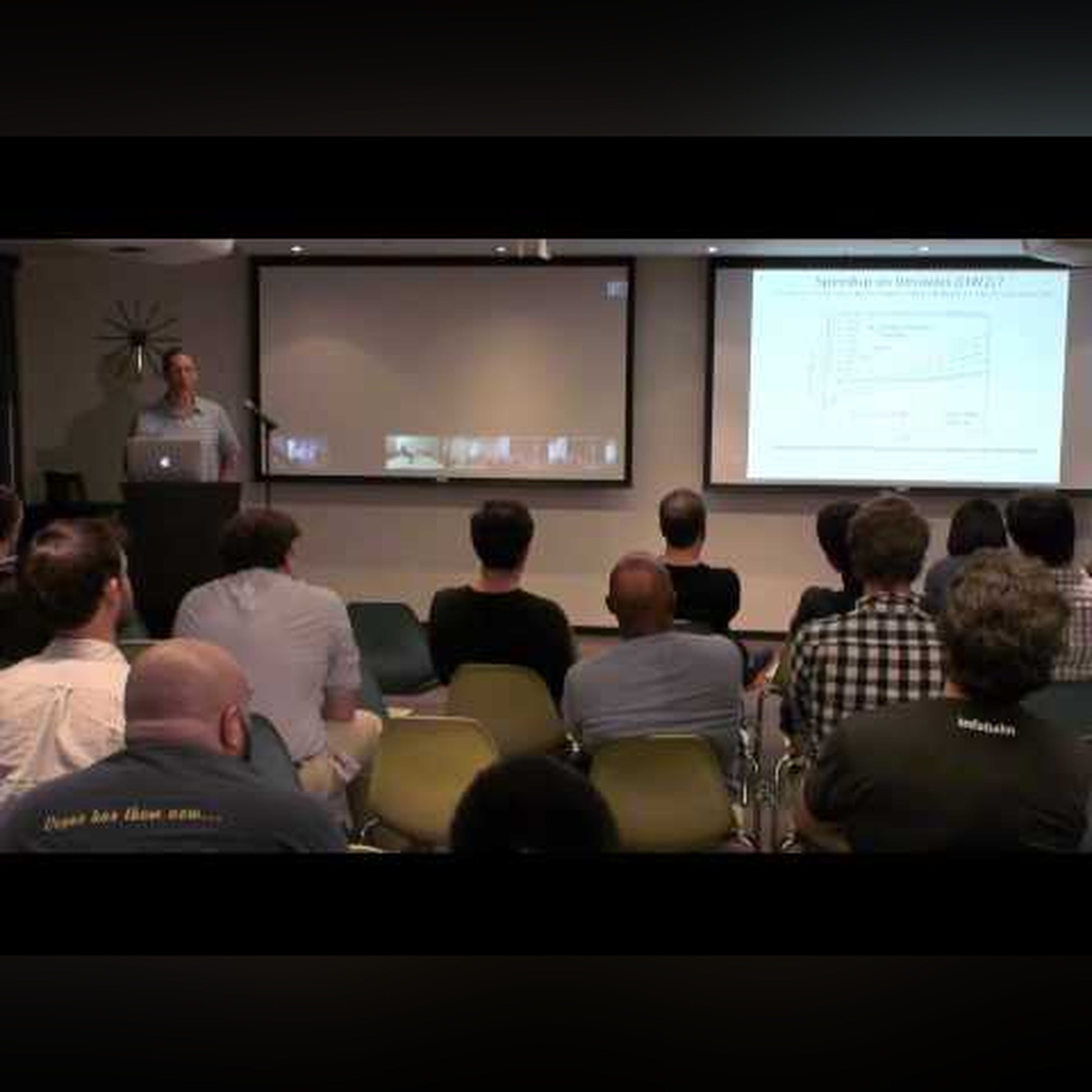
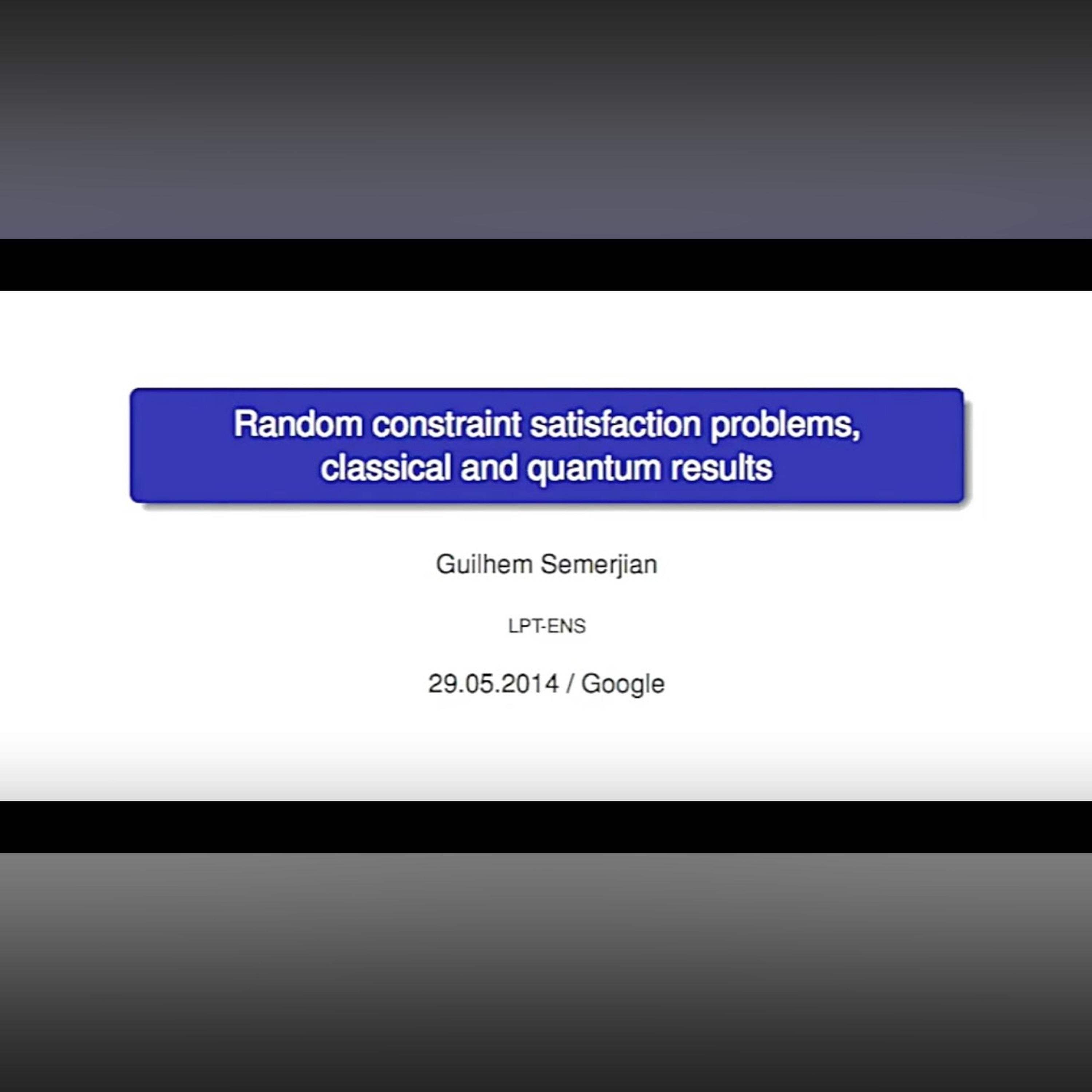
Guilhem Semerjian visited the Quantum AI Lab at Google LA to give a talk on "Random Constraint Satisfaction Problems, Classical and Quantum Results". This talk took place on May 29, 2014.
Uploaded 13-08-15
Abstract:
In the 90's numerical simulations have unveiled interesting properties of random ensembles of constraint satisfaction problems (satisfiability and graph coloring in particular). When a parameter of the ensemble (the density of constraints per variable) increases the probability of a satisfying instance drops abruptly from 1 to 0 in the large size limit. This threshold phenomenon has motivated a lot of research activity in theoretical computer science and in mathematics. In addition non-rigorous methods borrowed from theoretical physics (more precisely from mean-field spin glasses) have been applied to such problems, yielding a series of new results, including quantitative conjectures on the location of the satisfiability threshold and a much more detailed description of the structure of the satisfiable phase. I will survey some of these results, and their extensions to the quantum case where a transverse field is added to these classical Hamiltonians.
Bio:
Guilhem Semerjian has applied techniques developed in statistical mechanics to interdisciplinary problems arising at the frontier of theoretical computer science and discrete mathematics, in particular satisfaction of random constraint satisfaction problems. He has also been interested in the effect of quantum fluctuations on these problems, within the perspective of adiabatic quantum computing.
Google Tech Talk
May 30, 2015
("show more" for more information)
Presented by Edward Kmett
Web: https://wiki.haskell.org/ZuriHac2015#Edward_Kmett
Slides are available here: https://github.com/meiersi/HaskellerZ/blob/master/meetups/20150530-ZuriHac2015_Edward_Kmett-Discrimination_is_Wrong_Improving_Productivity/Discrimination%20-%20Zurihac.pdf
ABSTRACT
This talk is a case study in library design in Haskell.
Fritz Henglein has shown through a number of excellent papers how to use "discrimination" to do lots of things in O(n): Sorting many more data types than you'd expect, table joins, etc.
Uploaded 28-07-15
In the process of optimizing this approach and wrapping it up in a form that can be easily consumed, we'll take a lot of detours through the different ways you can think about code when optimizing Haskell.
We'll need some category theory, from a deeper understanding of monoids to Day convolution.
We'll need to consider final and initial encodings.
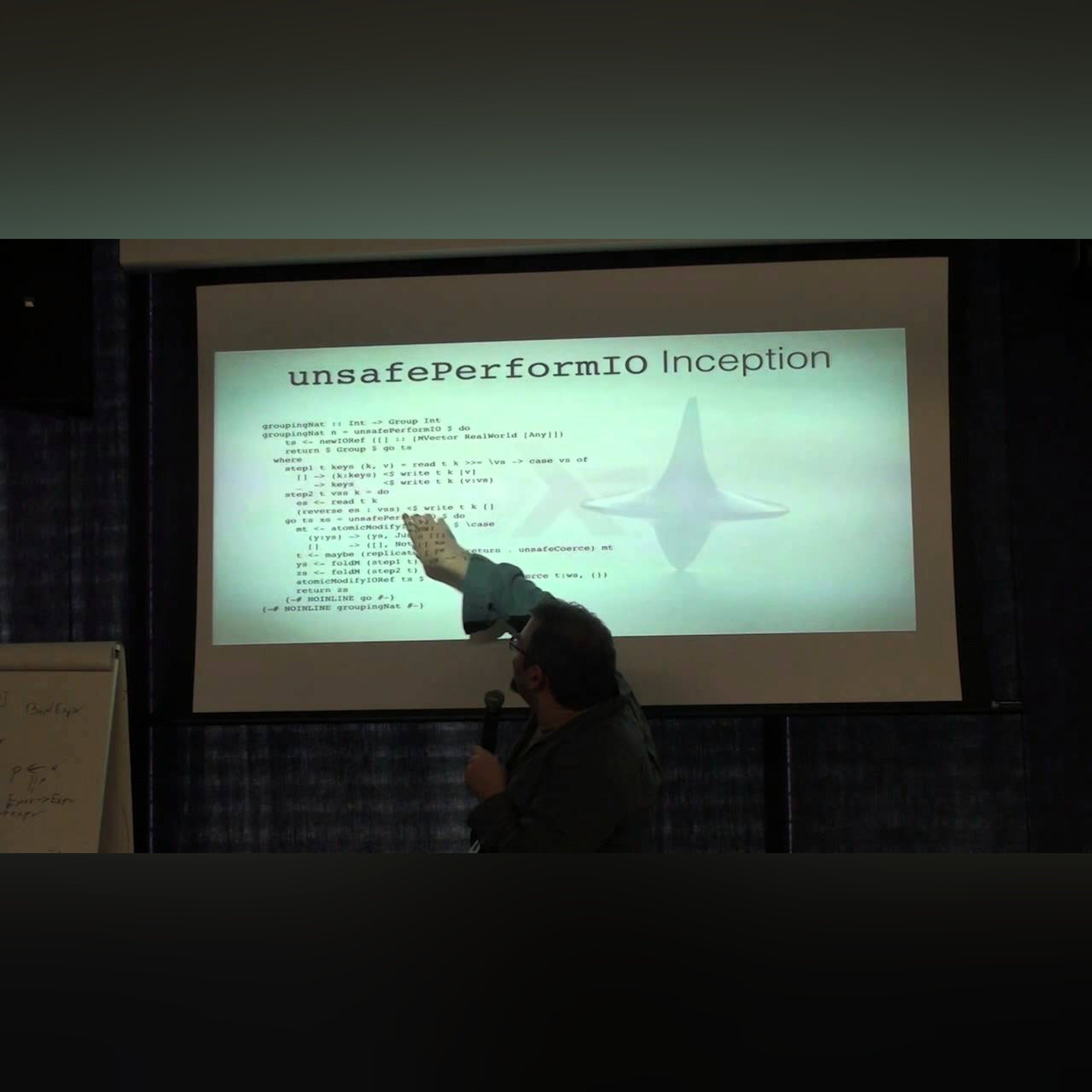
We'll need to drift down to low level system concerns from building a custom foreign prim to nesting unsafePerformIO within unsafePerformIO.
We'll need properties of laziness from productivity to IVars.
Along the way we'll find and fix a small problem with the initial discrimination paper, which opens the door to streaming results, rather than having to wait until all the input is ready.
Google Tech Talk
June 30, 2015
(click "show more" for more information)
Presented by Yasmin Green, Salome Vakhtangadze, and Baris Yuksel
Uploaded 28-07-15
ABSTRACT
As long as people have expressed ideas, others have tried to silence them. Today one out of every three people lives in a society that is severely censored. Online barriers can include everything from filters that block content to targeted attacks designed to take down websites. For many people, these obstacles are more than an inconvenience—they represent full-scale repression. Engineers from Google Ideas will present the way technology is being used to enable free expression online, and protect every voice in the digital debate.
Google Presenters:
Yasmin Green
Yasmin Green is the Head of Strategy and Operations for Google Ideas. She also oversees the team’s work on counter-radicalization and fragile states. At Google, Yasmin has assumed roles as Head of Sales Strategy and Operations for Southern Europe, Middle East, and Africa and Sub-Saharan Africa Operations Manager, and prior to joining Google, she consulted for Booz Allen Hamilton across Europe, the Middle East and Africa.
Yasmin has extensive experience leading and project managing in some of the world’s toughest environments. She has spent time in Iran, Syria and Nigeria, where she has worked cross-functionally in sectors ranging from oil and gas to the Internet. She recently led a multi-partner coalition to launch Against Violent Extremism, the world's first online network of former violent extremists and survivors of terrorism.
Yasmin is a Senior Advisor on Innovation to Oxford Analytica and Co-Chair of the European Commission's’ Working Group on Online Radicalization.
Salome Vakhtangadze
Salome is a Software Engineer. She joined Google Ideas after having worked on Google's Search Infrastructure team for 3 years. She currently works on uProxy, and is passionate about human rights.
Baris Yuksel
Baris Yuksel is a tech lead and software engineering manager. He is currently leading projects at Google Ideas, a think/do tank that explores how technology can enable people to confront threats in the face of conflict, instability and repression. Google Ideas was founded on the principle that the next five billion to come online will face far greater human challenges than the first two billion.
Baris has been focusing on designing and developing next generation features and technologies, trying to create magic moments not for few but for all. In the past, Baris worked on Google Search with Craig Nevill-Manning, founder of Google New York. Together they worked on features bridging the gap between Search and Google Now. Baris has been a volunteer with ScriptEd teaching high school students with an experimental curriculum, which he has been developing under the guidance of ScriptEd. He is hopeful that it will contribute to the major teaching effort.
Baris graduated from MIT with a BS in Electrical Engineering and Computer Science, minoring in Economics.
Google Tech Talk
May 29, 2015
("show more" for more information)
Presented by Duncan Coutts
https://wiki.haskell.org/ZuriHac2015#Duncan_Coutts
ABSTRACT
This talk is a case study in low level optimization in Haskell.
Uploaded 27-07-15
We have existing libraries for binary serialization but the mainstream ones use bad formats, and could always be faster. We will look at new work to improve on the existing libraries, to use a new better format, and to dramatically improve performance.
We will go into the details of a number of standard and new techniques for getting a good combination of performance with features and flexibility.
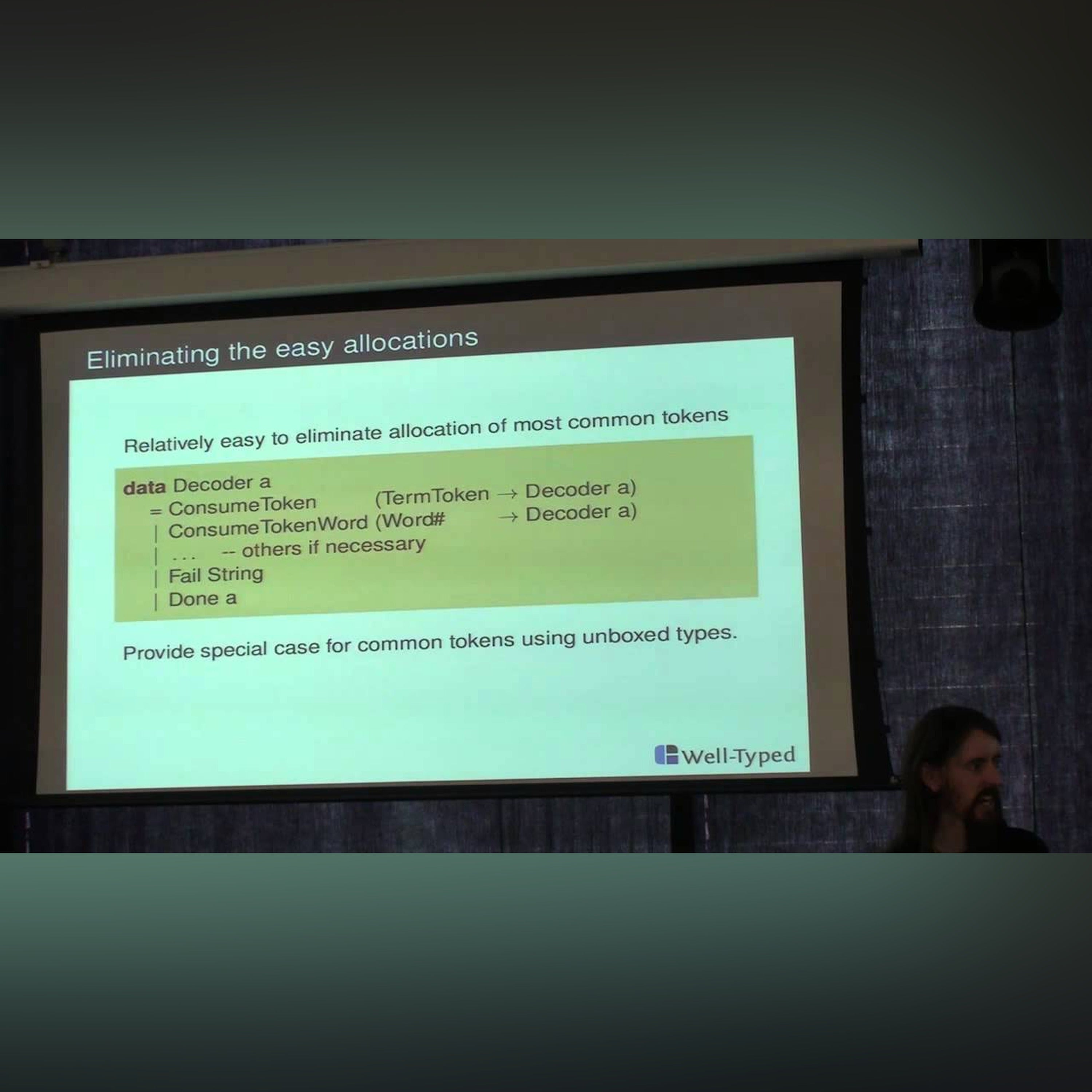
- High+low level approach to eliminating unnecessary allocations in deserialization
- Surprising use of deep embeddings and interpreters
- Moving work from compiled code to an interpreter
- Rewrite rules to improve interpreted code
- Deep embedding of composition to give statically allocated descriptions of branching programs
- Types to safely use unsafe low level data structures
- Looking at STG code to see allocations and other problems
- Fast path / slow path tricks
- Explicit control stacks
- ABIs / calling conventions for unknown functions
There'll be plenty of code, types and benchmarks.
Slides for this talk are available here:
https://github.com/meiersi/HaskellerZ/blob/master/meetups/20150529-ZuriHac2015_Duncan_Coutts-Better_Faster_Binary_Serialization/binary.pdf
Google Tech Talk
June 15, 2015
("show more" for more information)
Presented by Mahadev Satyanarayanan, School of Computer Science, Carnegie Mellon University
Uploaded 10-07-15
ABSTRACT
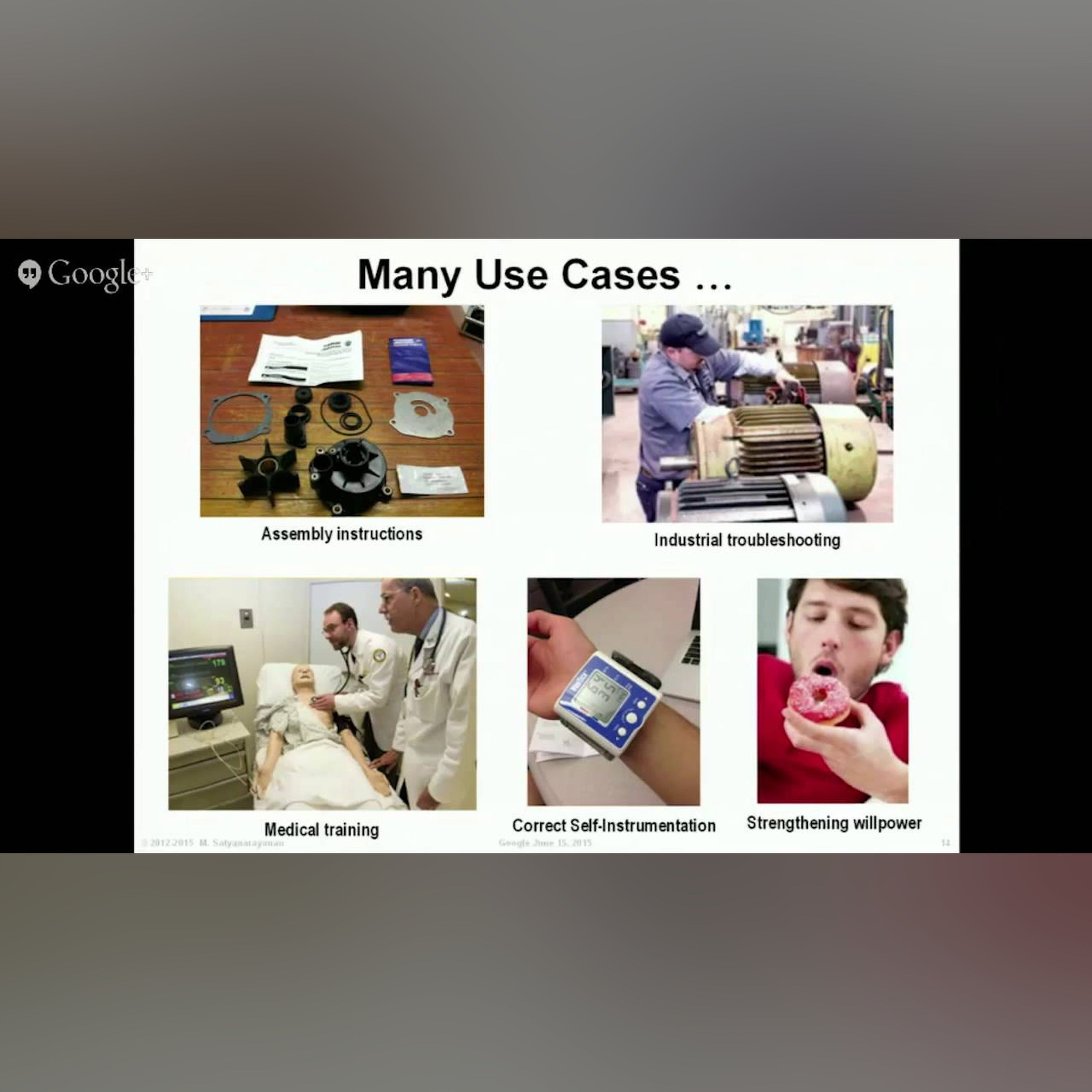
GPS navigation systems have transformed our driving experience. They guide you step-by-step to your destination, offering you helpful just-in-time voice guidance about upcoming actions. Can we generalize this metaphor? Imagine a wearable cognitive assistance system that combines a device like Google Glass with cloud-based processing to guide you through a complex task. You hear a synthesized voice telling you what to do next, and you see visual cues in the Glass display. When you make an error, the system catches it immediately and corrects you before the error cascades.
Fortunately, this is not science fiction. To support this genre of applications, we have created a multi-tiered system architecture called Gabriel. This architecture preserves tight end-to-end latency bounds on compute-intensive operations, while addressing concerns such as limited battery capacity and limited processing capability of wearable devices. We have gained initial experience on building Gabriel applications that provide user assistance for narrow and well-defined tasks that require specialized knowledge and/or skills. Specifically, we have built proof-of-concept implementations for four tasks: assembling 2D Lego models, freehand sketching, playing ping-pong, and recommending context-relevant YouTube tutorials. This talk will examine the potential and challenges of wearable cognitive assistance, present the Gabriel architecture, and describe the early proof-of-concept applications that we have built on it.
Credits
Bio at http://cs.cmu.edu/~satya
Google Tech Talk
March 12, 2014
(show more for more details)
Presented by Steve Hardt
ABSTRACT
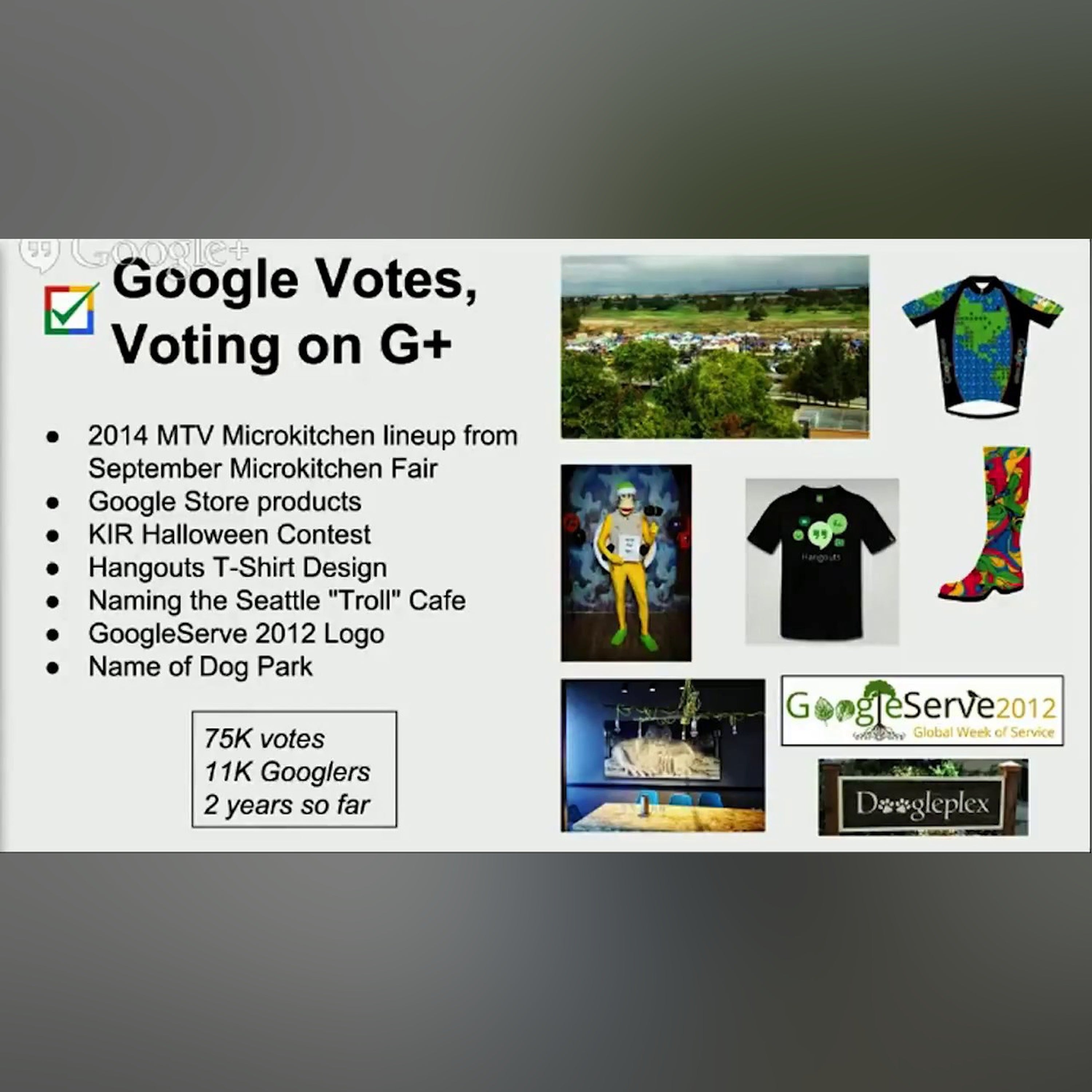
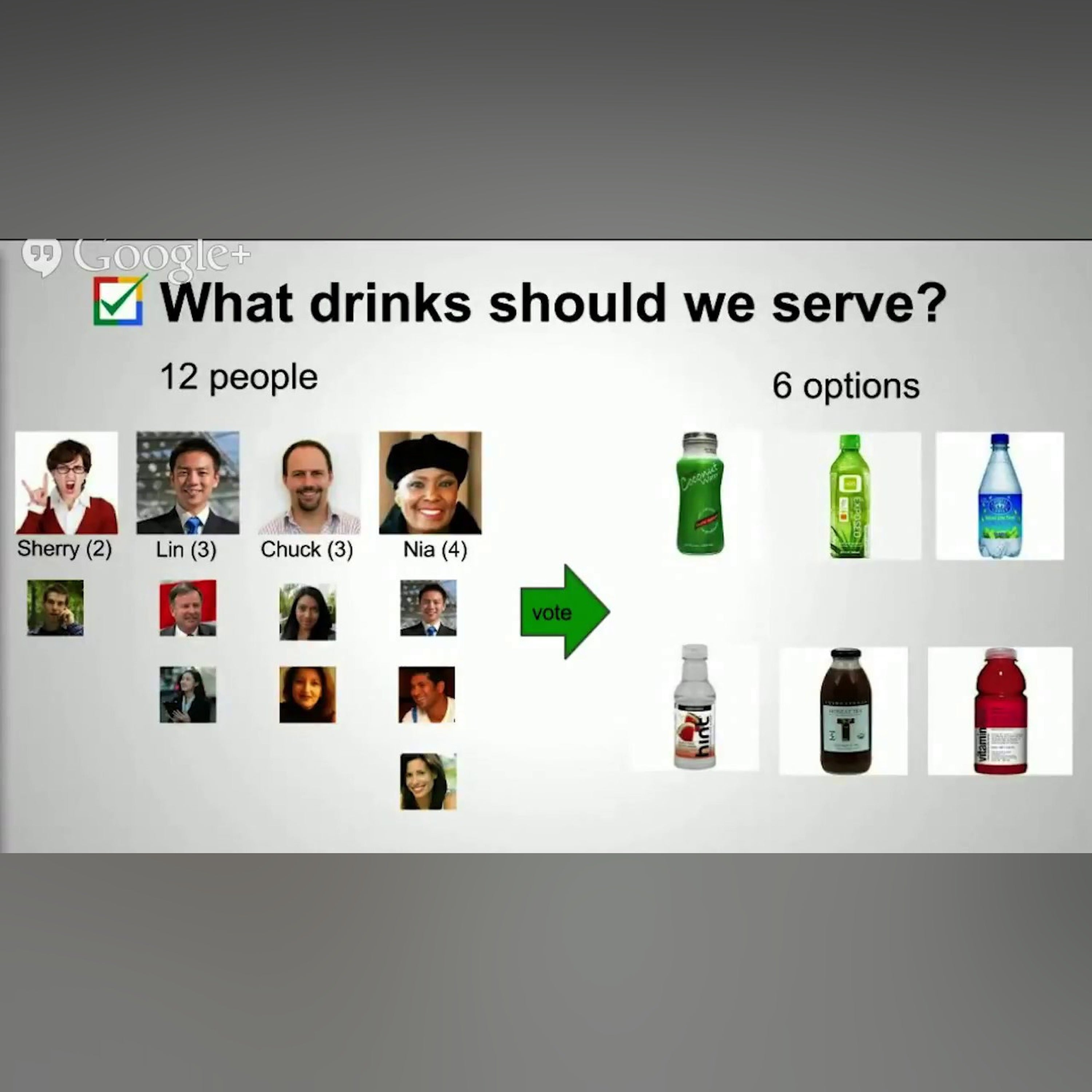
Google Votes is an experiment in liquid democracy built on Google's internal corporate Google+ social network. A Liquid Democracy system gives all the control of Direct Democracy with the scalability of Representative Democracy. Users can vote directly or delegate power through their social networks. This talk covers user experience aspects of delegated voting and three graph algorithms for flowing votes through a social graph called Tally, Coverage, and Power.
Uploaded 27-06-15
View part one of this two part series at http://youtu.be/7UqV3eN9Pa8
Read the paper at 'Google Votes: A Liquid Democracy Experiment on a Corporate Social Network' http://goo.gl/eAxj9e
Google Tech Talk
March 3, 2014
(show more for more details)
Presented by Steve Hardt
ABSTRACT
Learn the ins-and-outs of common voting methods and algorithms for group-decision-making with illustrated examples in Google Votes. Google Votes is a Google-internal voting platform used for decisions like food selections, cafe names, t-shirt designs, and Halloween contests. This talk covers Approval, Ranked, Range/Score, and Plurality voting along with the Borda and Schulze ranking algorithms and their relation to Condorcet's Paradox.
Uploaded 27-06-15
View part two of this two part series at http://youtu.be/F4lkCECSBFw
Read the paper at 'Google Votes: A Liquid Democracy Experiment on a Corporate Social Network' http://goo.gl/eAxj9e
Professor Mark Gold visited Google LA on May 1, 2015. He is the former director of Heal the Bay and made a presentation on the current water crisis.
Uploaded 03-06-15
California is in an unparalleled water crisis. Not only are we in the 4th year of a drought, but the April 1st Sierra snowpack was a record 5% of normal. In response to the crisis, cities have been mandated to cut their water use by an average of 25% and agriculture will soon receive massive cutbacks in their water allocations. How will the drought affect you and can you do anything to make a difference?
Google Tech Talks
October 23, 2008
ABSTRACT
The Third Annual Google Test Automation Conference (GTAC), Seattle, WA, Oct. 23rd and 24th.
Uploaded 30-10-08
Opening Remarks
Speaker: Lydia Ash
Alán Aspuru-Guzik visited the Quantum AI Lab at Google LA on May 12, 2015 and gave this talk: "Billions and Billions of Molecules: Molecular Materials Discovery in the Age of Machine Learning"
Uploaded 26-05-15
Abstract:
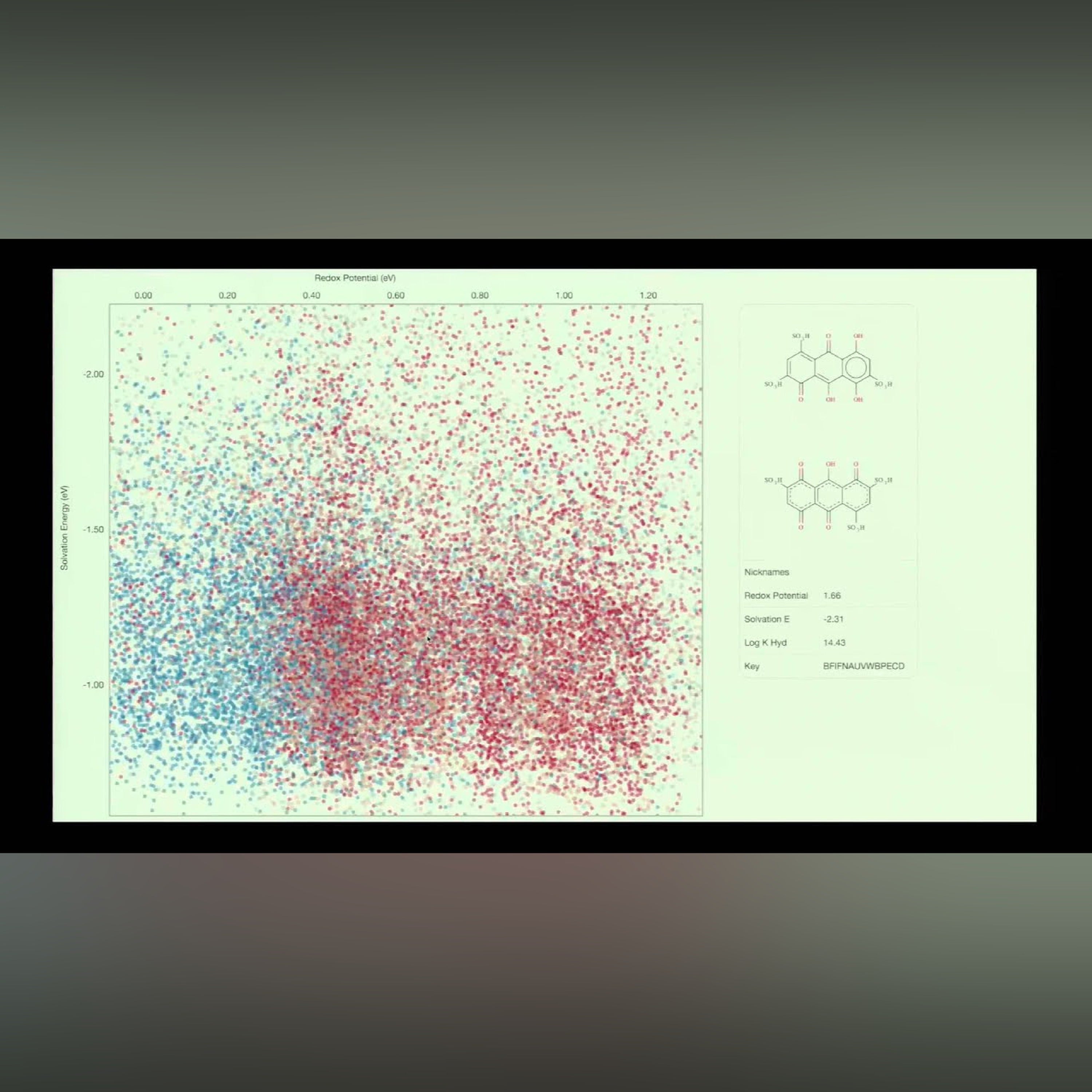
Many of the challenges of the twenty-first century are related to molecular processes such as the generation, transmission, and storage of clean energy, water purification and desalination. These transformations require a next generation of more efficient and ecologically-friendly materials. In the life sciences, we face similar challenges, for example drug-resistant bacterial strains require novel antibiotics. One of the paradigm shifts that the theoretical and experimental chemists needs to embrace is that of accelerated molecular discovery: The design cycles need to be sped up by the constant interaction of theoreticians and experimentalists, the use of high-throughput computational techniques, tools from machine learning and big data, and the development of public materials databases. I will describe three projects from my research group that aim to operate in this accelerated design cycle. First, I will describe our efforts on the Harvard Clean Energy Project (http://cleanenergy.harvard.edu), a search for materials for organic solar cells. I will continue by talking about our work on developing organic molecules for energy storage in flow batteries. Finally, I will describe our work towards the discovery of novel molecules for organic light-emitting diodes. If time permits, I will talk about molecular networks related to the origins of life.
Bio:
Professor Alán Aspuru-Guzik is currently Professor of Chemistry and Chemical Biology at Harvard University. He began at Harvard in 2006 and was promoted to Full Professor in 2013. Alán received his B.Sc. Chemistry from the National Autonomous University of Mexico (UNAM) in 1999. He received the Gabino Barreda Medal from UNAM. He obtained a PhD in Physical Chemistry from the University of California, Berkeley in 2004, under Professor William A. Lester, Jr., he was a postdoctoral scholar in the group of Martin Head-Gordon at UC Berkeley from 2005-2006. In 2009, Professor Aspuru-Guzik received the DARPA Young Faculty Award, the Camille and Henry Dreyfus Teacher-Scholar award and the Sloan Research Fellowship. In 2010, he received the Everett-Mendelsson Graduate Mentoring Award and received the HP Outstanding Junior Faculty award by the Computers in Chemistry division of the American Chemical Society. In the same year, he was selected as a Top Innovator Under 35 by the Massachusetts Institute of Technology Review magazine. In 2012, he was elected as a fellow of the American Physical Society, and in 2013, he received the ACS Early Career Award in Theoretical Chemistry. He is associate editor of the journal Chemical Science.
Professor Aspuru-Guzik carries out research at the interface of quantum information and chemistry. In particular, he is interested in the use of quantum computers and dedicated quantum simulators for chemical systems. He has proposed quantum algorithms for the simulation of molecular electronic structure, dynamics and the calculation of molecular properties. He recently has proposed two new approaches for quantum simulation: the variational quantum eigensolver and the adiabatic quantum chemistry approach. He also proposed the demon-like algorithmic cooling algorithm. He has studied the role of quantum coherence in excitonic energy transfer in photosynthetic complexes. Alán has been involved as a theoretician in several experimental demonstrations of quantum simulators using quantum optics, nuclear magnetic resonance, nitrogen vacancy centers and recently superconducting qubits.
Alán develops methodology for the high-throughput search of organic materials, especially organic materials. This has led to his discovery of candidate molecules
Christopher Monroe visited the Google LA Quantum AI Lab on May 4, 2015.
Uploaded 26-05-15
Abstract:
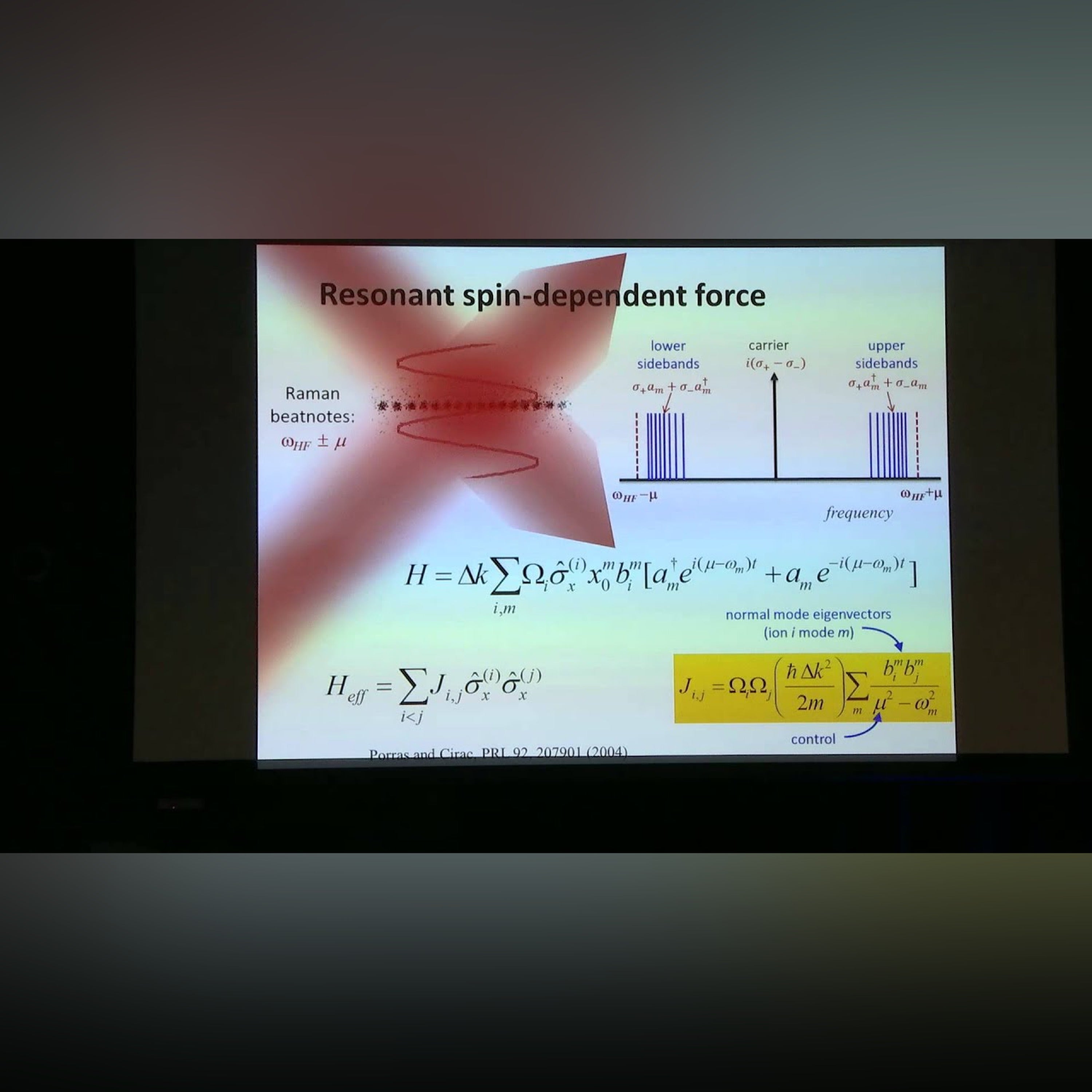
Laser-cooled and trapped atomic ions are standards for quantum information science, acting as qubits with unsurpassed levels of quantum coherence while also allowing near-perfect measurement. Trapped ions can be entangled locally with external laser beams that map the internal atomic qubits through their Coulomb-coupled motion; they can be entangled remotely through optical photons traveling through fibers. This quantum hardware platform scales favorably when compared to any other platform, because (a) each trapped ion is an atomic clock that is identical to the others, (b) the qubit wiring (interaction graph) is provided by external fields and is hence reconfigurable, and (c) the modular architecture of local and remote quantum gates provides a realistic path to building out huge systems with thousands of qubits. I will summarize the state-of-the art in ion trap quantum networks, which will soon involve systems of 50+ fully-interacting qubits, eclipsing the performance of classical computers for certain tasks. The remaining challenges in the ion trap architecture are primarily engineering, setting the stage for focused efforts to build a large scale quantum computer.
Bio:
Christopher Monroe is an quantum physicist who specializes in the isolation of individual atoms for applications in quantum information science. After graduating from MIT, Monroe studied with Carl Wieman and Eric Cornell at the University of Colorado, earning his PhD in Physics in 1992. His work paved the way toward the achievement of Bose-Einstein condensation in 1995 and led to the 2001 Nobel Prize for Wieman and Cornell. From 1992-2000 he was a postdoc then staff physicist at the National Institute of Standards and Technology, in the group of David Wineland. With Wineland, Monroe led the team that demonstrated the first quantum logic gate in 1995, and exploited the use of trapped atoms for the first controllable qubit demonstrations, eventually leading to Wineland's Nobel Prize in 2012. In 2000, Monroe became Professor of Physics and Electrical Engineering at the University of Michigan, where he pioneered the use of single photons to couple quantum information between atoms and also demonstrated the first electromagnetic atom trap integrated on a semiconductor chip. From 2006-2007 was the Director of the National Science Foundation Ultrafast Optics Center at the University of Michigan. In 2007 he became the Bice Zorn Professor of Physics at the University of Maryland and a Fellow of the Joint Quantum Institute. In 2008, Monroe's group succeeded in producing quantum entanglement between two widely separated atoms and for the first time teleported quantum information between matter separated by a large distance. Since 2009 his group has investigated the use of ultrafast laser pulses for speedy quantum entanglement operations, pioneered the use of trapped ions for quantum simulations of many-body models related to quantum magnetism, and with Jungsang Kim (Duke University) has proposed and made the first steps toward a scalable, reconfigurable, and modular quantum computer.
Daniel Lidar visited the Quantum AI Lab at Google LA to give a talk: "Quantum Information Processing: Are We There Yet?" This talk took place on January 22, 2015.
Uploaded 09-02-15
Abstract:
Quantum information processing holds great promise, yet large-scale, general purpose quantum computers capable of solving hard problems are not yet available despite 20+ years of immense effort. In this talk I will describe some of this promise and effort, as well as the obstacles and ideas for overcoming them using error correction techniques. I will focus on a special purpose quantum information processor called a quantum annealer, designed to speed up the solution to tough optimization problems. In October 2011 USC and Lockheed-Martin jointly founded a quantum computing center housing a commercial quantum annealer built by the Canadian company D-Wave Systems. A similar device is operated by NASA and Google. These processors use superconducting flux qubits to minimize the energy of classical spin-glass models with as many spins as qubits, an NP-hard problem with numerous applications. There has been much controversy surrounding the D-Wave processors, questioning whether they offer any advantage over classical computing. I will survey the recent work we have done to benchmark the processors against highly optimized classical algorithms, to test for quantum effects, and to perform error correction.
Bio:
Daniel Lidar has worked in quantum computing for nearly 20 years. He is a professor of electrical engineering, chemistry, and physics at USC, and hold a Ph.D. in physics from the Hebrew University of Jerusalem. His work revolves around various aspects of quantum information science, including quantum algorithms, quantum control, the theory of open quantum systems, and theoretical as well as experimental adiabatic quantum computation. He is a Fellow of the AAAS, APS, and IEEE. Lidar is the Director of the USC Center for Quantum Information Science and Technology, and is the Scientific Director of the USC-Lockheed Martin Center for Quantum Computing. Two of his former graduate students are now research scientists at Google’s quantum artificial intelligence lab.
Google Tech Talks
October 23, 2008
ABSTRACT
GTAC 2008: The New Genomics - Software Development at Petabyte Scale
The Third Annual Google Test Automation Conference (GTAC), Seattle, WA, Oct. 23rd and 24th.
Uploaded 31-10-08
Speaker: Matt Wood
Matthias Troyer visited Google LA to speak about "High Performance Quantum Computing." This talk took place on December 2, 2014.
Uploaded 13-01-15
Abstract:
As the outlines of a roadmap to building powerful quantum devices becomes more concrete an important emerging question is that of important real-world applications of quantum computers. While there exist many quantum algorithms which asymptotically outperform classical algorithms, asymptotic superiority can be misleading. In order for a quantum computer to be competitive, it needs to not only be asymptotically competitive but be able to solve problems within a limited time (for example one year) that no post-exa-scale classical supercomputer can solve within the same time. This search for a quantum killer-app turns out to be a formidable challenge. Using quantum chemistry simulations as a typical example, it turns out that significant advances in quantum algorithms are needed to achieve this goal. I will review how substantial improvements and optimized massively parallel implementation strategies of quantum algorithms have brought the problem of quantum chemistry from the realm of science fiction closer to being realistic. Similar algorithmic improvements will be needed in other areas in order to identify more “killer apps” for quantum computing. I will end with a short detour to quantum annealers and present a summary of our recent results on simulated classical and quantum annealing.
Bio:
Matthias Troyer is professor of computational physics at ETH Zurich where he teaches advanced C++ programming, high performance computing, and simulations methods for quantum systems. He is a pioneer of cluster computing in Europe, having been responsible for the installation of the first Beowulf cluster in Europe with more than 500 CPUs in 1999, and the most energy efficient general purpose computer on the top-500 list in 2008. He is a Fellow of the American Physical Society and his activities range from quantum simulations and quantum computing to the development of novel simulation algorithms, high performance computing, and computational provenance. He is, the author of the Boost MPI C++ library for message passing on parallel computers, and the leader of the open-source ALPS library for the simulation of quantum many body systems.
Google Tech Talks
October 24, 2008
ABSTRACT
GTAC 2008: Practicing Testability in the Real World
The Third Annual Google Test Automation Conference (GTAC), Seattle, WA, Oct. 23rd and 24th.
Uploaded 31-10-08
Speaker: Vishal Chowdhary
Google Tech Talks
October 24, 2008
ABSTRACT
GTAC 2008: Context-Driven Test Automation - How to Build the System You Really Need
The Third Annual Google Test Automation Conference (GTAC), Seattle, WA, Oct. 23rd and 24th.
Uploaded 01-11-08
Speaker: Pete Schneider
Zack Newsham (University of Waterloo)
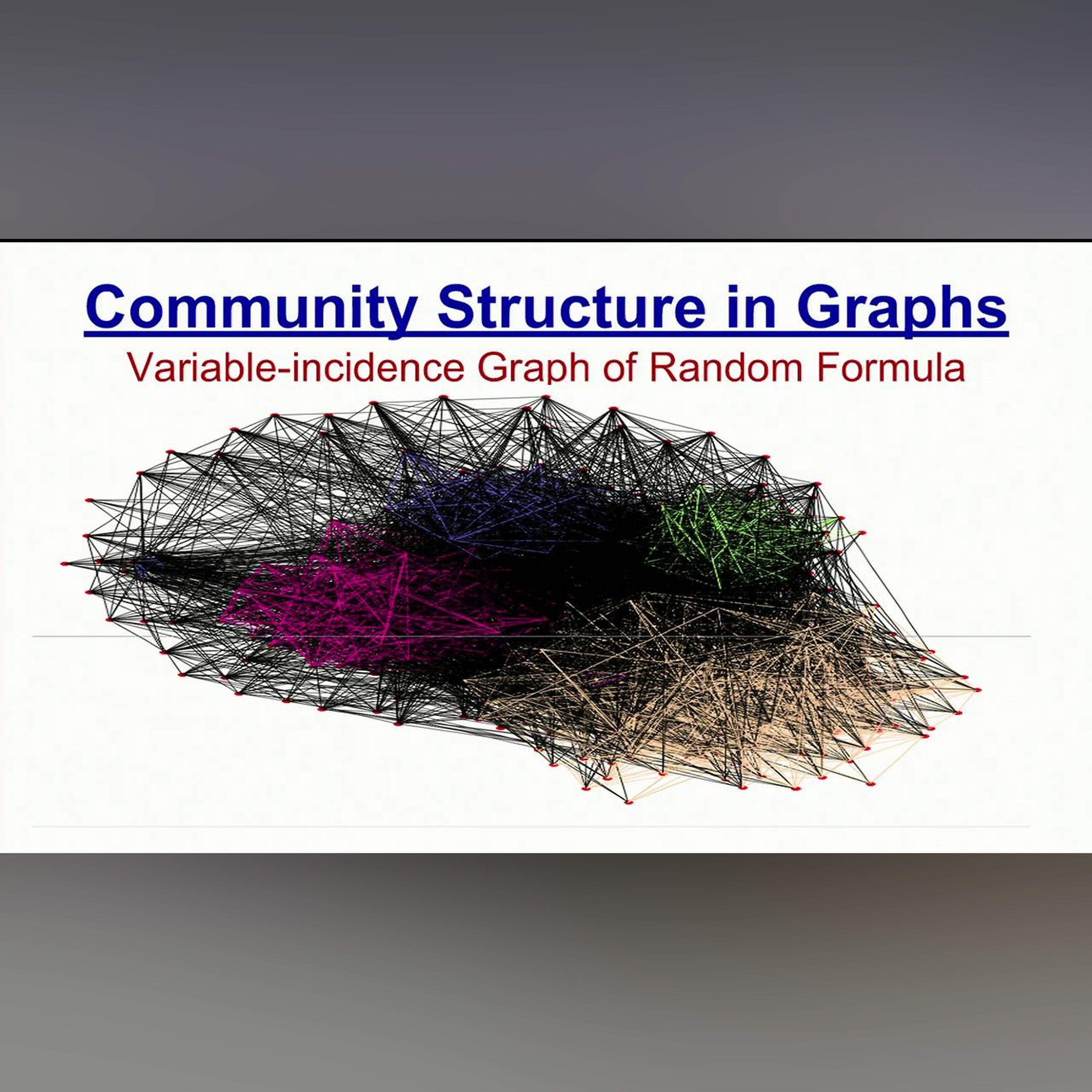
Modern CDCL SAT solvers routinely solve very large in- dustrial SAT instances in relatively short periods of time. It is clear that these solvers somehow exploit the structure of real-world instances. How- ever, to-date there have been few results that precisely characterise this structure. In this paper, we provide evidence that the community struc- ture of real-world SAT instances is correlated with the running time of CDCL SAT solvers. It has been known for some time that real-world SAT instances, viewed as graphs, have natural communities in them. A community is a sub-graph of the graph of a SAT instance, such that this sub-graph has more internal edges than outgoing to the rest of the graph. The community structure of a graph is often characterised by a quality metric called Q. Intuitively, a graph with high-quality community struc- ture (high Q) is easily separableinto smaller communities, while the one with low Q is not. We provide three results based on empirical data which show that community structure of real-world industrial instances is a bet- ter predictor of the running time of CDCL solvers than other commonly considered factors such as variables and clauses. First, we show that there is a strong correlation between the Q value and Literal Block Distance metric of quality of conflict clauses used in clause-deletion policies in Glucose-like solvers. Second, using regression analysis, we show that the the number of communities and the Q value of the graph of real-world SAT instances is more predictive of the running time of CDCL solvers than traditional metrics like number of variables or clauses. Finally, we show that randomly-generated SAT instances with 0.05 ≤ Q ≤ 0.13 are dramatically harder to solve for CDCL solvers than otherwise.
Uploaded 14-11-14
Gareth Bowles (Netflix)
Every day, Netflix has more customers consuming more content on an increasing number of client devices. We're also constantly innovating to improve our customers' experience. Testing in such a rapidly changing environment is a huge challenge, and we've concluded that running tests in our production environment can often be the most efficient way to validate those changes. This talk will cover three test methods that we use in production: simulating all kinds of outages with the Simian Army, looking for regressions using canaries, and measuring test effectiveness with code coverage analysis from production.
Uploaded 14-11-14
Vishal Arora (Dropbox)
Many open source tools are available for continuous integration (CI). Only a few operate well at large scale. And almost none are built to scale in a distributed environment. Come find out the challenges of implementing CI at scale, and one way to put together open source pieces to quickly build your own distributed, scalable CI system.
Uploaded 14-11-14
Google Tech Talks
October 24, 2008
ABSTRACT
GTAC 2008: JInjector - A Coverage and End-to-End Testing Framework for J2ME and RIM
The Third Annual Google Test Automation Conference (GTAC), Seattle, WA, Oct. 23rd and 24th.
Uploaded 07-11-08
Speaker: Julian Harty
Speaker: Olivier Gaillard
Speaker: Michele Sama
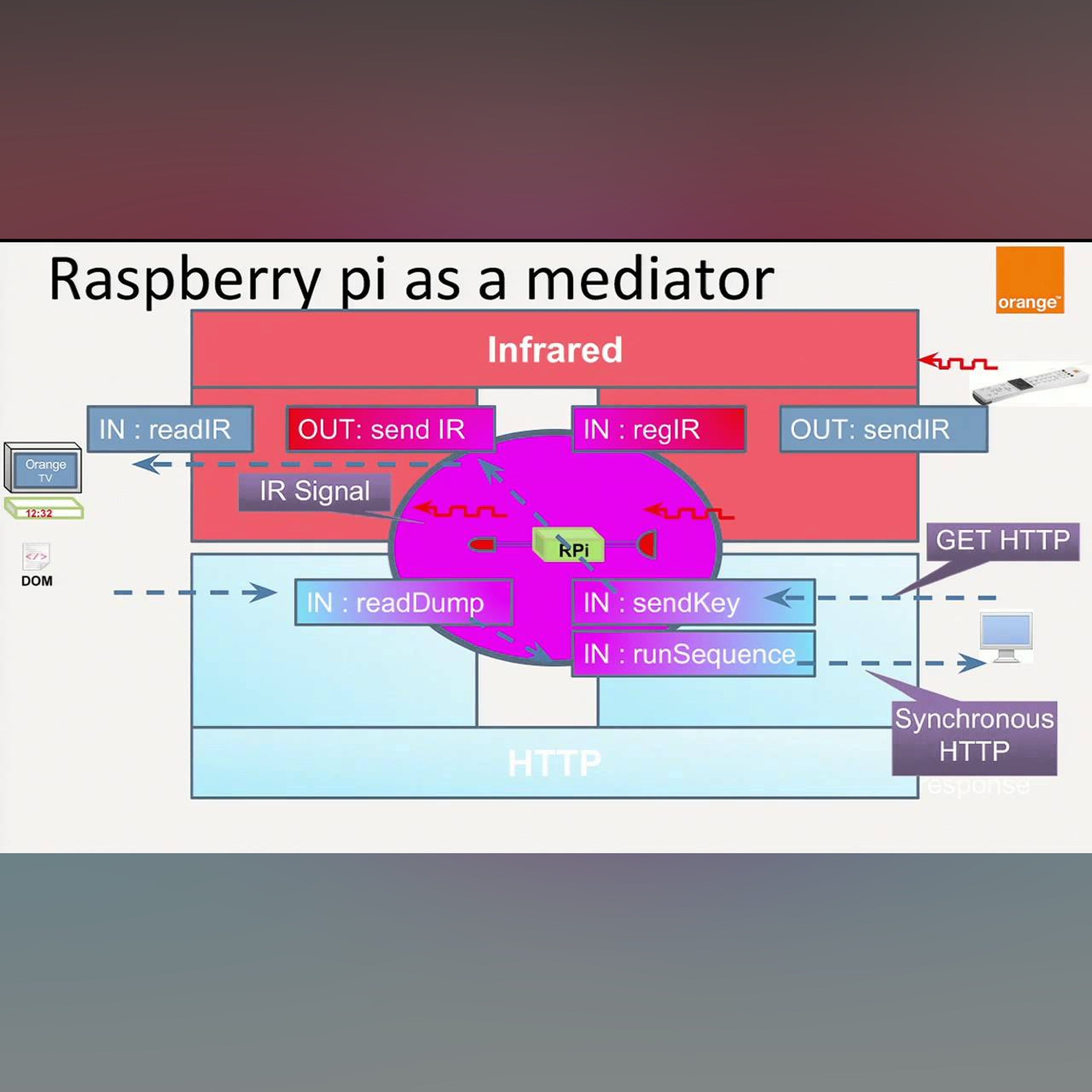
Olivier Etienne (Orange)
This talk will explain what a TV App context is and the kind of problems we can encounter when trying to automate the things out. Olivier will go through previous failures, their approach and what have been the key points to build an automatic test tool. If time permits, he will go deeper in the details of the implementation.
Uploaded 14-11-14
Come listen how a few solders and some lines of code have opened the rich world of web testing to a set-top box.
Google Tech Talks
October 24, 2008
ABSTRACT
GTAC 2008: Simple Tools to Fight the Bigger Quality Battle: Continuous Integration Using Batch Files and Task Scheduler
The Third Annual Google Test Automation Conference (GTAC), Seattle, WA, Oct. 23rd and 24th.
Uploaded 07-11-08
Speaker: Komal Joshi
Speaker: Patrick Martin
Alex Eagle (Google)
Google's products release frequently, and that requires significant automated testing and "build-copping". We are now working to offer our testing infrastructure as part of Google Cloud Platform. This talk will discuss some of the methodology we use to keep our builds green and our products defect-free, and give a preview of how we are exposing this to the world.
Uploaded 14-11-14
Michael Bailey (American Express)
GTAC 2014: Espresso, Spoon, Wiremock, Oh my! ( or how I learned to stop worrying and love Android testing )
Uploaded 14-11-14
Learn about creating and executing fast and reliable automated Android UI tests. Tools will include Espresso, Spoon, Wiremock and Jenkins. Basic Android and Java development knowledge is assumed.
Google Tech Talks
September 19, 2008
ABSTRACT
This is the first Annual Cornell University Faculty of Computing and Information Science (CIS)/Cornell Silicon Valley (CSV) event in Silicon Valley. It will feature the Dean of CIS, Robert Constable, along with Cornell alumnus (and Googler) Amit Singhal.
Uploaded 09-11-08
Speaker: Robert Constable
Speaker: Amit Singhal
Jay Srinivasan (Google) and Manish Lachwani (Google)
Compared to the web world, mobile testing is a minefield. From different devices, operating systems, networks and locations, there are seemingly an infinite number of variables developers must account for. In this educational session, we will discuss some of the unique challenges that come with optimizing the performance and quality of mobile apps, and strategies for addressing them, including the need for automation, real devices and real user conditions.
Uploaded 14-11-14

 GS