Plastic. Climate. Future. enables engagement among industry members, climate activists, innovators, and the rest of world (the general public) to ultimately achieve positive changes related to plastic and the climate. In their podcast, Mat & John host guests from these groups of stakeholders and talk about their…
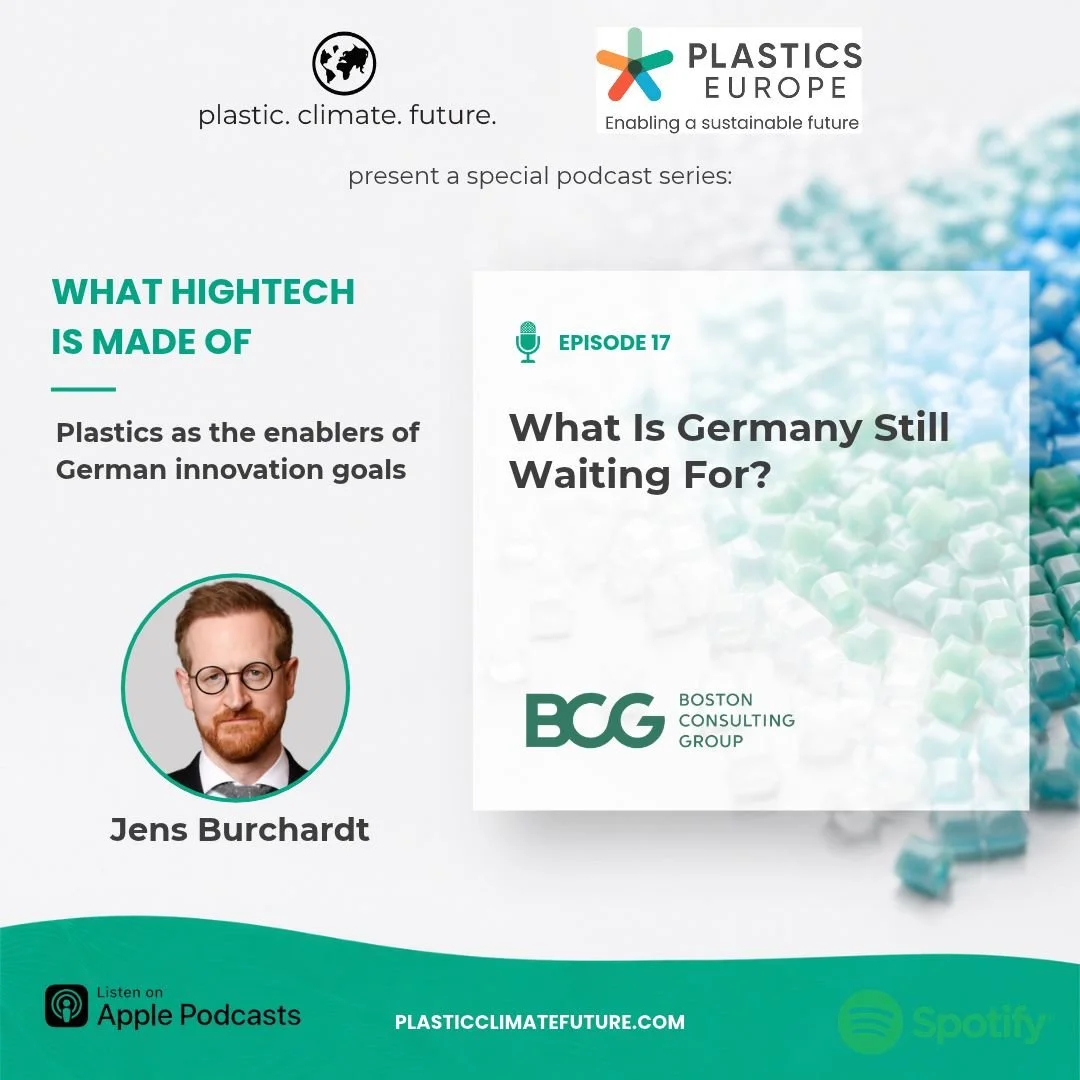
The grand finale of our series WHAT HIGHTECH IS MADE OF with Plastics Europe Deutschland is here!
Germany has the research, the technologies and the industrial expertise. So why aren't we moving faster?
As we wrap up our series, we're taking a step back to look at the bigger picture.
In this episode,we speak with Jens Burchardt from Boston Consulting Group (BCG) about Germany's industrial future, the economics of the green transition and what it really takes to turn innovation into progress.
We discuss:
What's holding back Germany's industrial competitiveness
Why the green transition is neither an economic miracle nor an economic disaster
Where the real business opportunities in circularity li
Why collaboration, consistent policies and decisive action matter more than waiting for perfect conditions
The key takeaway? Germany doesn't lack ideas. But innovation alone won't secure its industrial future.
After a series full of inspiring conversations, one message stands out: *Stop waiting for everything to be perfect. Start with what is already possible.
A big thank you to Plastics Europe Deutschland and all our guests for joining us on this journey and exploring what Germany's high-tech future could look like!
Listen now on Spotify and Apple Podcasts!
What if one of Europe's most valuable resources is something we're throwing away?
In the second-to-last episode of our series WHAT HIGHTECH IS MADE OF with Plastics Europe Deutschland, we explore why circularity is becoming more than a sustainability goal — it's a question of Europe's industrial future.
In this episode we speak with Dr. Lukas Dössel from Röhm about turning plastic waste into valuable resources and making circularity work at scale.
We discuss:
How PLEXIGLAS® can be recycled back into virgin-quality material
Why partnerships and trust are essential to closing the loop
What it takes to scale recycling technologies into industrial reality
Why keeping valuable materials in Europe strengthens competitiveness and resource independence
The key takeaway? Circularity isn't just about reducing waste. It's about creating value, securing resources and strengthening Europe's industrial future.
Because sometimes, what we throw away is exactly what we should be keeping.
Listen now on Spotify and Apple Podcasts!
We're approaching the end of our series WHAT HIGHTECH IS MADE OF with Plastics Europe Deutschland — and there's one big question we still need to answer:
If Germany has world-class research and engineering, why is turning innovation into industrial reality still so difficult?
In this episode of, we speak with Prof. Dr. Manfred Renner and Prof. Dr. Matthias Franke from Fraunhofer Umsicht about what happens between a promising scientific breakthrough and a technology that actually works at scale.
And surprisingly, the biggest obstacles aren't always technological.
We discuss:
Why promising recycling technologies struggle to move from pilot projects to industrial scale
Why trust, regulatory certainty and investment confidence are just as important as innovation itself
What Fraunhofer's chemical recycling map reveals about the gap between ambition and reality
Why collaboration across the entire value chain is essential to make circular solutions work
The key takeaway? Great research is only the beginning. Without reliable frameworks, market demand and the confidence to invest, even the best technologies can remain stuck in the lab.
Listen now on Spotify and Apple Podcasts!
What do humanoid robots, artificial skin and innovative medical devices have in common?
They all depend on materials that make new technologies possible. But turning promising ideas into reality takes more than scientific breakthroughs.
In this episode of we speak with Andreas Binder, Head of Sustainability Transformation and Business Building at Covestro, about how material innovation becomes commercially viable and scalable.
We discuss:
How high-performance polymers enable the next generation of robotics, from lightweight structures to artificial skin
Why successful innovation starts with real customer needs, not just interesting ideas
How circular and lower-carbon materials can create commercial value
What Germany needs to turn scientific excellence into scalable businesses
The key takeaway? Innovation needs three things: the right technology, a supporting ecosystem and a convincing business case.
And sometimes, the most meaningful innovations aren't the most spectacular ones. They can be as simple as a medical compression sock that makes everyday life easier.
One thing is clear: plastics are often the invisible enablers of tomorrow's technologies. But great ideas alone are not enough.
Listen now on Spotify and Apple Podcasts!
When we talk about plastics, we often think about packaging, recycling and waste. But what about the plastics that become part of the human body — sometimes for decades?
In the latest episode of our series with Plastics Europe Deutschland, we speak with Alexander Paasche and Marc Knebel from Evonik about a fascinating side of material innovation: high-performance polymers that are helping shape the future of medical care.
From personalized skull implants made with 3D printing to hip implants for dogs, the applications are as surprising as they are meaningful. At the center of the conversation is PEEK, a high-performance polymer that can offer an alternative to metal in certain medical applications.
We discuss:
How advanced plastics are enabling new possibilities for medical implants — including patient-specific solutions
Why 3D printing is changing how implants are designed and manufactured, bringing surgeons and engineers closer together
What it takes to develop materials that must meet the highest standards of safety, biocompatibility and long-term performance
How reusable medical instruments, more efficient manufacturing and alternatives to metal can contribute to more sustainable healthcare
One of the most striking insights from the conversation is that innovation isn't always about producing more material. Sometimes, a few grams of the right polymer can make an extraordinary difference.
And while the technology continues to evolve, the ultimate goal remains the same: better patient care, improved quality of life and medical solutions that can benefit more people.
Sometimes the most impactful applications of plastics are the ones we never see.
Listen now on Spotify and Apple Podcasts!
Circular plastics are no longer just a sustainability ambition. They are becoming a strategic business opportunity. But what will it take to move from early adopters to industry-wide adoption?
In the latest episode of our series with Plastics Europe Deutschland, we speak with Dirk Langhammer from Borouge International about the future of circular plastics and what needs to happen to make circularity the norm rather than the exception.
From mechanical and chemical recycling to renewable and CO₂-based feedstocks, the technologies are evolving. But technology alone isn't enough. Scaling circularity requires market demand, investment, collaboration across the value chain and a regulatory framework that creates long-term certainty.
We discuss:
Why mechanical recycling remains the backbone of circular plastics — and where newer technologies can complement it
How mandatory recycled-content targets can create demand and unlock investment across the circular value chain
Why Europe is leading the circular transition in some areas, but bureaucracy and slow approval processes risk holding back progress
How brands, recyclers and material producers can work together to make circular solutions commercially attractive
For Dirk, the outlook is optimistic. Circularity isn't just about reducing environmental impact. It's also about cost efficiency, reliable supply chains and resource security.
The opportunity is there. The technologies are developing. Now it's about creating the conditions for circular plastics to compete, scale and become part of everyday industrial practice.
Listen now on Spotify and Apple Podcasts!
PVC has been around for decades — and so have many of the perceptions surrounding it. But how much has the material, and the industry behind it, changed?
In the latest episode of our series with Plastics Europe Deutschland we speak with Alexander Kronimus from VinylPlus Deutschland about taking a fresh look at PVC: where it is used, why durability matters, and how the industry is working to make an already long-lasting material more circular.
From window frames and cable insulation to medical applications and, of course, vinyl records, PVC is often an invisible part of the products and infrastructure around us.
We discuss:
Why circularity starts with smart product design — not just recycling
How durability and energy efficiency can make PVC an important material for buildings and infrastructure
How the industry is addressing legacy additives while developing new recycling technologies
How recycled and non-fossil feedstocks, renewable energy and innovation could further reduce PVC’s environmental footprint
Perhaps one of the most interesting takeaways is that sustainability isn’t simply about replacing materials. It’s about looking at their entire life cycle — how they are produced, how long they perform, and what happens when they finally reach the end of their useful life.
Sometimes that means looking at a familiar material with fresh eyes.
Listen now on Spotify and Apple Podcasts!
What does it take to make industry truly future-ready?
In this episode, we speak with Gunther Weidinger, founder and chairman of Estanium and former Siemens executive, about how manufacturing can become more connected, resilient, intelligent, sustainable and people-centric — or, in one word: CRISP.
Drawing on more than three decades of industrial experience, Gunther shares why the biggest challenges facing manufacturing cannot be tackled in isolation. Digitalization, resilience, sustainability, AI and people all need to become part of the same transformation.
We discuss:
What CRISP manufacturing means — and why factories need a more holistic approach to transformation
How trusted data sharing can create transparency across complex supply chains
Why circularity can strengthen both sustainability and industrial resilience
Why technology alone is not enough — and the role trust, collaboration and people play in making transformation work
And the conversation continues in Munich!
📅 On October 20, Gunter will moderate the Munich Climate Week event “From Ambition to Implementation – How CRISP Transforms Manufacturing for a Sustainable Future”, with Matt joining the panel alongside experts from procurement, supply chain and sustainability.
The discussion will explore one of the key themes from our conversation: how companies can turn supply-chain decarbonization ambitions into measurable action.
Register here: https://luma.com/7e0f4epl
The technologies are evolving quickly. But building the future of manufacturing is about more than adopting the latest tools. It is about connecting technology, sustainability, resilience and people into one coherent industrial system.
Or, as Gunter puts it: keeping it CRISP.
🎧 Listen now on Spotify and Apple Podcasts — and see you at Munich Climate Week!
Another episode of our series with Plastics Europe Deutschland is out! This time, we look at why successful recycling often starts long before a product reaches the end of its life — at the design stage.
We speak with Dr. Alexander Azzawi from Evonik about the technologies that can make plastics easier to separate, repair and recycle.
From inks that can be washed off packaging to adhesives designed to debond on demand, Alex shows how innovations at the design stage can enable higher-quality recycling and more circular material flows.
We discuss:
How de-inking technology can improve the quality of recycled plastics
How “debonding on demand” can make products easier to repair, disassemble and recycle
Why circular solutions require collaboration across the entire value chain
Why designing for recyclability is becoming increasingly important as circularity requirements reshape the market
Circularity doesn’t begin at the recycling plant. Increasingly, it begins with the choices we make when products and materials are designed.
Listen now on Spotify and Apple Podcasts!
In this episode, we speak with Dr. Jens Hamprecht, VP Global Plastics Steering Committee & Sustainability at BASF, about the transformation of the plastics industry and why circularity is becoming increasingly important for Europe's industrial future.
From innovative recycling technologies to reducing dependence on imported resources, Jens shares his perspective on the opportunities and challenges of building a circular plastics industry.
We discuss:
How BASF is advancing circular plastics through innovative recycling technologies and industry collaborations
Why scaling circular solutions requires market demand, investment and collaboration across the value chain
How circularity can strengthen Europe's industrial resilience and resource independence
Why clear and stable regulatory frameworks are essential to accelerate the transition
Circularity is no longer just an environmental ambition. It is becoming a strategic opportunity to strengthen Europe's industrial future.
Listen now on Spotify and Apple Podcasts!
Last week in Berlin, Germany’s innovation ambitions took center stage. Our series with Plastics Europe Deutschland continues with another example of the technologies and companies shaping its industrial future.
We speak with Melanie Hackler and Eva Kamp from matterr about what happens after you develop a promising recycling technology: how do you actually scale it into an industrial business?
matterr has developed a chemical recycling process that breaks polyester-rich waste back down into its original building blocks. Those recycled monomers can then be used again in existing polyester production — turning waste into a new raw material.
But technology alone doesn’t create a circular economy. Scaling requires reliable waste streams, sorting infrastructure, customers, investment and an ecosystem capable of bringing all of those pieces together.
We discuss:
How matterr’s technology tackles complex polyester waste that conventional recycling struggles with
What it takes to move from a pilot plant to industrial scale
Why circular materials have to compete with linear production systems optimized over decades — and the role regulation and investment can play in enabling the transition
Why Germany’s infrastructure, expertise and industrial ecosystem can provide a strong foundation for scaling the next generation of circular technologies
The technology is there. The need is clear. The challenge is taking circular solutions from promising innovations to competitive industrial scale.
Because for circular technologies to matterr, they have to scale.
🎧 Listen now on Spotify and Apple Podcasts!
This week, Germany’s plastics industry takes its innovation story to Berlin — and our series with Plastics Europe Deutschland looks at what it will take to turn industrial strength into action.
Ahead of this week’s innovation press conference, we sit down with Christine Bunte from Plastics Europe Deutschland to discuss what Germany’s plastics industry can contribute to the country’s high-tech ambitions — and what needs to happen to turn that potential into action.
Germany has strong industrial capabilities, material expertise and an active innovation landscape. But having the right ingredients is not enough. The challenge now is to move faster and get into the “do stage.”
We discuss:
Why plastics and material competence are essential to Germany’s High-Tech Agenda — from e-mobility and renewable energy to electronics and robotics
What industry needs from policymakers — including competitive energy, infrastructure, less bureaucracy and stronger incentives for transformation
What progress could realistically look like three years from now — and why transforming industrial competitiveness will take time
This week, many of these ideas will take center stage at the innovation press conference in Berlin, bringing together voices from industry, startups and academia to discuss the future competitiveness of Germany’s plastics industry.
The capabilities are there. The innovation is there. Now the question is how to turn Germany’s industrial strength into action.
🎧 Listen now on Spotify and Apple Podcasts!
Our series with Plastics Europe Deutschland continues with a perspective from someone who has been observing the chemical and plastics industries from a front-row seat for more than three decades.
Michael Reubold is a polymer chemist by training — but instead of working directly in the plastics industry, he has spent more than 30 years observing, reporting on and engaging with it as Editor-in-Chief of CHEManager.
That gives him a unique perspective on how the industry has changed, the challenges it faces today, and where it could go next.
𝗪𝗲 𝗱𝗶𝘀𝗰𝘂𝘀𝘀:
How the plastics industry — and the way we talk about it — has changed over the past three decades
Why today’s combination of climate, waste, energy and competitiveness challenges makes this transformation different
How innovation ecosystems connecting startups, academia and established industry can help Germany and Europe reinvent the sector
Why circularity, material sovereignty and the right policy environment are becoming increasingly important for Europe’s industrial future
Despite the scale of the challenges, Michael remains optimistic. The knowledge, infrastructure and innovative capacity are there. The task now is to connect these strengths and create the conditions for the industry to reinvent itself.
Listen now on Spotify and Apple Podcasts!
Our series with Plastics Europe Germany takes on another key question for the future of plastics: What happens when conventional recycling isn't enough?
In this episode, we sit down with Marcel Beermann, CEO of ARCUS GreencyclingTechnologies, to explore the role chemical recycling can play in tackling mixed and difficult-to-recycle plastic waste — and what it takes to turn these waste streams back into valuable resources.
We discuss:
Why mechanical and chemical recycling can complement each other, rather than compete
How mixed plastic waste can be converted into pyrolysis oil and used again as feedstock for new plastics
What it takes to scale chemical recycling from technology to industrial reality
Why regulation and market demand will be critical to creating a viable circular economy
How making better use of our own plastic waste can strengthen Europe’s resource resilience and industrial competitiveness
One thing becomes clear: Europe already has a significant resource in its plastic waste. The question is how we make better use of it.
Listen now on Spotify and Apple Podcasts!
New episode of our series with Plastics Europe Deutschland, exploring “What HighTech is made of – Plastics as the Enablers of German Innovation Goals,” is live.
Episode 2: Rethinking How We Innovate Materials
How do we turn promising material ideas into solutions that actually work at industrial scale — and can we do it faster?
In this episode, we sit down with Dr. Jürgen Stebani, founder and CEO of Polymaterials, to explore how material innovation itself is changing.
We discuss:
How to accelerate material development and move from ideas to industrial solutions faster
How to bridge the gap between startups, research and established industry
How AI, digitalization and data are changing the way new compounds and materials are developed
What Germany needs to remain competitive as a location for material innovation
Why speed, experimentation and a willingness to take risks matter for the next generation of materials
Because ultimately, innovation isn’t only about discovering new materials. It’s also about rethinking how we develop them and bring them into industry.
Listen now on Spotify and Apple Podcasts!
Germany’s future technologies share one common denominator: plastics. In our series with Plastics Europe Deutschland, we talk to the people turning that into solutions — from material volume to material competence, the core idea behind The Plastic Shift.
For our first company conversation, we sit down with Daniel Koch from LyondellBasell to look at what circularity means when it moves beyond the lab and into industrial reality.
At LyondellBasell’s Wesseling site, the company is building its first industrial-scale MoReTec plant, designed to turn difficult-to-recycle mixed plastic waste into feedstock for new polymers.
We talk about what it really takes to bring circularity to industrial scale — from transforming existing production sites and integrating new technologies into established operations, to creating the conditions that allow these investments to succeed. And we explore why the transition will depend not only on new technology, but also on infrastructure, expertise, regulation and demand.
As Daniel puts it:
“Circularity is not really only a technology question.”
And perhaps that is the bigger story: transforming the plastics industry doesn’t necessarily mean starting again from scratch. It can also mean using the infrastructure, expertise and people we already have to build something new.
This is the first episode in our new mini-series exploring the innovative spirit of Germany’s plastics and polymer industry — and the people turning transformation into industrial reality.
🎧 Listen now on Spotify and Apple Podcasts!
What started as an effort to create a better alternative to conventional plastic straws led to something nobody expected.
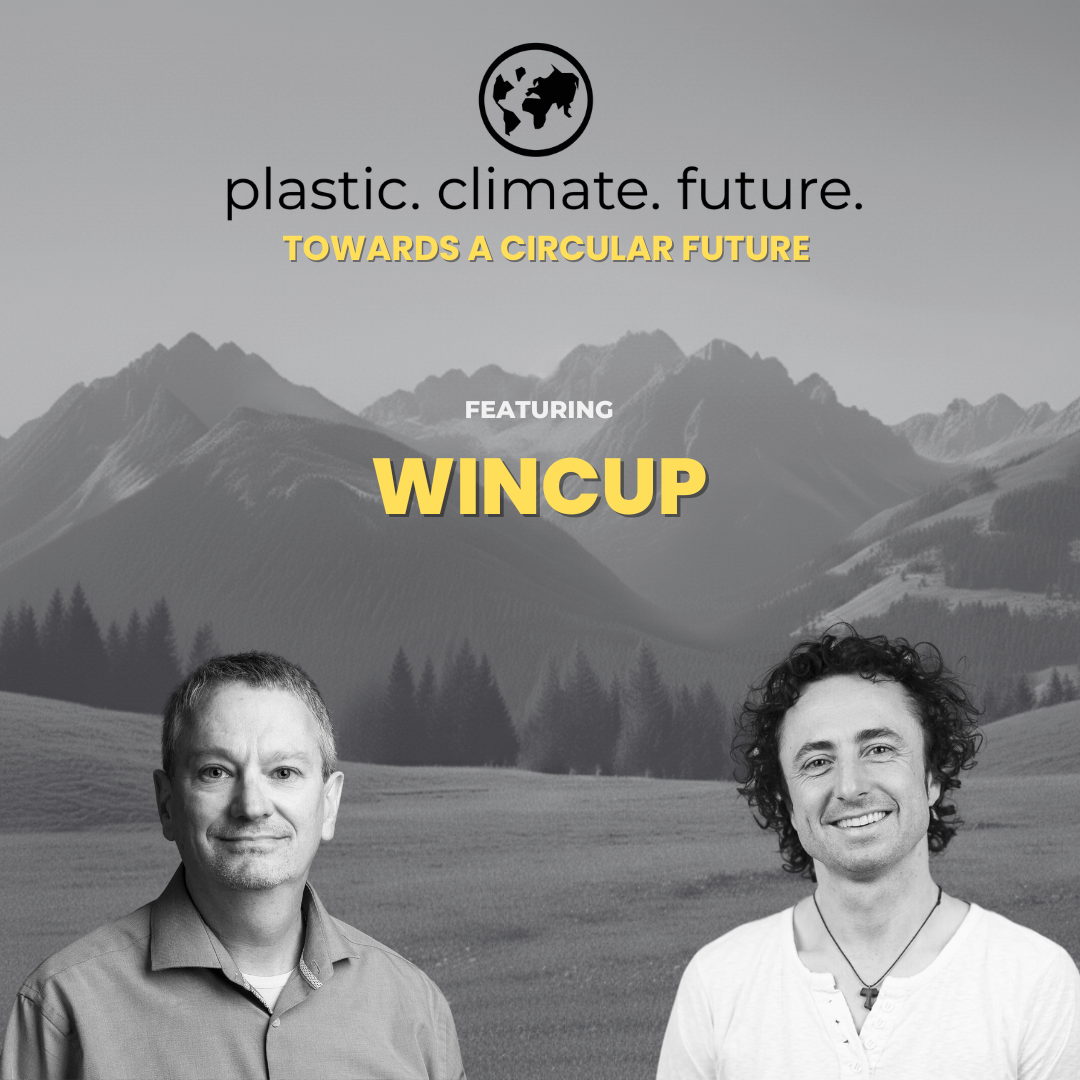
In this episode, we speak with Brad Laporte and Michael Winters from WinCup, the team behind PHADE®—a PHA-based material designed to biodegrade in environments where conventional plastics persist. Along the way, they discovered an entirely unexpected application: helping researchers restore coral reefs by protecting young corals during their most vulnerable stage.
Together, we discuss:
- How bacteria can produce the next generation of plastics
- Why they chose PHA over paper straws
- The surprising connection between biodegradable plastics and coral restoration
- What it takes to bring a new material from the lab to billions of products
- Why science, certification, and performance matter in building trust
This is a fascinating conversation about material innovation, unexpected discoveries, and how one idea can solve problems far beyond its original purpose.
🎧 Listen now on Spotify or Apple Podcasts!
Circular plastics have moved beyond pilot projects. Today, companies are investing in mechanical recycling, chemical recycling, renewable feedstocks, and even CO₂-based materials. But are these solutions ready to scale—and what will it take to make them mainstream?
In this episode, we sit down with Stephan Roest, Head of Circular Economy Business Development at Borouge International. Having spent many years at Borealis, Stephan brings a unique perspective on how the plastics industry is evolving—from linear production towards truly circular value chains.
Together, we discuss:
What it takes to scale circular plastics
The roles of mechanical and chemical recycling
Renewable and alternative carbon feedstocks
Why collaboration across the value chain is essential
How regulation, innovation, and market demand are shaping the industry's future
This is an insightful conversation about the opportunities (and the challenges) of making circular plastics part of the mainstream.
🎧 Listen now on Spotify or Apple Podcasts!
In this episode, we speak with Neil Morris, founder of Kelpi, about how seaweed-based materials could help reshape the future of packaging — and what it really takes to move beyond fossil-based plastics.
We discuss:
Why seaweed is attracting attention as a renewable feedstock
The challenge of scaling sustainable packaging solutions
How brands are approaching next-generation materials
The realities behind replacing conventional plastics
Why infrastructure, economics, and regulation matter as much as innovation
What makes this conversation especially interesting is that it moves beyond hype. Neil shares the practical realities of building a materials startup in one of the world’s most challenging industries — packaging.
At Plastic Climate Future, we believe serious conversations about plastics, climate, circularity, and innovation need nuance, not slogans.
🎧 Listen now on Spotify or Apple Podcasts!
What if the problem isn’t that we’re failing to recycle, but that the system itself is working against it?
In this episode, we speak with Joan Marc Simon, founder of Zero Waste Europe and one of the leading voices shaping circular economy policy across the EU. With decades of experience bridging grassroots action and European regulation, he brings a sharp and often uncomfortable perspective on what’s really happening behind the scenes of plastic recycling.
Note: This conversation was recorded prior to recent developments in the Middle East impacting global oil and plastics markets.
From oversupply and global market dynamics to policy design and economic realities, this conversation challenges some of the most widely held assumptions about circularity.
𝗪𝗵𝗮𝘁 𝘄𝗲 𝗲𝘅𝗽𝗹𝗼𝗿𝗲:
Why plastic recycling in Europe is struggling — despite ambitious targets
How global oversupply is undermining local circular systems
The role of policy, economics, and unintended consequences
Whether we need to rethink not just recycling, but plastic production itself
A thought-provoking conversation that goes beyond the surface — and asks whether we’re solving the right problem at all.
🎧 Listen now on Spotify or Apple Podcasts!
What if the future of plastics doesn’t start in a lab, but in a design studio?
In this episode of Plastic. Climate. Future., we speak with Beat Karrer, founder of FluidSolids, who took an unconventional path from industrial design into material innovation — developing high-performance materials made entirely from waste streams.
From corn cobs to coffee waste, his work challenges a fundamental assumption: that plastics must come from fossil resources.
We explore:
How waste streams can become high-performance material feedstock
Why design thinking is a powerful (and often overlooked) driver of material innovation
What it takes to scale new materials — from pilot to industrial production
Why circularity depends on systems, not just materials
A refreshing and grounded perspective on what it really takes to rethink plastics, not just replace them.
🎧 Listen now on Spotify or Apple Podcasts!
Circularity isn’t just about materials. It’s about energy.
In this episode of Plastic. Climate. Future., we speak with Constantine Lau from Schneider Electric, who is leading electrification strategies for some of the world’s most energy-intensive industries.
With decades of experience across oil, gas, and chemicals, Constantine shares why the shift from managing molecules to managing electrons may be one of the most underestimated levers for circular transformation.
We explore:
Why electrification is central to scaling circular systems
How digitalization and energy management reshape industrial operations
The connection between decarbonization and circularity
Why ROI and regulatory clarity must align for real impact
A strategic, forward-looking conversation about how energy systems and circular systems are more connected than we often think.
🎧 Listen now on Spotify or Apple Podcasts!
What if the breakthrough in plastic recycling doesn’t come from higher temperatures or bigger reactors — but from biology?
In this episode of Plastic. Climate. Future., we speak with Oliver Borek from Entzimatiko, a company developing a novel enzymatic technology that goes beyond conventional chemical recycling.
Their approach combines enzyme engineering, nano-encapsulation, and oxidation in a single-step process — operating at ambient conditions and targeting even the toughest materials, including polyolefins.
We explore:
Why polyolefins have long been considered “uncrackable” — and what may be changing
How enzymatic machinery differs from pyrolysis and hydrothermal methods
What low-temperature, solvent-free processing could mean for cost and scalability
Why competitiveness with fossil equivalents is critical for real impact
The roadmap to commercial scale by 2030
A fascinating conversation about science, risk, and what it takes to move breakthrough technology from lab to market.
If circularity is to scale, innovation must go beyond incremental change. This episode dives into what that could look like.
🎧 Listen now on Spotify or Apple Podcasts!
53 minAbspielen in:
Gäste, die länger als 12 Monate zurückliegen, gibt es mit Pro. Pläne ansehen
 JB