Bekomm eine E-Mail, wenn Simon in einem Podcast zu Gast istPodAppear prüft neue Folgen, sobald sie erscheinen, und lässt die weg, in denen Simon nur erwähnt wird. Bis zu 15 Personen kostenlos, ohne Kreditkarte.Bis zu 15 Personen kostenlos, ohne Kreditkarte.
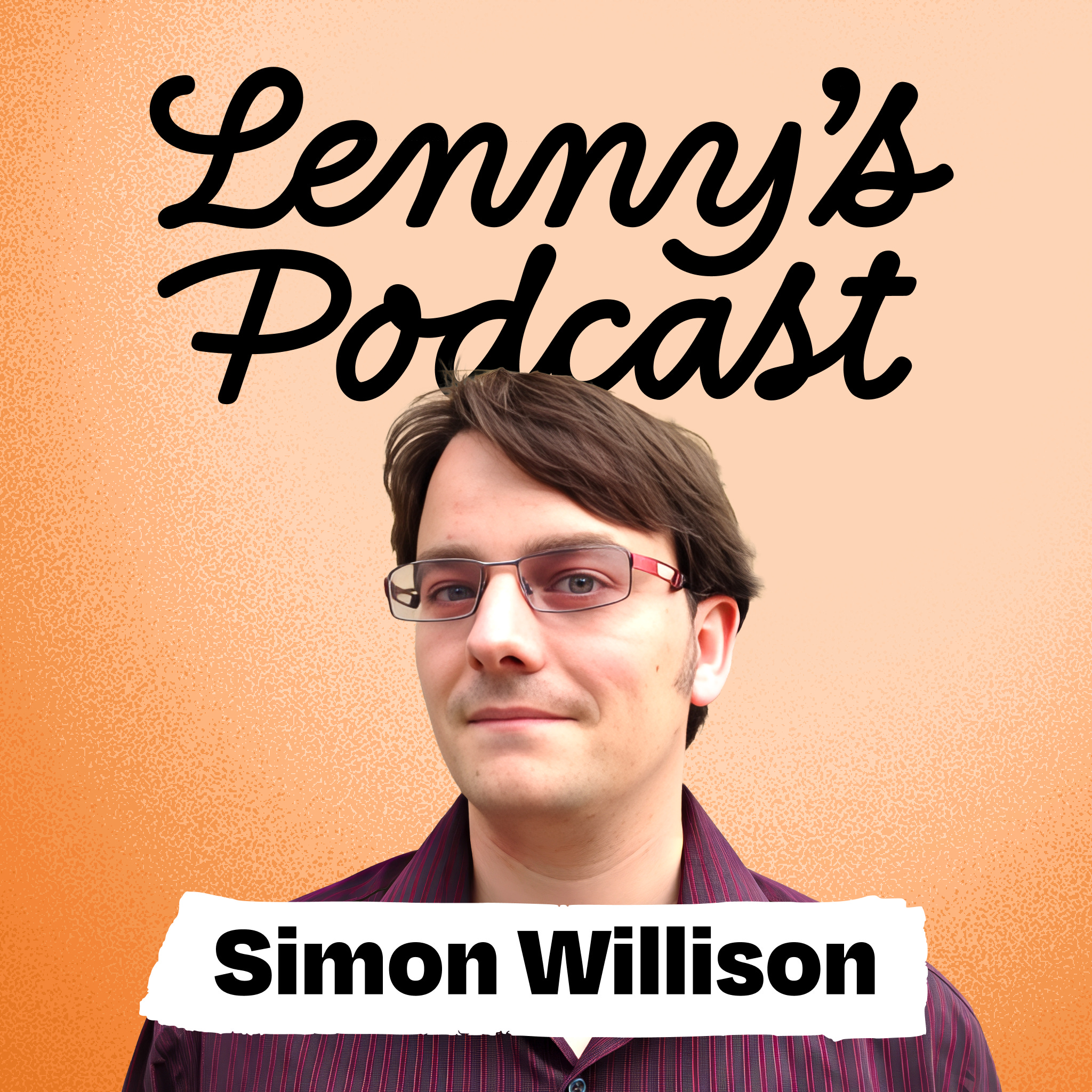
Simon Willison war in den letzten 12 Monaten in 4 Podcast-Folgen aus 2 verschiedenen Sendungen zu Gast, am häufigsten bei Lenny's Podcast: Product | Career | Growth (2-mal). Zuletzt: Lenny's Podcast: Product | Career | Growth, 29. Nov. 2026.
Simon Willison’s first visit to the podcast was a crowd favorite, and now he’s back for round two! Simon has been a professional software engineer for 27 years, and he says the job has changed more in the past year than in the rest of his career combined. We talk about what it actually feels like to be a working engineer today.
We discuss:
1. His predictions for 2027, and how last year’s predictions held up
2. AI mania: the can’t-put-the-AI-down state he says he’s in right now
3. “Deep blue”: the existential angst hitting engineers and mathematicians
4. How AI cracked game development, and the one-line prompt for vibe coding your first game
5. Why Simon now thinks prompt injection may be solved, which he’d thought was impossible
6. Why every engineer now needs a marketing co-founder
—
Brought to you by:
WorkOS—Make your app enterprise-ready, with SSO, SCIM, RBAC, and more
DX—Engineering intelligence for the AI era
—
Where to find Simon Willison:
• X: https://x.com/simonw
• LinkedIn: https://www.linkedin.com/in/simonwillison
• Substack: https://simonw.substack.com
• Website: https://simonwillison.net
—
Where to find Lenny:
• Newsletter: https://www.lennysnewsletter.com
• X: https://twitter.com/lennysan
• LinkedIn: https://www.linkedin.com/in/lennyrachitsky/
—
In this episode, we cover:
(00:00) Teaser
(01:13) Welcome back: the 50x productivity claim
(03:31) Will we still need engineers?
(07:06) AI mania
(09:40) What Claude Fable 5.2 unlocked
(10:56) Anthropic vs. OpenAI, and AI-built games that are fun
(13:33) 3D modeling, robotics, and world models
(15:05) The games inflection point
(17:06) The beep-in-a-box project
(19:54) The harder the problem, the better
(22:24) How to vibe code your first game
(27:49) Retention, competition, and the lost moat
(34:07) “Deep blue” and intellectual exhaustion
(36:56) Managing agents like a team lead
(40:05) Deep blue beyond software: careers and math
(44:17) The cybersecurity avalanche
(52:44) Prompt injection may be solved
(57:43) Predictions for 2027
(01:00:59) Recursive self-improvement
(01:04:24) Will things be OK?
(01:06:32) Grading last year’s predictions
(01:11:18) A plug for Python
—
References: https://www.lennysnewsletter.com/p/coding-is-solvednow-what-do-we-do
—
Production and marketing by https://penname.co/. For inquiries about sponsoring the podcast, email podcast@lennyrachitsky.com.
—
Lenny may be an investor in the companies discussed.
To hear more, visit www.lennysnewsletter.com
Simon Willison joined Bryan and Adam to discuss a wild couple of weeks in AI. First, we have a high-profile, AI-induced, AI-diagnosed security incident. Next we have the rise of frontier-class open-weights models. Who's for or against open weights? Do they make for a more or less secure future? Exciting times!
In addition to Bryan Cantrill and Adam Leventhal, our special guest was Simon Willison.
Previously, on Oxide and Friends:
OxF: Shell Game with Evan Ratliff
OxF: Discovering the XZ Backdoor with Andres Freund
OxF: Predictions 2025
OxF: Predictions 2026!!
OxF: Bookclub: How Life Works by Philip Ball
OxF: OpenAI's Boardroom Brawl
Some of the topics we hit on, in the order that we hit them:
Gerald the turkey terrorizes Oakland's rose garden
ABC7: Gerald the turkey and the Morcom Rose Garden
APD cautions residents after aggressive wild turkey attacks elderly Alamedan
Hawking radiation
DHH's racist complaints
Grok's "MechaHitler" antisemitic spree
Simon on Grok aka "MechaHitler"
Hugging Face security incident, July 2026
OpenAI on the Hugging Face model evaluation security incident
Greg Brockman's political donations and the Leading the Future super PAC
OpenAI co-founder and wife donate $5.5M to save the home of bald eagles Jackie and Shadow
Firecracker microVM
Meltdown (security vulnerability)
Kernel page-table isolation
Jensen Huang on X
Electronic design automation
Golden Gate Claude
Tethics
Halloween documents
Zizians
Biohazard (book)
CRISPR
Oliver Sacks: criticism and falsifications
How Alice Hamilton waged a one-woman campaign to get the lead out of everything
American Poison by Daniel Stone
Lead–crime hypothesis
Pope Leo XIV, Magnifica Humanitas encyclical
Rerum novarum
If we got something wrong or missed something, please file a PR! Our next show will likely be on Monday at 5p Pacific Time on our Discord server; stay tuned to our Mastodon feeds for details, or subscribe to this calendar. We'd love to have you join us, as we always love to hear from new speakers!
Simon Willison is a prolific independent software developer, a blogger, and one of the most visible and trusted voices on the impact AI is having on builders. He co-created Django, the web framework that powers Instagram, Pinterest, and tens of thousands of other websites. He coined the term “prompt injection,” popularized the terms “AI slop” and “agentic engineering,” and has built over 100 open source projects, including Datasette, a data analysis tool used by investigative journalists worldwide. What makes Simon unique is that he’s made the leap from traditional software engineering to AI-native development more fully and visibly than almost anyone—and he’s been documenting everything he learns in real time on his blog, SimonWillison.net.
In our in-depth conversation, Simon shares:
1. Why November 2025 was the inflection point when AI coding agents crossed from “mostly works” to “actually works”
2. How Simon writes 95% of his code from his phone now and why he’s mentally exhausted by 11 a.m.
3. Why mid-career engineers (not juniors) are most at risk right now
4. The three agentic engineering patterns Simon uses daily (red/green TDD, templates, hoarding)
5. The next leap: the “dark factory” pattern where nobody writes or reviews code and AI does its own QA
6. Why prompt injection is an unsolved security problem and the “lethal trifecta” that will likely lead to an AI Challenger disaster
7. Why the pelican riding a bicycle became the unofficial benchmark for AI model quality
—
Brought to you by:
WorkOS—Modern identity platform for B2B SaaS, free up to 1 million MAUs
Vanta—automate compliance, manage risk, and accelerate trust with AI
—
Episode transcript: https://www.lennysnewsletter.com/p/an-ai-state-of-the-union
—
Archive of all Lenny's Podcast transcripts: https://www.dropbox.com/scl/fo/yxi4s2w998p1gvtpu4193/AMdNPR8AOw0lMklwtnC0TrQ?rlkey=j06x0nipoti519e0xgm23zsn9&st=ahz0fj11&dl=0
—
Where to find Simon Willison:
• X: https://x.com/simonw
• LinkedIn: https://www.linkedin.com/in/simonwillison
• Website: https://simonwillison.net
• Agentic Engineering Patterns: https://simonwillison.net/guides/agentic-engineering-patterns
—
Where to find Lenny:
• Newsletter: https://www.lennysnewsletter.com
• X: https://twitter.com/lennysan
• LinkedIn: https://www.linkedin.com/in/lennyrachitsky/
—
In this episode, we cover:
(00:00) Introduction to Simon Willison
(02:40) The November 2025 inflection point
(08:01) What’s possible now with AI coding
(10:42) Vibe coding vs. agentic engineering
(13:57) The dark-factory pattern
(20:41) Where bottlenecks have shifted
(23:36) Where human brains will continue to be valuable
(25:32) Defending of software engineers
(29:12) Why experienced engineers get better results
(30:48) Advice for avoiding the permanent underclass
(33:52) Leaning into AI to amplify your skills
(35:12) Why Simon says he’s working harder than ever
(37:23) The market for pre-2022 human-written code
(40:01) Prediction: 50% of engineers writing 95% AI code by the end of 2026
(44:34) The impact of cheap code
(48:27) Simon’s AI stack
(54:08) Using AI for research
(55:12) The pelican-riding-a-bicycle benchmark
(59:01) The inherent ridiculousness of AI
(1:00:52) Hoarding things you know how to do
(1:08:21) Red/green TDD pattern for better AI code
(1:14:43) Starting projects with good templates
(1:16:31) The lethal trifecta and prompt injection
(1:21:53) Why 97% effectiveness is a failing grade
(1:25:19) The normalization of deviance
(1:28:32) OpenClaw: the security nightmare everyone is looking past
(1:34:22) What’s next for Simon
(1:36:47) Zero-deliverable consulting
(1:38:05) Good news about Kakapo parrots
—
References: https://www.lennysnewsletter.com/p/an-ai-state-of-the-union
—
Production and marketing by https://penname.co/. For inquiries about sponsoring the podcast, email podcast@lennyrachitsky.com.
—
Lenny may be an investor in the companies discussed.
To hear more, visit www.lennysnewsletter.com
Time for the annual predictions episode! Bryan and Adam were joined by frequent future-ologists Simon Willison, Steve Klabnik, and Ian Grunert to review past predictions and peer into the future. If any of these predictions come to fruition, it's going to be an interest 1, 3, or 6 years!
In addition to Bryan Cantrill and Adam Leventhal, speakers included Simon Willison, Steve Klabnik, and Ian Grunert.
Previously on Oxide and Friends:
OxF s04e02 – Open Source LLMs with Simon Willison
OxF s02e23 – Predictions 2022
OxF s03e20 – Predictions 2023!
OxF s04e01 – Predictions 2024!
OxF s05e01 – Predictions 2025
Predictions during the show:
Adam
1 year: AI companies go on an acquisition binge (especially for anything that smells like data)
3 year: Crisis of AI slop open source (both projects and contributions)
6 year: Jensen hands over the reins at Nvidia
6 year: Tesla is out of the consumer car business
6 year: With the iPhone market shrinking, Apple has several new attempts at the next potential flagship product
Bryan
1 year: "Vibe coding" is out of the lexicon -- or used strictly pejoratively it becomes a named condition (for which Adam -- in an act of nomenclature genius rivaling The Leventhal Conundrum -- suggested "Deep Blue")
1 year: A frontier model company has a prominent whitepaper making the case that AI will lead to broad-based prosperity rather than job loss
1 year: Harvey.ai becomes the pets.com of the AI boom -- and a harbinger of the coming bust (which becomes known as a Correction-like euphemism)
1 year: A prominent S1 has revalations of economic behavior that has an effect beyond the company's IPO
3 year: Frontier models treat AGI as "already done" -- and ASI as a non-goal
3 year: Custom-written software thrives in lieu of SaaS
6 year: DSM adds LLMs as a substance that can induce psychosis
6 year: $NVDA not beyond its November 2025 peak
Simon
1 year: The AI for programming holdouts are going to have a nasty shock
1 year: We're going to solve sandboxing
1 year: Our own challenger disaster with respect to coding agent security - see the Normalization of Deviance in AI by Johann Rehberger
3 year: Something that seems impossible for a coding agent to build today - like a full working web browser - won't just be built by coding agents, it will be unsurprising
3 year: We will find out if the Jevons paradox saves our careers as software engineers or not
6 year: The number of people employed to type code into computers will drop to almost nothing - it will be like punch card operators. Those of us who write code today will have very different jobs that still build software and take advantage of our previous coding experience.
Steve
1 year: Agent Orchestration will still be a hot topic. It'll be partially, but not entirely, solved. Updated with some more rigour: We won't have a "kubernetes for agents" just yet.
3 year: Using AI tools when writing software professionally will be considered something closer to using autocomplete or syntax highlighting than something controversial or exceptional.
6 year: AI will not have caused the total collapse of our economic and governmental systems.
If we got something wrong or missed something, please file a PR! Our next show will likely be on Monday at 5p Pacific Time on our Discord server; stay tuned to our Mastodon feeds for details, or subscribe to this calendar. We'd love to have you join us, as we always love to hear from new speakers
1 h 39 minAbspielen in:
Warum PodAppear
Folge Menschen, nicht Podcasts.
Du hast Simon in einer Sendung gehört. PodAppear findet für dich die nächste, und genauso für alle anderen, die du hören willst.
Eine Meldung, wenn die Person zu Gast istPer E-Mail: sofort oder gebündelt als Tages- oder Wochenübersicht. Dann nur noch auf Play drücken.
Gäste statt bloßer ErwähnungenFolgen, in denen ein Name nur fällt, landen getrennt. Eine Meldung heißt: Die Person ist wirklich in der Sendung.
Alle in einem FeedGründerinnen, Autoren, Sportler, Forscherinnen. Folge allen mit Namen, quer durch jede Sendung, in der sie auftreten.