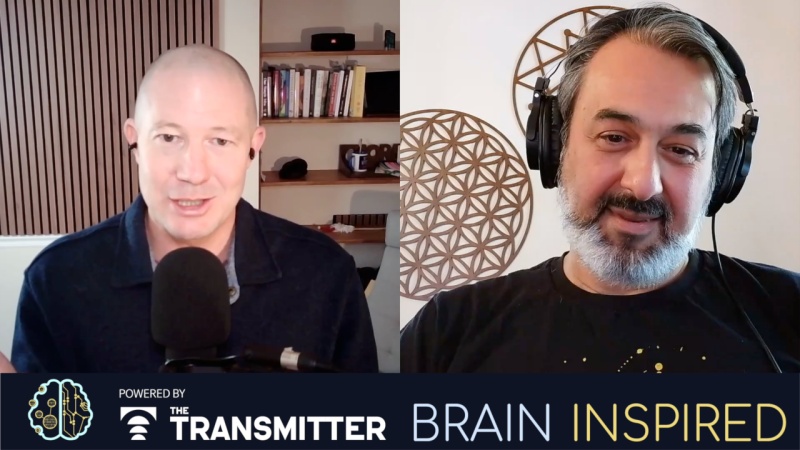
BI 250 Nima Dehghani: How Brains Compute
Wer in dieser Folge vorkommt
Kapitel
Zeitmarken aus den Shownotes. Tippe auf eine, um dort weiterzuhören. Werbung, die der Anbieter bei jedem Abruf einfügt, kann diese Zeiten um ein, zwei Minuten verschieben.
Beschreibung der Folge
Support the show to get full episodes, full archive, and join the Discord community.
The Transmitter is an online publication that aims to deliver useful information, insights and tools to build bridges across neuroscience and advance research. Visit thetransmitter.org to explore the latest neuroscience news and perspectives, written by journalists and scientists.
Read more about our partnership.
Sign up for Brain Inspired email alerts to be notified every time a new Brain Inspired episode is released.
To explore more neuroscience news and perspectives, visit thetransmitter.org.
Ganze Beschreibung zeigen
Nima Dehghani is a computational and theoretical neuroscientist at MIT. His work is framed by what he calls an N4 framework: neurophysics, neurocomputation, neurodynamics, and, encompassing them all, neuro-AI. We have a wide ranging discussion, mostly revolving around his work and views on how brains - and physical systems in general - perform computations to carry out their functions. Most neuroscientists more or less casually use the term computation to describe whatever it is the brain might be doing, but Nima is focused on a principled account of how the various parts of our brains work, how they compose together, and what those compositions can achieve across the many scales of the brain and within the massive recurrence of the brain. In the show notes I link to the papers we discuss, to his website, where he blogs about his work, and to some nice primer videos he created to help ease us into his work.
Nima's Neurovium website
@neurovium.bsky.social
Video explainers:
What is "Physical Computation"? Computational closure and System Compositionality
How Long Is the Coast of a Neuron? Resolution-Dependent Interaction Order and Computational Capacity
Related papers
Autonomous Physical Computation: A Categorical Closure Criterion for Physical and Neuromorphic Reservoirs.
Harnessing cortical geometry, wiring, and function as inductive biases for recurrent neural networks
Algebraic Emergence of Effective Theories in Canonical Recurrent Motifs of Biological Neuronal Networks
Evolutionary Optimization Reveals Structural Constraints on Reservoir Architecture for Spatiotemporal Chaos
0:00 - Intro
2:49 - Computer metaphor
9:38 - N4 approach
19:00 - Defining computation
30:36 - Category theory for computation
36:37 - Computational closure
43:40 - Agency
47:31 - Canonical motifs of cortical operations
52:44 - Marr's levels
59:02 - Canonical motifs of cortical operations
1:15:12 - Bio-inspired AI
1:28:58 - Importance of composition
1:34:22 - Computation across all life?